

Quick Answer
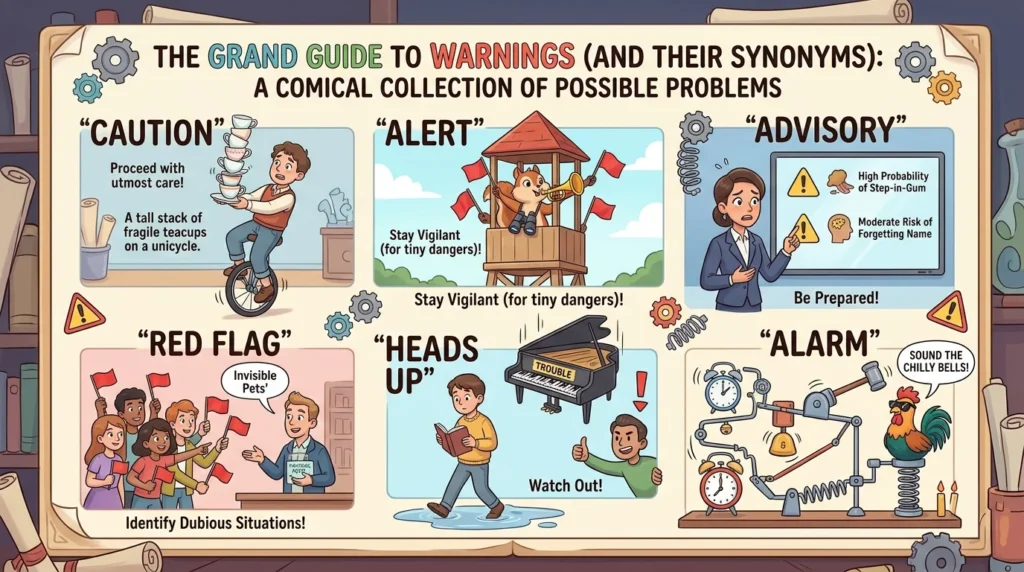
The best synonyms for warning depend on the situation. Common alternatives include caution, alert, notice, advisory, notification, reminder, alarm, threat, admonition, and forewarning. Some words describe a general notice about danger, while others suggest advice, urgency, or a possible negative consequence.
Quick Synonym List
- Caution
- Alert
- Notice
- Advisory
- Notification
- Reminder
- Alarm
- Forewarning
- Admonition
- Advice
- Counsel
- Signal
- Red flag
- Heads-up
- Precaution
- Threat
- Danger signal
- Announcement
- Disclosure
- Indication
- Sign
- Hint
- Caveat
- Disclaimer
- Reprimand
- Chastisement
- Monition
- Portent
- Omen
- Advance notice
What Does Warning Mean?
A warning is a message, sign, or statement that tells someone about possible danger, trouble, risk, or an unwanted consequence. It can also be an expression of advice intended to prevent a problem.
For example:
The sign gave a warning about slippery floors.
Here, warning means a notice about possible danger.
In another sentence:
She gave me a warning not to touch the equipment.
Here, it means advice or a strong caution about what might happen.
Because warning can refer to danger, advice, notice, or a threat, the best synonym depends on the intended meaning.
Caution
Caution is one of the closest synonyms for warning. It tells someone to be careful because a danger or problem may exist.
Example:
The label contains a caution about using the product near heat.
Best for: Safety instructions, signs, formal advice, and general warnings.
Difference: Caution often sounds less urgent than alarm or threat.
Alert
An alert is a warning that draws attention to a possible danger, emergency, or important situation.
Example:
The weather service issued an alert for severe storms.
Best for: Emergencies, security, weather, technology, and public safety.
Tone: Direct and urgent.
Notice
A notice is a message that provides information or draws attention to something important.
Example:
A notice warned visitors that the building would close early.
Best for: Signs, public information, workplaces, schools, and official communication.
Difference: A notice does not always involve danger.
Advisory
An advisory is an official recommendation or warning about a situation that may affect people.
Example:
The government issued a travel advisory.
Best for: Government announcements, weather, travel, health, transportation, and professional communication.
Tone: Formal and official.
Notification
A notification is a message that informs someone about an event, condition, or change.
Example:
Users received a notification about the security issue.
Best for: Apps, websites, workplaces, services, and digital communication.
Difference: A notification may simply provide information and does not necessarily warn about danger.
Reminder
A reminder can function as a mild warning when it encourages someone to avoid a mistake or remember an important rule.
Example:
The teacher gave students a reminder about the approaching deadline.
Best for: Deadlines, rules, responsibilities, appointments, and everyday communication.
Difference: A reminder is usually less serious than a warning.
Alarm
An alarm is a warning of immediate or serious danger.
Example:
The fire alarm warned everyone to leave the building.
Best for: Emergencies, security systems, fires, accidents, and urgent situations.
Tone: Strong and urgent.
Forewarning
Forewarning means advance notice that something potentially unpleasant or dangerous may happen.
Example:
We received no forewarning about the sudden change.
Best for: Formal writing, storytelling, news, and serious situations.
Difference: It specifically emphasizes that the warning came before the event.
Admonition
An admonition is a firm warning or expression of advice, especially telling someone not to do something.
Example:
His admonition against taking unnecessary risks was ignored.
Best for: Formal writing, literature, moral advice, and serious instructions.
Tone: Formal and authoritative.
Advice
Advice is guidance about what someone should or should not do. In some contexts, it can function as a warning.
Example:
Her advice was to avoid traveling during the storm.
Best for: Personal guidance, professional recommendations, and everyday situations.
Difference: Advice does not necessarily involve danger.
Counsel
Counsel means serious or thoughtful advice.
Example:
The lawyer’s counsel was to avoid signing the agreement immediately.
Best for: Formal writing, legal contexts, professional advice, and serious decisions.
Signal
A signal can serve as a warning when it indicates that something may happen or that action is needed.
Example:
The sudden drop in temperature was a signal of changing weather.
Best for: Indications, signs, behavior, technology, and safety situations.
Difference: A signal may not be an intentional message.
Red Flag
A red flag is an informal expression for a sign that something may be wrong or dangerous.
Example:
His refusal to provide basic information was a red flag.
Best for: Relationships, business, personal decisions, online safety, and casual writing.
Tone: Informal and conversational.
Heads-Up
Heads-up is an informal warning or advance notice that helps someone prepare.
Example:
Just a heads-up: the road will be closed tomorrow.
Best for: Text messages, emails, conversations, and casual workplace communication.
Tone: Friendly and informal.
Precaution
A precaution is an action taken in advance to prevent danger or problems.
Example:
As a precaution, the company closed the facility.
Difference: A warning gives information about danger, while a precaution is something done to reduce the risk.
Threat
A threat indicates possible harm, danger, or negative consequences.
Example:
The storm presented a serious threat to coastal communities.
Best for: Security, violence, disasters, risks, and serious situations.
Difference: Threat is much stronger than warning and can suggest that harm is likely or deliberately intended.
Danger Signal
A danger signal is a sign or message indicating potential danger.
Example:
The flashing light acted as a danger signal.
Best for: Safety, machinery, transportation, and technical descriptions.
Announcement
An announcement communicates information to a group of people. It can contain a warning but is not itself necessarily a warning.
Example:
The announcement informed passengers about the approaching storm.
Disclaimer
A disclaimer is a statement that limits responsibility or points out important conditions or risks.
Example:
The website included a disclaimer about potential risks.
Best for: Websites, products, legal writing, media, and professional communication.
Caveat
A caveat is a condition or qualification that should be considered before accepting or acting on something.
Example:
The plan looks promising, with one important caveat.
Best for: Academic writing, business, contracts, analysis, and formal discussions.
Tone: Formal.
Reprimand
A reprimand is a strong expression of disapproval, often because someone has done something wrong.
Example:
The employee received a reprimand for ignoring safety procedures.
Difference: A reprimand usually happens after misconduct, while a warning often comes before a problem occurs.
Chastisement
Chastisement means criticism or punishment intended to correct someone’s behavior.
Example:
The manager’s comments were a clear chastisement for the repeated mistakes.
It is much stronger and more formal than warning.
Omen
An omen is a sign believed to indicate that something, often good or bad, may happen.
Example:
The dark clouds seemed like an omen of trouble.
Best for: Literature, storytelling, mythology, and figurative language.
Portent
A portent is a sign or indication that something significant, often unpleasant, is going to happen.
Example:
The sudden silence was seen as a portent of trouble.
Tone: Formal and literary.
Synonyms for Warning by Context
Warning About Danger
Use:
- Alert
- Caution
- Alarm
- Danger signal
- Threat
- Red flag
- Advisory
Example:
The emergency alert warned residents to leave the area.
Warning Someone to Be Careful
Use:
- Caution
- Advice
- Admonition
- Reminder
- Heads-up
- Counsel
Example:
She gave him a caution about driving too quickly.
Official Warning
Use:
- Advisory
- Notice
- Alert
- Notification
- Announcement
- Formal caution
Example:
Authorities issued an advisory before the storm.
Informal Warning
Use:
- Heads-up
- Reminder
- Tip
- Red flag
- Word of caution
Example:
Just a heads-up—the store closes early today.
Strong Warning
Use:
- Alarm
- Threat
- Admonition
- Serious caution
- Forewarning
Example:
The official issued a serious warning about the approaching danger.
Warning About Future Events
Use:
- Forewarning
- Prediction
- Signal
- Indication
- Omen
- Portent
Example:
The unusual weather was a warning of a difficult winter.
Formal Synonyms for Warning
For professional, academic, or official writing, useful alternatives include:
- Advisory
- Caution
- Notification
- Forewarning
- Admonition
- Caveat
- Notice
- Alert
- Indication
- Precaution
For example:
The agency issued an advisory regarding severe weather conditions.
This sounds more official than:
The agency gave a warning about bad weather.
Casual Synonyms for Warning
In everyday conversation, these alternatives sound natural:
- Heads-up
- Caution
- Tip
- Reminder
- Red flag
- Be careful
- Word of caution
For example:
Just a heads-up—the parking lot is almost full.
True Synonyms vs. Related Alternatives
| Alternative | Relationship | Can Replace “Warning”? | Tone | Best Context |
|---|---|---|---|---|
| Caution | Close synonym | Often | Neutral | Safety |
| Alert | Close synonym | Often | Urgent | Emergencies |
| Advisory | Close synonym | Often | Formal | Official information |
| Notice | Related alternative | Sometimes | Neutral | Signs and announcements |
| Forewarning | Close synonym | Often | Formal | Advance notice |
| Admonition | Close synonym | Sometimes | Formal | Strong advice |
| Reminder | Related alternative | Sometimes | Mild | Rules and deadlines |
| Alarm | Stronger alternative | Sometimes | Urgent | Immediate danger |
| Threat | Stronger alternative | Sometimes | Serious | Harm or risk |
| Heads-up | Informal synonym | Often | Casual | Everyday communication |
| Caveat | Contextual alternative | Sometimes | Formal | Conditions and qualifications |
| Reprimand | Related but different | Rarely | Strong | Misconduct |
Comparison Table
| Word/Phrase | Meaning | Tone | Strength | Best Use | Interchangeable? |
|---|---|---|---|---|---|
| Warning | Message about possible danger or trouble | Neutral | Broad | General use | — |
| Caution | Advice to act carefully | Neutral | Moderate | Safety | Often |
| Alert | Urgent notice of danger | Urgent | Strong | Emergencies | Often |
| Advisory | Official recommendation or warning | Formal | Moderate | Government/public safety | Often |
| Notice | Information calling attention to something | Neutral | Mild | Signs | Sometimes |
| Alarm | Warning of immediate danger | Urgent | Strong | Emergencies | Sometimes |
| Reminder | Prompt to remember something | Mild | Mild | Deadlines/rules | Sometimes |
| Threat | Possible harm or danger | Serious | Very strong | Security/risk | Rarely |
| Heads-up | Informal advance notice | Casual | Mild | Conversation | Often |
| Forewarning | Warning given in advance | Formal | Moderate | Future events | Often |
Practical Word-Choice Guide
Ask yourself what you want the warning to communicate.
Do you want someone to be careful?
Use caution.
Is there immediate danger?
Use alert or alarm.
Is the message official?
Use advisory or notice.
Are you giving advance information?
Use forewarning or heads-up.
Is the warning informal?
Use heads-up or red flag.
Does the warning concern a condition or limitation?
Use caveat.
Is the warning especially serious?
Use threat or alarm, depending on the situation.
Are you advising someone not to repeat a mistake?
Use admonition or caution.
Sentence Transformations
1. Original
The sign gave a warning about wet floors.
Alternative:
The sign provided a caution about wet floors.
Why: Caution works naturally for safety information.
2. Original
The weather service issued a warning.
Alternative:
The weather service issued an alert.
Why: Alert sounds more urgent and is commonly used for weather hazards.
3. Original
She gave me a warning about the difficult road.
Alternative:
She gave me a heads-up about the difficult road.
Why: Heads-up creates a friendly, informal tone.
4. Original
Officials issued a warning about the storm.
Alternative:
Officials issued a weather advisory about the storm.
Why: Advisory is appropriate for official public communication.
5. Original
His warning came before the accident.
Alternative:
His forewarning came before the accident.
Why: Forewarning specifically emphasizes advance notice.
6. Original
The report included a warning about the risks.
Alternative:
The report included a caveat about the risks.
Why: Caveat works when the writer is pointing out an important condition or limitation.
7. Original
The warning alarmed the residents.
Alternative:
The alert alarmed the residents.
Why: Alert fits a message intended to draw attention to danger.
8. Original
Her warning prevented us from making a mistake.
Alternative:
Her advice prevented us from making a mistake.
Why: Advice works when the message is primarily guidance rather than an urgent danger notice.
Common Mistakes With Warning Synonyms
Mistake 1: Using “threat” for every warning
A threat is stronger than a warning and may imply actual harm or deliberate intimidation.
Mistake 2: Treating “notice” as an exact synonym
A notice simply provides information. It becomes a warning only when the information concerns danger or a possible problem.
Mistake 3: Using “advisory” in casual conversation
Advisory is usually more formal and official. In everyday speech, heads-up or warning may sound more natural.
Mistake 4: Confusing a precaution with a warning
A warning tells you about a risk. A precaution is an action taken to prevent or reduce that risk.
Mistake 5: Using “reprimand” as a synonym
A reprimand is criticism for something someone has already done wrong. It is not simply a warning about future danger.
Mistake 6: Overusing “alarm”
An alarm suggests urgency or serious danger. It can make a mild warning sound much more severe.
When Not to Use a Synonym
Sometimes warning is the clearest and most flexible word.
For example:
The doctor gave him a warning about the possible side effects.
Replacing warning with alarm could make the sentence sound unnecessarily serious. Using notice could make it sound too neutral.
Similarly:
The warning sign was easy to see.
Here, warning is a standard term and usually does not need replacement.
Choose a synonym when you want to add a specific meaning, such as urgency, formality, informality, or advance notice.
How to Improve Your Writing
Instead of repeating warning throughout a paragraph, identify the exact purpose of each message.
For example:
The company issued a warning about the storm. The warning told employees to stay home.
You could write:
The company issued a weather advisory about the storm. The notice told employees to stay home.
This creates variety while making each sentence more specific.
However, avoid changing words simply for variety. If warning is the most accurate word, keeping it is better than forcing an unusual synonym.
Editor’s Choice: Best Alternatives for “Warning”
The strongest alternatives depend on context:
- Caution — best general alternative for safety.
- Alert — best for urgent danger.
- Advisory — best for official warnings.
- Forewarning — best for advance notice.
- Heads-up — best for casual communication.
These choices are context-based rather than a universal ranking.
FAQs
What is the best synonym for warning?
Caution is one of the closest general synonyms for warning. Depending on context, alert, advisory, notice, forewarning, or heads-up may be more precise.
What is a formal word for warning?
Formal alternatives include advisory, caution, admonition, forewarning, notification, and caveat.
What is a stronger word than warning?
Depending on the situation, alarm or threat can be stronger than warning. Threat especially suggests possible harm or danger.
What is a polite way to say warning?
You can use caution, reminder, advisory, heads-up, or word of caution, depending on the level of formality.
What is another word for a warning sign?
Possible alternatives include red flag, danger signal, indication, alert, signal, and omen, depending on whether the sign is literal or figurative.
What is the difference between a warning and an alert?
A warning generally tells someone about possible danger or trouble. An alert usually emphasizes the need to pay attention, often because a situation is urgent.
What is the difference between a warning and a threat?
A warning informs someone about possible danger or consequences. A threat suggests that harm or a negative consequence may actually occur and can also imply intentional harm.
Key Takeaways
- Warning is a broad word for information about possible danger, trouble, or negative consequences.
- Caution is one of the closest general alternatives.
- Alert and alarm are better when urgency or immediate danger is involved.
- Advisory and notice work well for official communication.
- Heads-up, red flag, and forewarning add specific informal or contextual meanings.