
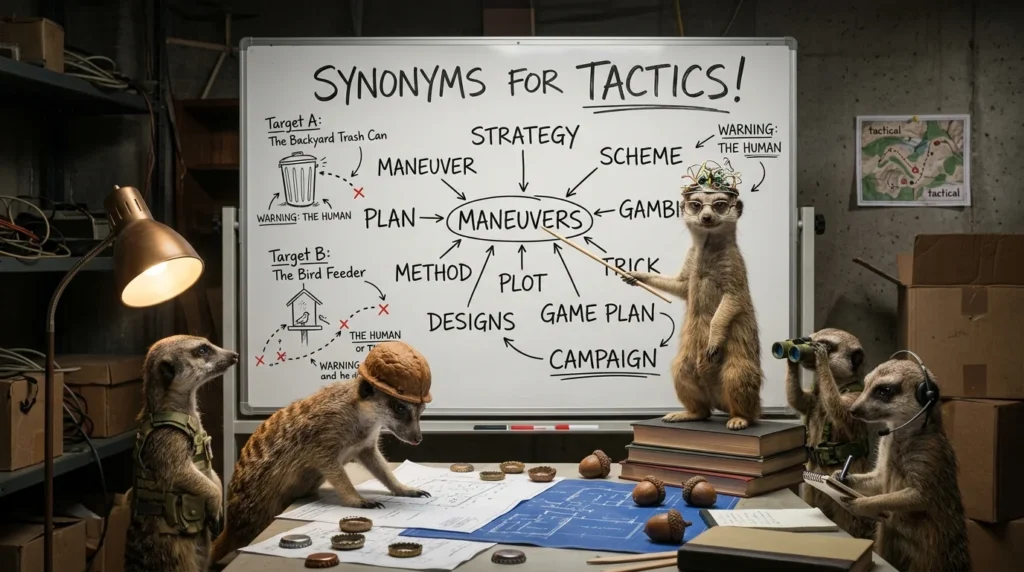

Quick Answer: What Are the Best Synonyms for Tactics?
The best synonyms for tactics include methods, techniques, approaches, maneuvers, measures, procedures, and actions. Use strategies when referring to an overall plan, techniques when emphasizing specialized skills, and maneuvers when describing calculated moves in a competitive situation. The best choice depends on your goal, audience, and context.
Quick List of Synonyms for Tactics
Here are 35 useful alternatives to the word tactics.
Strategies
Methods
Techniques
Approaches
Maneuvers
Measures
Procedures
Actions
Steps
Plans
Practices
Operations
Initiatives
Solutions
Tools
Resources
Moves
Devices
Schemes
Policies
Processes
Practices
Methods of operation
Courses of action
Action plans
Game plans
Countermeasures
Negotiation methods
Working methods
Operational methods
Problem-solving methods
Competitive moves
Persuasion techniques
Defensive measures
Implementation methods
Note: These words are related to tactics, but they are not exact synonyms in every context. Some describe an overall plan, while others refer to individual actions, established procedures, or specialized ways of doing something.
What Does Tactics Mean?
Tactics is the plural form of tactic. It refers to specific actions or methods used to achieve an immediate objective, respond to a situation, or gain an advantage.
Tactics are often part of a larger strategy. They focus on what someone does in a particular situation rather than the entire long-term plan.
Consider these examples:
Business: The company uses discount offers and targeted advertisements as sales tactics.
Sports: The coach changes the team’s defensive tactics during the second half.
Negotiation: The representative uses several tactics to reach a favorable agreement.
Education: The teacher introduces new tactics to help students remember difficult concepts.
Everyday life: She uses different tactics to organize her time and finish her work.
The word can have a neutral, positive, or negative meaning. Helpful tactics may solve problems or improve performance, while manipulative tactics may involve misleading or pressuring other people.
20 Detailed Synonyms for Tactics
1. Strategies
Meaning: Plans designed to achieve a particular goal, often over a longer period.
How it differs: A strategy usually provides the overall direction, while tactics are the specific actions used to implement it.
Tone: Professional and analytical.
Best for: Business planning, leadership, marketing, and competition.
Example: The company introduced new strategies to increase customer retention.
Watch out: Use tactics when discussing individual actions rather than the entire plan.
2. Methods
Meaning: Ways of doing something or accomplishing a task.
How it differs: Methods is a broad term for how work is performed. Tactics usually emphasize actions selected to achieve a particular objective.
Tone: Neutral and versatile.
Best for: Education, research, business, and problem-solving.
Example: The team tested several methods to improve productivity.
Watch out: Methods may sound less competitive or goal-oriented than tactics.
3. Techniques
Meaning: Specific skills, procedures, or ways of performing an activity.
How it differs: Techniques often emphasize skill and execution, whereas tactics emphasize choosing actions to reach an objective.
Tone: Professional and practical.
Best for: Sports, communication, training, and specialized work.
Example: The salesperson learned new techniques for handling customer objections.
Watch out: Use techniques when the skill or execution process matters most.
4. Approaches
Meaning: Ways of dealing with a problem, task, or situation.
How it differs: An approach describes the general way someone handles something. Tactics usually refer to more specific actions within that approach.
Tone: Neutral and professional.
Best for: Management, education, problem-solving, and communication.
Example: The manager considered several approaches to resolving the conflict.
Watch out: Approach may describe a general philosophy rather than a concrete action.
5. Maneuvers
Meaning: Carefully planned movements or actions intended to achieve an advantage.
How it differs: Maneuvers often suggests competition, calculated movement, or a change in position.
Tone: Strategic and sometimes forceful.
Best for: Sports, politics, negotiations, and military contexts.
Example: The team made several defensive maneuvers to protect its lead.
Watch out: In some contexts, the word can suggest secrecy or manipulation.
6. Measures
Meaning: Actions taken to achieve a result, prevent a problem, or address a situation.
How it differs: Measures often emphasize practical steps taken in response to a need or risk.
Tone: Formal and practical.
Best for: Safety, business, public policy, and risk management.
Example: The company introduced new measures to protect customer information.
Watch out: Measures may refer to safeguards or corrective actions rather than competitive tactics.
7. Procedures
Meaning: Established steps or rules for completing a task.
How it differs: Procedures are usually structured and repeatable, while tactics may change depending on circumstances.
Tone: Formal and systematic.
Best for: Workplace instructions, administration, and technical processes.
Example: The department revised its procedures for handling complaints.
Watch out: Use procedures when the actions follow an established process.
8. Actions
Meaning: Things people do to achieve an outcome or respond to a situation.
How it differs: Actions is broader and more general than tactics. Not every action is carefully planned.
Tone: Direct and accessible.
Best for: General writing and everyday conversation.
Example: The coach praised the players’ quick actions during the final minutes.
Watch out: Use tactics when you want to emphasize planning or purposeful decision-making.
9. Steps
Meaning: Individual stages or actions taken toward completing a task.
How it differs: Steps often follow a sequence, while tactics may be selected or changed as a situation develops.
Tone: Simple and practical.
Best for: Instructions, planning, and problem-solving.
Example: The team took several steps to improve its customer service.
Watch out: Steps may sound procedural rather than competitive.
10. Plans
Meaning: Arrangements or ideas for achieving a goal.
How it differs: A plan describes intended actions, while tactics often refer to specific actions used during implementation.
Tone: Neutral and professional.
Best for: Project management, personal goals, and business.
Example: The organizers developed plans to attract more visitors.
Watch out: A plan may exist without the actions needed to carry it out.
11. Practices
Meaning: Regular ways of doing something, especially methods used repeatedly.
How it differs: Practices are often established habits or routines, whereas tactics may be chosen for a specific situation.
Tone: Neutral and professional.
Best for: Workplace standards, education, training, and management.
Example: The organization adopted better practices for managing its resources.
Watch out: Use tactics when emphasizing deliberate actions rather than routine behavior.
12. Operations
Meaning: Organized activities or processes used to achieve a particular result.
How it differs: Operations usually describe coordinated activities on a broader scale, while tactics refer to specific actions within them.
Tone: Technical and professional.
Best for: Business, logistics, security, and military contexts.
Example: The rescue team adjusted its operations as weather conditions changed.
Watch out: Operations can refer to an entire activity or system rather than individual tactics.
13. Initiatives
Meaning: New actions or projects intended to achieve an improvement.
How it differs: An initiative often involves a new effort or organized project, while a tactic can be a single action within that effort.
Tone: Positive and professional.
Best for: Business development, education, and community projects.
Example: The school introduced new initiatives to improve student attendance.
Watch out: An initiative is usually broader than an individual tactic.
14. Solutions
Meaning: Answers or ways of resolving a problem.
How it differs: A solution describes what addresses a problem, while a tactic describes an action used to achieve a result.
Tone: Practical and problem-focused.
Best for: Business, technology, education, and everyday challenges.
Example: The team explored several solutions to reduce delays.
Watch out: Not every tactic solves a problem; some are designed to gain an advantage or manage a situation.
15. Tools
Meaning: Resources, instruments, or techniques used to complete a task.
How it differs: A tool supports an action, while a tactic is the action or method itself.
Tone: Practical and straightforward.
Best for: Marketing, management, technology, and education.
Example: The marketing team used several tools to track campaign performance.
Watch out: A tool is not always a tactic, although the term can be used metaphorically.
16. Moves
Meaning: Individual actions taken to gain an advantage or influence what happens next.
How it differs: Moves is often more conversational than tactics and can refer to one specific action.
Tone: Informal and dynamic.
Best for: Games, negotiations, competition, and everyday conversation.
Example: The negotiator made several smart moves before presenting the final offer.
Watch out: Moves can sound informal in academic or technical writing.
17. Schemes
Meaning: Organized plans intended to achieve a particular result.
How it differs: Scheme can be neutral in some varieties of English, but it often suggests secrecy, deception, or an elaborate plan in American English.
Tone: Context-dependent, sometimes negative.
Best for: Describing deceptive plans or carefully organized arrangements.
Example: The investigation uncovered a scheme to mislead customers.
Watch out: Avoid using schemes as a neutral synonym for tactics unless the context supports that meaning.
18. Processes
Meaning: Series of actions or stages used to complete work or produce a result.
How it differs: A process describes how something progresses, while tactics usually emphasize deliberate choices within a situation.
Tone: Professional and systematic.
Best for: Business operations, research, and project management.
Example: The company improved its processes for resolving customer complaints.
Watch out: Process can refer to a complete system rather than an individual tactic.
19. Courses of Action
Meaning: Possible ways to act in a particular situation.
How it differs: A course of action describes a chosen or proposed path, which may include multiple tactics.
Tone: Formal and analytical.
Best for: Planning, decision-making, leadership, and emergency response.
Example: The committee considered several courses of action before making its decision.
Watch out: This phrase is more formal and may be unnecessarily long in casual writing.
20. Countermeasures
Meaning: Actions taken to prevent, resist, or respond to a threat or opposing action.
How it differs: Countermeasures specifically respond to a risk or challenge, while tactics can be offensive, defensive, or neutral.
Tone: Technical and defensive.
Best for: Cybersecurity, safety, risk management, and competitive situations.
Example: The security team introduced countermeasures to reduce the risk of data theft.
Watch out: Use countermeasures when the response-to-a-threat meaning is intended.
Synonyms for Tactics by Context
The best alternative depends on the situation in which you are using the word.
In Business and Marketing
Business tactics are specific actions used to attract customers, increase sales, improve efficiency, or achieve organizational goals.
Useful alternatives include:
Methods: Ways to complete work or achieve results.
Techniques: Specialized ways to perform a task.
Initiatives: New efforts designed to create improvement.
Measures: Practical actions taken to address a problem.
Approaches: General ways of handling a business challenge.
Promotional strategies: Plans and activities intended to increase awareness or sales.
Example: Instead of saying, “The business changed its tactics to attract customers,” you could write, “The business introduced new promotional methods to attract customers.”
In Sports and Competition
Sports tactics involve decisions and actions used to gain an advantage over an opponent.
Useful alternatives include:
Maneuvers: Calculated movements or actions.
Game plans: Plans for approaching a competition.
Moves: Individual competitive actions.
Techniques: Specific skills used during performance.
Plays: Planned actions in a sport or game.
Strategies: Broader plans for winning or performing well.
Example: “The coach changed the team’s defensive tactics” could become “The coach adjusted the team’s defensive game plan.”
In Negotiations and Persuasion
Negotiation tactics are actions intended to influence decisions, resolve disagreements, or reach favorable agreements.
Useful alternatives include:
Negotiation methods: Ways to conduct negotiations.
Persuasion techniques: Methods used to influence someone’s thinking.
Approaches: Ways of handling a discussion.
Maneuvers: Calculated actions used to gain an advantage.
Moves: Individual actions during a negotiation.
Communication techniques: Methods used to express ideas effectively.
Example: “She used effective tactics during the negotiation” could become “She used effective persuasion techniques during the negotiation.”
Be aware that manipulation and deception are not neutral synonyms. They describe tactics that involve controlling, misleading, or unfairly influencing others.
In Education and Learning
Educational tactics are specific actions used to help students learn, remember information, and improve performance.
Useful alternatives include:
Learning techniques
Teaching methods
Study strategies
Instructional approaches
Problem-solving methods
Practice methods
Example: “Students used different tactics to prepare for the exam” could become “Students used different study techniques to prepare for the exam.”
In Military and Security Contexts
Military tactics concern actions used to accomplish objectives in specific operational situations. Security tactics may involve preventing threats, protecting people, or responding to incidents.
Useful alternatives include:
Maneuvers
Operational methods
Defensive measures
Countermeasures
Procedures
Courses of action
Example: “The unit changed its tactics in response to new conditions” could become “The unit adjusted its operational approach in response to new conditions.”
The precise term depends on whether you mean a particular action, a formal procedure, or a broader operational plan.
Tactics vs. Similar Words: What’s the Difference?
Although several words can replace tactics, each has a distinct emphasis.
| Word | Meaning | Best Use | Interchangeable with Tactics? |
|---|---|---|---|
| Strategy | A broader plan for achieving a goal | Long-term planning | Sometimes |
| Method | A way of doing something | General tasks and processes | Often, depending on context |
| Technique | A specialized way of performing an activity | Skills and execution | Sometimes |
| Approach | A general way of handling a situation | Problem-solving and management | Sometimes |
| Maneuver | A calculated action or movement | Competition and negotiation | Often in specific contexts |
| Procedure | An established series of steps | Rules and routine work | Sometimes |
| Action | Something done to achieve an outcome | General situations | Broadly related |
| Measure | An action taken to address a need or risk | Prevention and improvement | Sometimes |
| Scheme | An organized plan, sometimes deceptive | Plans and plots | Only in suitable contexts |
| Countermeasure | An action taken against a threat | Defense and risk management | Only for defensive tactics |
Strategy vs. Tactics
A strategy explains the broader plan, while tactics are the specific actions used to put that plan into practice.
Example:
Strategy: Increase the company’s market share.
Tactics: Offer discounts, improve advertising, and introduce a customer referral program.
Methods vs. Tactics
A method is a way of doing something. A tactic is a purposeful action selected to achieve a particular objective.
Example:
Method: Conduct customer surveys.
Tactic: Send a short survey to customers immediately after a purchase to encourage feedback.
Techniques vs. Tactics
A technique emphasizes how a task is performed, often using a particular skill. A tactic emphasizes which action is selected to achieve an outcome.
Example:
Technique: Using active listening during a discussion.
Tactic: Asking open-ended questions to understand the other person’s priorities before making an offer.
10 Sentence Transformations Using Synonyms for Tactics
These examples demonstrate how to replace tactics while keeping the intended meaning clear.
1. Original
The company changed its tactics to increase sales.
Alternative: The company changed its methods to increase sales.
Why it works: Methods provides a broad, neutral description of how the company works toward its goal.
2. Original
The coach introduced new tactics during the game.
Alternative: The coach introduced new maneuvers during the game.
Why it works: Maneuvers emphasizes calculated actions during competition.
3. Original
The teacher used effective tactics to help students learn.
Alternative: The teacher used effective teaching techniques to help students learn.
Why it works: Teaching techniques is more specific to educational practice.
4. Original
The marketing team tested several tactics.
Alternative: The marketing team tested several approaches.
Why it works: Approaches emphasizes different ways of handling the marketing challenge.
5. Original
The negotiator’s tactics helped secure the agreement.
Alternative: The negotiator’s methods helped secure the agreement.
Why it works: Methods sounds neutral and professional while preserving the central meaning.
6. Original
The organization adopted new tactics to reduce risks.
Alternative: The organization adopted new measures to reduce risks.
Why it works: Measures emphasizes practical actions taken to prevent or address potential problems.
7. Original
The players discussed their tactics before the match.
Alternative: The players discussed their game plan before the match.
Why it works: Game plan is a natural expression in sports and competition.
8. Original
The security team developed tactics to prevent data theft.
Alternative: The security team developed countermeasures to prevent data theft.
Why it works: Countermeasures specifically emphasizes actions taken against a threat.
9. Original
The manager used clever tactics to resolve the disagreement.
Alternative: The manager used a thoughtful approach to resolve the disagreement.
Why it works: Approach emphasizes the general way the manager handled the conflict.
10. Original
The students developed tactics for preparing for exams.
Alternative: The students developed study strategies for preparing for exams.
Why it works: Study strategies is a natural phrase for organized preparation and learning.
Common Mistakes When Using Synonyms for Tactics
Choosing a synonym without considering its meaning can make a sentence less accurate. Avoid these common mistakes.
1. Treating Strategy and Tactics as Identical
A strategy is generally the broader plan, while tactics are the individual actions used to carry it out. Use the word that matches the level of planning you mean.
2. Using Methods When You Mean Specialized Skills
Methods can describe almost any way of doing something. If you mean a particular skill or way of performing an activity, techniques may be more precise.
3. Using Schemes as a Neutral Alternative
In American English, scheme can suggest a secretive or dishonest plan. Choose approach, method, or plan when you want a neutral tone.
4. Confusing Measures with Long-Term Plans
Measures often refer to specific actions taken to solve a problem or reduce a risk. They do not necessarily describe an overall strategy.
5. Using Procedures for Flexible Competitive Actions
Procedures are usually established and repeatable. Tactics may change as circumstances develop, especially during sports, negotiations, or competition.
6. Using Maneuvers in Every Professional Context
Maneuvers can sound competitive, forceful, or even manipulative. In a routine business report, methods or approaches may be more appropriate.
7. Assuming Every Tactic Is Manipulative
Tactics can be helpful, ethical, neutral, or harmful. The word itself does not automatically imply deception.
8. Choosing a Synonym Only to Avoid Repetition
Repeated words can sometimes be improved, but changing tactics to a less accurate word may weaken your message. Precision should come before variety.
When Should You Keep the Word Tactics?
Sometimes, tactics is the most accurate and natural choice. Keep it when you are describing specific actions deliberately selected to achieve an objective in a changing situation.
For example:
“The coach adjusted the team’s tactics at halftime.”
“The negotiator used several tactics to reach an agreement.”
“The company tested new sales tactics to attract customers.”
“The team changed its defensive tactics after studying the opposition.”
In each sentence, the word emphasizes purposeful actions rather than just a general method or long-term plan.
You should also keep tactics when it is the established term in your field, such as sports analysis, tactical planning, or business discussions about specific competitive actions.
Do not replace a clear word merely to make your writing sound more sophisticated. If tactics communicates your intended meaning precisely, it is often the best choice.
Tips for Choosing the Right Synonym for Tactics
Use these practical guidelines to select the most suitable alternative.
For a broad plan: Use strategy or game plan.
For a general way of doing something: Use method.
For specialized skills: Use technique.
For a general way of handling a problem: Use approach.
For calculated competitive actions: Use maneuvers or moves.
For actions that reduce risk: Use measures or countermeasures.
For established steps: Use procedures.
For individual things people do: Use actions or steps.
For organized improvement efforts: Use initiatives.
For potentially dishonest plans: Use schemes only when that negative or secretive meaning is appropriate.
Always consider the audience and purpose of your writing. A sports article may benefit from game plan, a technical report may call for procedures, and a business document may be clearer with methods or approaches.
Editor’s Choice: The Best Alternatives to Tactics
These five alternatives are especially useful in common writing situations.
1. Strategies
Best when discussing plans designed to achieve broader objectives. Remember that strategies are usually broader than individual tactics.
2. Methods
Best for general-purpose writing. This word is flexible, neutral, and appropriate for many professional and academic contexts.
3. Techniques
Best when the focus is on specific skills or ways of carrying out an activity.
4. Approaches
Best when describing how a person or organization handles a challenge, problem, or situation.
5. Maneuvers
Best when describing calculated actions in sports, negotiations, competition, or other situations where gaining an advantage matters.
Editor’s tip: For the most natural wording, match the synonym to the action you are describing. Choose techniques for skill, methods for how work is done, strategies for broad planning, and maneuvers for calculated moves.
Frequently Asked Questions
1. What is the closest synonym for tactics?
Methods and techniques are two common alternatives. Methods refers broadly to ways of doing something, while techniques emphasizes particular skills or procedures. The best choice depends on the context.
2. What is another word for tactics in business?
Useful alternatives include methods, approaches, measures, initiatives, and techniques. For specific sales or marketing actions, terms such as sales methods or marketing techniques may be more precise.
3. What is a more professional word for tactics?
Methods, approaches, operational measures, and procedures can sound more formal in professional writing. Choose procedures for established steps and approaches for general ways of handling a challenge.
4. What is the difference between tactics and strategy?
A strategy is the broader plan for reaching a goal. Tactics are the specific actions used to carry out that plan. For example, increasing sales is a strategic objective, while launching a targeted promotion is a tactic.
5. What is another word for tactics in sports?
Common alternatives include game plan, maneuvers, plays, and techniques. Game plan refers to the overall plan, while plays and maneuvers can describe specific actions during a competition.
6. Are tactics always manipulative?
No. Tactics can be ethical and practical, such as using study techniques to prepare for an exam or adjusting a team’s defense. The word can have a negative connotation when the tactics involve deception or unfair influence, but that is not its only meaning.
7. What is the opposite of tactics?
There is no single direct opposite of tactics. Depending on the intended contrast, you might use improvisation to suggest acting without a prepared plan, or inaction to describe not taking action. Neither is a universal antonym.
Key Takeaways
Methods, techniques, approaches, strategies, and maneuvers are among the most useful alternatives to tactics.
Strategy generally refers to a broader plan, while tactics refers to specific actions used to achieve a goal.
Techniques emphasize skills, procedures emphasize established steps, and measures emphasize practical responses.
Tactics can be positive, neutral, or negative depending on how they are used.
Choose the synonym that best communicates your intended meaning, audience, and situation.
Suggested Internal Links
Consider linking this article to related vocabulary guides on your website:
Synonyms for Strategy
Synonyms for Methods
Synonyms for Techniques
Synonyms for Approach
Synonyms for Effective
Synonyms for Clever
Synonyms for Persuade
Synonyms for Solution