
Quick Answer: What Are the Best Synonyms for Climate?
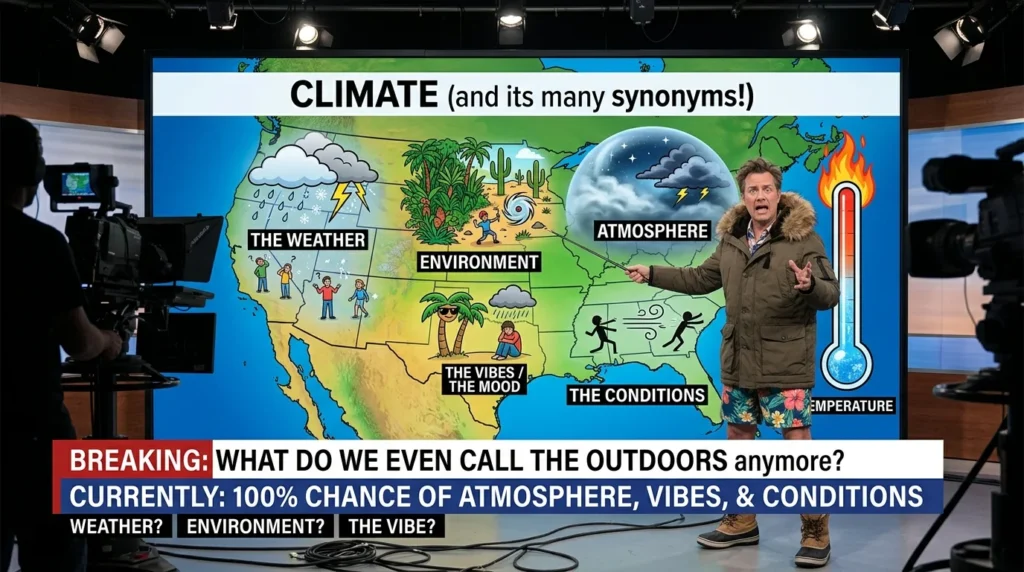
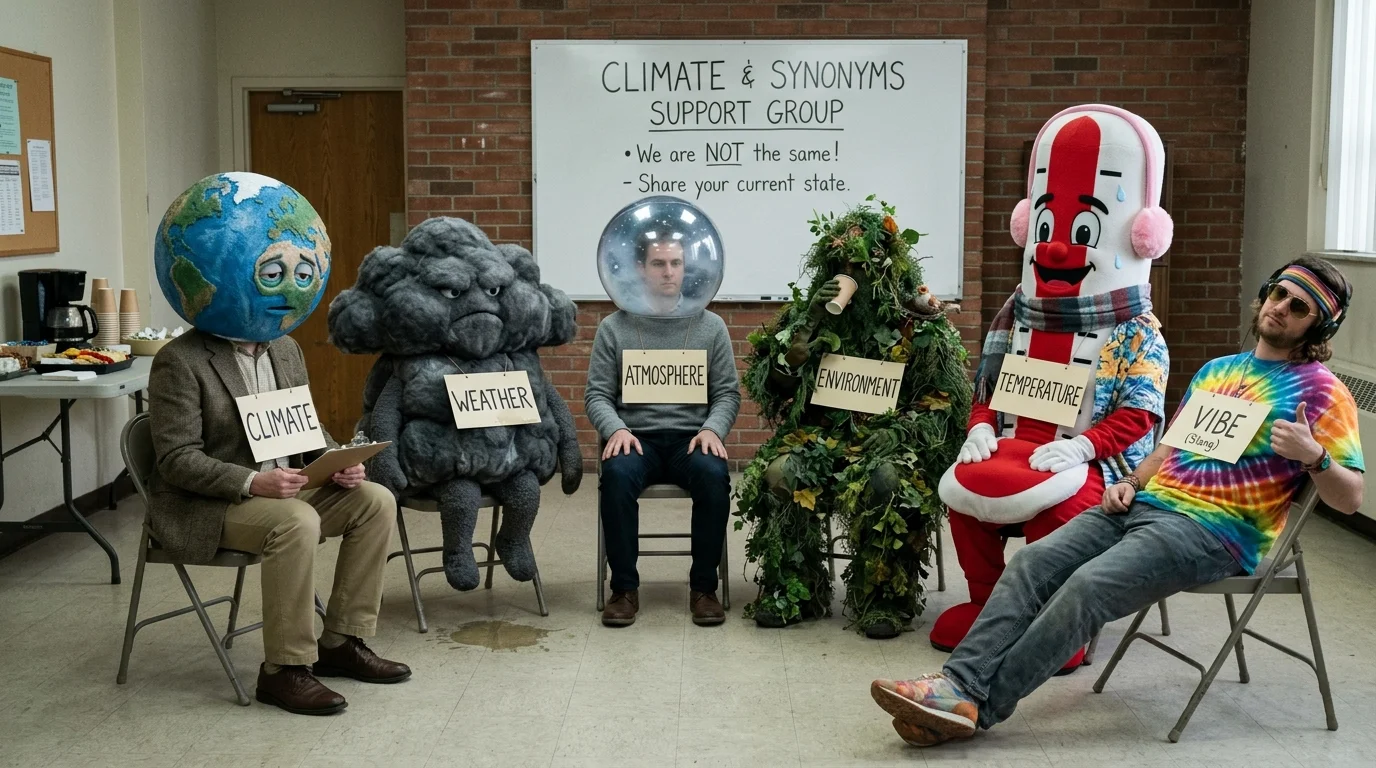
The best synonyms for climate include atmosphere, environment, conditions, weather patterns, setting, and overall mood. Use weather patterns when discussing long-term weather trends, atmosphere for the mood surrounding a place or situation, and environment for the conditions in which people or organizations operate. The right choice depends on the intended meaning.
Quick List of Synonyms for Climate
Here are 35 alternatives and related expressions for different meanings of climate.
Atmosphere
Environment
Weather patterns
Weather conditions
Conditions
Setting
Surroundings
Mood
Ambience
Tone
Outlook
State of affairs
General feeling
Political atmosphere
Economic environment
Social environment
Workplace atmosphere
Cultural environment
Business environment
Natural environment
Regional weather patterns
Meteorological conditions
Temperature patterns
Precipitation patterns
Seasonal conditions
Weather regime
Climatic conditions
General conditions
Context
Circumstances
Situation
Background
Landscape
Prevailing mood
Overall environment
Note: These words relate to different meanings of climate. Weather patterns refers to long-term atmospheric trends, while atmosphere and mood are often used figuratively to describe feelings or attitudes. They are not interchangeable in every sentence.
What Does Climate Mean?
Climate is a noun with several common meanings. Understanding these meanings helps you choose the most accurate synonym.
1. The Typical Weather of a Region
Climate describes the long-term patterns of temperature, rainfall, humidity, wind, and other atmospheric conditions in a particular area.
Example: The region has a warm, dry climate.
Possible alternatives include weather patterns, climatic conditions, and regional climate.
Important distinction: Climate describes long-term patterns, while weather refers to short-term atmospheric conditions. A rainy afternoon is weather; a region’s typical rainfall patterns over many years are part of its climate.
2. The Mood of a Place or Situation
Climate can describe the general feeling, attitude, or atmosphere surrounding a place, group, or event.
Example: The school has a positive climate that encourages learning.
Possible alternatives include atmosphere, ambience, mood, and general feeling.
3. The Conditions Affecting an Organization or Society
Climate can also describe the broader political, economic, cultural, or social conditions that influence decisions and behavior.
Example: The uncertain economic climate has affected consumer spending.
Possible alternatives include economic environment, business conditions, political atmosphere, and state of affairs.
20 Detailed Synonyms for Climate
1. Atmosphere
Meaning: The general feeling, mood, or character of a place or situation.
How it differs: Atmosphere is one of the closest alternatives when climate describes attitudes or feelings rather than weather.
Tone: Neutral and versatile.
Best for: Workplaces, schools, events, relationships, and social situations.
Example: The office has a friendly atmosphere that helps employees feel comfortable.
Watch out: In scientific writing, atmosphere can also refer to the layer of gases surrounding a planet. It is not automatically a synonym for long-term climate.
2. Environment
Meaning: The surroundings and conditions in which people, animals, organizations, or processes exist.
How it differs: Environment emphasizes the surrounding conditions, while climate often refers to their general pattern or character.
Tone: Neutral and professional.
Best for: Business, education, ecology, workplaces, and social discussions.
Example: The company aims to create a supportive working environment.
Watch out: Environment can refer to physical surroundings as well as social or organizational conditions.
3. Weather Patterns
Meaning: Recurring or long-term patterns in atmospheric conditions.
How it differs: Weather patterns is a useful alternative when discussing the meteorological meaning of climate, although the terms may not have precisely the same technical scope.
Tone: Informative and scientific.
Best for: Environmental articles, geography, climate studies, and educational content.
Example: Researchers are studying changes in regional weather patterns.
Watch out: Individual weather events do not necessarily represent a long-term pattern.
4. Weather Conditions
Meaning: The atmospheric state at a particular time or over a specified period.
How it differs: Weather conditions often refers to current or short-term conditions, whereas climate describes long-term patterns.
Tone: Neutral and practical.
Best for: Travel, outdoor activities, forecasts, and safety reports.
Example: Weather conditions may affect the timing of the outdoor event.
Watch out: Do not use weather conditions as a perfect substitute for climate when discussing long-term averages.
5. Conditions
Meaning: The circumstances or state in which something exists or happens.
How it differs: Conditions is a broad term that can describe weather, work, business, or social circumstances.
Tone: Neutral.
Best for: General comparisons, reports, and everyday writing.
Example: The company operates under challenging economic conditions.
Watch out: Because the word is broad, it may be less precise than climate.
6. Setting
Meaning: The place or circumstances in which an event or activity occurs.
How it differs: Setting focuses on the context or surroundings, rather than a pattern of weather or attitudes.
Tone: Neutral and descriptive.
Best for: Stories, events, education, and descriptions of places.
Example: The peaceful setting helps students concentrate.
Watch out: Setting is not a direct replacement when you mean a region’s long-term weather patterns.
7. Surroundings
Meaning: The physical or social things around a person or place.
How it differs: Surroundings emphasizes what is around something, while climate can describe the broader conditions that develop within those surroundings.
Tone: Conversational and descriptive.
Best for: Travel writing, homes, workplaces, and outdoor descriptions.
Example: The natural surroundings make the village attractive to visitors.
Watch out: Use environment when you want to discuss broader influences or systems.
8. Mood
Meaning: The general emotional feeling of a person, group, or situation.
How it differs: Mood focuses on emotional tone, while climate can include broader attitudes, relationships, and social conditions.
Tone: Conversational.
Best for: Social settings, meetings, stories, and group behavior.
Example: The mood in the room changed after the announcement.
Watch out: A mood may be temporary, whereas a climate can describe a more lasting pattern.
9. Ambience
Meaning: The character or atmosphere of a place, especially the feeling created by its surroundings.
How it differs: Ambience often refers to the sensory or emotional impression created by lighting, sounds, design, and other features.
Tone: Descriptive and sometimes sophisticated.
Best for: Restaurants, hotels, homes, events, and hospitality writing.
Example: Soft lighting gives the restaurant a relaxed ambience.
Watch out: Ambience is usually more suitable for a place’s feel than for political or economic conditions.
10. Tone
Meaning: The general attitude or character conveyed by a person, message, group, or situation.
How it differs: Tone often reflects communication or behavior, while climate describes the broader atmosphere in which that communication occurs.
Tone: Neutral to professional.
Best for: Workplace communication, meetings, writing, and public discussions.
Example: The manager established a respectful tone during the meeting.
Watch out: Tone may refer to a specific message or interaction rather than the overall culture.
11. Outlook
Meaning: A general attitude toward the future or a view of how circumstances are likely to develop.
How it differs: Outlook emphasizes expectations and future prospects, not the full set of conditions described by climate.
Tone: Neutral and professional.
Best for: Economics, business, planning, and personal perspectives.
Example: The economic outlook improved after the announcement.
Watch out: Use economic climate when describing the broader business or economic conditions, and outlook when focusing on expectations.
12. State of Affairs
Meaning: The overall situation or set of circumstances at a particular time.
How it differs: This phrase describes a broad situation rather than specifically the mood or long-term weather of a place.
Tone: Formal and analytical.
Best for: Political analysis, reports, and social commentary.
Example: The report examines the current state of affairs in the industry.
Watch out: It may sound too formal for everyday conversation.
13. General Feeling
Meaning: The overall impression or emotional character of a group or situation.
How it differs: General feeling is less formal than climate and often describes how people perceive a situation.
Tone: Conversational.
Best for: Informal writing, meetings, schools, and community discussions.
Example: There was a general feeling of optimism among the employees.
Watch out: Use atmosphere or climate in formal writing when you need a more concise expression.
14. Political Atmosphere
Meaning: The prevailing attitudes, tensions, and relationships within a political setting.
How it differs: This expression narrows political climate to the mood and attitudes surrounding political events.
Tone: Analytical and professional.
Best for: News, political commentary, history, and social analysis.
Example: The political atmosphere became more tense before the election.
Watch out: Political atmosphere emphasizes attitudes and tensions, while political climate can also include institutions, public opinion, and broader conditions.
15. Economic Environment
Meaning: The economic conditions that affect people, companies, markets, or industries.
How it differs: Economic environment emphasizes the external factors affecting economic activity, while economic climate often describes the general economic mood and conditions.
Tone: Professional and analytical.
Best for: Business reports, market analysis, finance, and planning.
Example: Businesses are adapting to a changing economic environment.
Watch out: This phrase may include laws, markets, and other external factors beyond economic sentiment.
16. Social Environment
Meaning: The social conditions, relationships, and influences surrounding people or groups.
How it differs: Social environment emphasizes relationships and social influences, while social climate often highlights prevailing attitudes or public sentiment.
Tone: Neutral and academic.
Best for: Education, sociology, community work, and public policy.
Example: A supportive social environment can help students feel included.
Watch out: Choose social climate when discussing broad attitudes toward a particular issue.
17. Workplace Atmosphere
Meaning: The general feeling and interpersonal tone within a workplace.
How it differs: This expression specifically focuses on employees’ experiences, relationships, and the emotional character of the workplace.
Tone: Professional and accessible.
Best for: Human resources, leadership, company culture, and employee engagement.
Example: Open communication helped improve the workplace atmosphere.
Watch out: Workplace culture may be more appropriate when discussing shared values, habits, and long-term organizational practices.
18. Cultural Environment
Meaning: The cultural norms, values, traditions, and influences surrounding a group or society.
How it differs: Cultural environment emphasizes the wider cultural context, while cultural climate often highlights current attitudes toward cultural issues.
Tone: Academic and descriptive.
Best for: Education, travel, sociology, and cultural studies.
Example: The city’s cultural environment attracts artists and international students.
Watch out: This phrase is broad and may describe long-standing traditions rather than current public attitudes.
19. Business Environment
Meaning: The conditions and external factors that affect businesses and their operations.
How it differs: Business environment can include regulations, competition, customer demand, and economic conditions, whereas business climate often refers to the overall ease or confidence associated with doing business.
Tone: Professional.
Best for: Entrepreneurship, business planning, market research, and management.
Example: A stable business environment can encourage investment.
Watch out: If you mean public confidence or optimism among businesses, business climate may be more precise.
20. Climatic Conditions
Meaning: The characteristic weather-related conditions of a region or place.
How it differs: Climatic conditions is a formal expression closely related to the scientific meaning of climate.
Tone: Technical and scientific.
Best for: Environmental research, agriculture, geography, and scientific reports.
Example: Climatic conditions influence which crops grow successfully in the region.
Watch out: This phrase is generally more technical than necessary for casual writing.
Synonyms for Climate by Context
The right alternative depends on whether you are discussing weather, feelings, society, or business.
Climate Synonyms for Weather and Geography
When describing the typical weather of a region, consider:
Weather patterns: Long-term trends in weather.
Climatic conditions: Characteristic atmospheric conditions.
Temperature patterns: Trends in temperature over time.
Precipitation patterns: Patterns in rain, snow, and other forms of precipitation.
Weather regime: The characteristic pattern of weather in a region.
Regional climate: The climate associated with a particular geographic area.
Example:
Original: The climate of the region is becoming warmer.
Alternative: The region’s temperature patterns are changing over time.
The alternative is more specific if the main point concerns temperature rather than all aspects of climate.
Climate Synonyms for Business and Economics
When discussing market conditions, investment, or company performance, useful alternatives include:
Economic environment: The economic factors influencing activity.
Business environment: The conditions affecting companies.
Market conditions: Factors influencing supply, demand, and market activity.
Economic outlook: Expectations about future economic performance.
Business conditions: The circumstances in which companies operate.
Investment environment: Conditions affecting investment decisions.
Example:
Original: The current economic climate makes expansion difficult.
Alternative: Current economic conditions make expansion difficult.
Use economic outlook instead when focusing primarily on future expectations rather than present conditions.
Climate Synonyms for Politics and Society
When discussing public opinion, political events, or social attitudes, consider:
Political atmosphere: The prevailing mood and tensions in politics.
Social climate: Broad attitudes within society.
Public mood: The general feelings or opinions of the public.
State of affairs: The overall situation.
Social environment: The social influences surrounding people.
Prevailing attitudes: The opinions or beliefs commonly held by a group.
Example:
Original: The political climate changed after the election.
Alternative: The political atmosphere changed after the election.
The alternative works well when the main focus is the mood or tone surrounding political events.
Climate Synonyms for Workplaces and Education
When describing relationships, employee experiences, or learning conditions, useful alternatives include:
Workplace atmosphere: The general feeling within a workplace.
Organizational climate: Employees’ shared perceptions of workplace policies and practices.
Learning environment: The setting and conditions that support learning.
School atmosphere: The general feeling and social tone of a school.
Work environment: The physical and social conditions in which people work.
Classroom environment: The conditions that influence classroom learning.
Example:
Original: The school has a positive climate.
Alternative: The school has a supportive learning environment.
The alternative is especially useful when the intended meaning involves student support, participation, and learning.
Climate Synonyms for Mood and Ambience
When climate describes a feeling or emotional tone, consider:
Atmosphere: The general feeling of a place or situation.
Mood: The emotional tone at a particular time.
Ambience: The character or feeling created by a place.
Tone: The attitude or character conveyed by a message or interaction.
General feeling: The overall impression of a situation.
Prevailing mood: The dominant emotional feeling within a group.
Example:
Original: The meeting had a tense climate.
Alternative: The meeting had a tense atmosphere.
The alternative sounds natural and clearly describes the emotional tone of the meeting.
Climate vs. Similar Words: What’s the Difference?
These words overlap with climate, but they have important differences.
| Word | Meaning | Best Use | Interchangeable With Climate? |
|---|---|---|---|
| Weather | Short-term atmospheric conditions | Forecasts and daily conditions | No, not in technical contexts |
| Atmosphere | General feeling or gaseous surroundings | Mood, setting, or science | Sometimes |
| Environment | Surroundings and influencing conditions | Workplaces, ecology, and society | Sometimes |
| Conditions | Circumstances or state | Business, weather, and daily life | Sometimes |
| Setting | Place or context where something happens | Stories, events, and descriptions | Occasionally |
| Mood | Emotional feeling | People, groups, and situations | Sometimes |
| Ambience | Character or feeling of a place | Restaurants, hotels, and events | Sometimes |
| Outlook | Expectations about the future | Economics, business, and planning | No, not generally |
| State of affairs | Overall situation | Politics and social analysis | Sometimes |
| Climatic conditions | Characteristic weather-related conditions | Scientific and environmental writing | Often, in relevant contexts |
Climate vs. Weather
Climate describes long-term patterns, while weather refers to atmospheric conditions over a shorter period.
Climate: The region has a dry climate.
Weather: The weather is rainy today.
Use climate when discussing typical conditions over time and weather when describing what is happening now or over a short period.
Climate vs. Atmosphere
Climate can describe long-term social attitudes, while atmosphere often refers to the general feeling of a place or situation.
Climate: The organization has a climate of trust and cooperation.
Atmosphere: The meeting had a relaxed atmosphere.
Both can work, but atmosphere often sounds more natural when describing a specific event or room.
Climate vs. Environment
Climate often describes prevailing patterns or attitudes, while environment refers to the wider conditions and surroundings.
Climate: The company is operating in a challenging business climate.
Environment: The company operates in a competitive business environment.
The first emphasizes the overall business conditions or sentiment. The second can include competition, regulations, technology, and other external influences.
Climate vs. Mood
Mood is usually an emotional state, while climate can describe a more lasting pattern of attitudes or conditions.
Climate: The school has a positive climate that supports learning.
Mood: The students were in a cheerful mood after the celebration.
A mood may change quickly, whereas a climate often develops over time.
10 Sentence Transformations Using Synonyms for Climate
These examples show how to replace climate with a more precise word or expression.
1. Describing Regional Weather
Original: The climate in the area is warm and dry.
Alternative: The region has warm, dry weather patterns.
Why it works: Weather patterns emphasizes recurring atmospheric conditions. In a scientific context, climate remains the more precise technical term.
2. Describing Workplace Feelings
Original: The company has a positive climate.
Alternative: The company has a positive workplace atmosphere.
Why it works: Workplace atmosphere clearly describes the general feeling among employees.
3. Describing Business Conditions
Original: The economic climate has become uncertain.
Alternative: Economic conditions have become uncertain.
Why it works: Economic conditions focuses on the circumstances affecting the economy.
4. Describing Political Attitudes
Original: The political climate became tense before the election.
Alternative: The political atmosphere became tense before the election.
Why it works: Political atmosphere emphasizes the mood and tension surrounding political events.
5. Describing School Culture
Original: A positive school climate can improve student engagement.
Alternative: A supportive school environment can improve student engagement.
Why it works: School environment emphasizes the conditions and support that influence learning.
6. Describing a Restaurant
Original: The restaurant has a welcoming climate.
Alternative: The restaurant has a welcoming ambience.
Why it works: Ambience naturally describes the overall feeling created by a restaurant’s design, lighting, and service.
7. Describing Public Opinion
Original: The social climate is changing rapidly.
Alternative: Public attitudes are changing rapidly.
Why it works: The alternative is more specific when the intended meaning concerns people’s views and opinions.
8. Describing Investment
Original: The country has a favorable investment climate.
Alternative: The country has a favorable investment environment.
Why it works: Investment environment describes the conditions that influence investment decisions.
9. Describing a Meeting
Original: The climate during the meeting was uncomfortable.
Alternative: The atmosphere during the meeting was uncomfortable.
Why it works: Atmosphere is more natural when describing the emotional tone of a particular meeting.
10. Describing Farming
Original: The local climate affects crop production.
Alternative: Local climatic conditions affect crop production.
Why it works: Climatic conditions is a suitable formal alternative in agricultural and environmental writing.
Common Mistakes When Using Synonyms for Climate
1. Treating Climate and Weather as Identical
Weather refers to short-term atmospheric conditions, while climate describes long-term patterns. A single storm does not necessarily indicate a change in climate.
2. Using Atmosphere for Every Meaning
Atmosphere works well for moods and feelings, but it may not be precise enough for scientific discussions of regional climate.
3. Confusing Climate With Environment
The environment includes surroundings and many factors that influence living things or organizations. Climate is only one part of the natural environment, although the word also has figurative meanings.
4. Using Mood for Long-Term Conditions
Mood generally describes feelings at a particular time. Use climate when discussing a more lasting pattern of attitudes or organizational conditions.
5. Using Ambience in Technical Writing
Ambience is often suitable for describing the character of a restaurant, hotel, or event. It is usually inappropriate as a substitute for climate in meteorology.
6. Confusing Economic Climate With Economic Outlook
The economic climate describes current or prevailing economic conditions. The economic outlook focuses on expectations about future performance.
7. Replacing Climate Without Considering Context
A political climate, tropical climate, and workplace climate have different meanings. A synonym that fits one context may be inaccurate in another.
8. Choosing a More Complicated Word Unnecessarily
Sometimes, climate is already the clearest choice. Replacing it with a long phrase may make your sentence harder to understand without adding useful meaning.
When Should You Keep the Word Climate?
Sometimes, climate is the most accurate and natural word. You should keep it when it clearly expresses the intended meaning.
For example:
The region has a tropical climate.
Climate change affects ecosystems around the world.
The company is working to improve its organizational climate.
The political climate has changed significantly.
A supportive classroom climate can encourage participation.
In scientific writing, climate has a specific meaning involving long-term patterns in the climate system. Replacing it with weather or atmosphere may change the meaning.
In business, politics, and education, climate can also describe broader patterns of attitudes and conditions. It may communicate these ideas more effectively than a narrower word such as mood.
Keep the original word when it is familiar, accurate, and appropriate for your audience. Use a synonym when it clarifies the specific aspect you want to emphasize.
Tips for Choosing the Right Synonym for Climate
Follow these guidelines to find the most suitable alternative.
For long-term weather patterns: Use climate, climatic conditions, or weather patterns, depending on the technical context.
For today’s weather: Use weather conditions.
For the feeling in a room or event: Use atmosphere or ambience.
For workplace relationships and attitudes: Use workplace atmosphere or organizational climate.
For economic conditions: Use economic environment or business conditions.
For political attitudes: Use political atmosphere or prevailing attitudes.
For public opinion: Use public mood or social climate.
For the surroundings that influence people: Use environment.
For a temporary emotional feeling: Use mood.
For expectations about future performance: Use outlook.
Always consider what your sentence is trying to communicate. A precise synonym should make your writing clearer without changing the original meaning.
Editor’s Choice: The Best Alternatives to Climate
These five alternatives are especially useful in common writing situations.
1. Atmosphere
Best for describing the mood or general feeling of a workplace, meeting, event, or social setting.
2. Environment
Best for discussing the surrounding conditions that influence people, organizations, or natural systems.
3. Weather Patterns
Best for explaining recurring or long-term atmospheric trends in accessible language.
4. Conditions
Best for describing the circumstances affecting business, society, work, or other activities.
5. Ambience
Best for describing the character and feeling of a place, especially in hospitality, interior design, and travel writing.
Editor’s tip: First identify which meaning of climate you intend. If you mean weather over many years, use climate or a precise scientific alternative. If you mean the mood of a workplace or event, atmosphere is often the best choice.
Frequently Asked Questions
1. What is the closest synonym for climate?
Atmosphere is one of the closest synonyms when climate describes the mood or general feeling of a situation. For meteorological meanings, weather patterns and climatic conditions are more appropriate alternatives.
2. What is another word for climate in a sentence?
Common alternatives include atmosphere, environment, conditions, setting, and weather patterns. The right word depends on the context. For example, “The workplace has a positive climate” could become “The workplace has a positive atmosphere.”
3. What is a formal synonym for climate?
Formal alternatives include climatic conditions, environment, prevailing conditions, economic environment, and state of affairs. In scientific writing, use a term that accurately describes the long-term atmospheric patterns being discussed.
4. What is another word for climate in business?
Common alternatives include business environment, economic conditions, market conditions, and investment environment. Use business environment for the broader conditions affecting companies and economic outlook for expectations about future economic performance.
5. What is another word for political climate?
Useful alternatives include political atmosphere, political environment, prevailing political attitudes, and state of political affairs. Political atmosphere is especially useful when discussing public sentiment, tension, or the general mood surrounding political events.
6. What is the difference between climate and atmosphere?
Climate can describe long-term weather patterns or lasting social conditions. Atmosphere usually describes the general feeling of a place or situation, although it also has a scientific meaning relating to the gases surrounding a planet.
7. What is the opposite of climate?
There is no single direct opposite of climate. Depending on the intended meaning, you might contrast a warm climate with a cold climate, or a positive social climate with a hostile social climate. The appropriate opposite depends on the specific characteristic being described.
Key Takeaways
Atmosphere, environment, conditions, weather patterns, and setting are useful alternatives to climate in different contexts.
Use weather patterns for recurring atmospheric trends and weather conditions for short-term weather.
Use atmosphere or ambience when describing the mood or feeling of a place.
Use business environment, economic conditions, or political atmosphere when discussing social and organizational contexts.
Choose the synonym that matches the intended meaning rather than replacing climate simply to vary your vocabulary.
Suggested Internal Links
Consider linking this article to related vocabulary guides on your website:
Synonyms for Environment
Synonyms for Atmosphere
Synonyms for Weather
Synonyms for Conditions
Synonyms for Mood
Synonyms for Setting
Synonyms for Economic
Synonyms for Change