
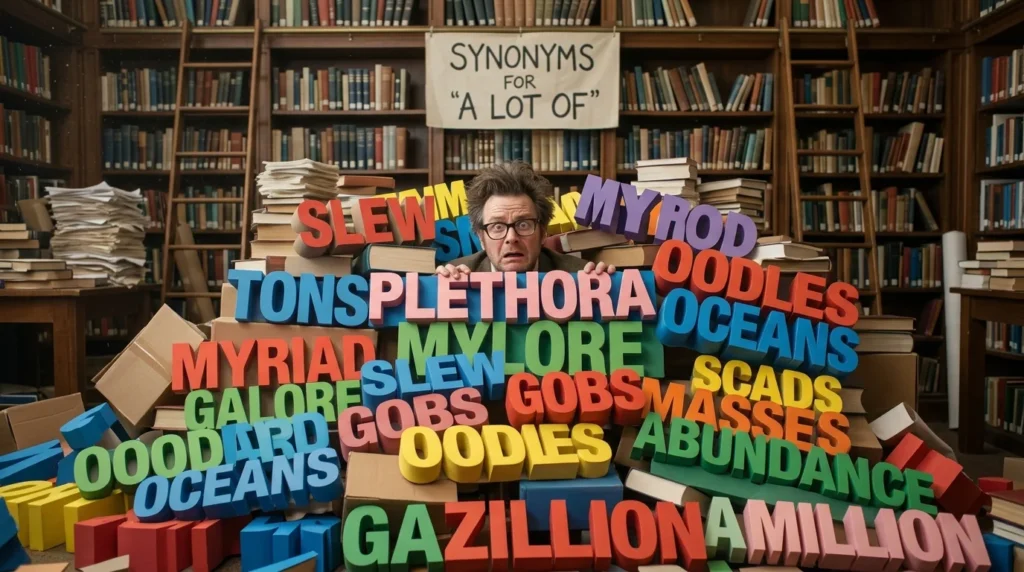

Quick Answer: What Are the Best Synonyms for A Lot Of?
The best synonyms for “a lot of” include many, much, plenty of, numerous, a great deal of, a large number of, a substantial amount of, numerous, several, abundant, and loads of. Use many with countable nouns, much with uncountable nouns, and plenty of when you want to express that something is available in a sufficient or generous quantity.
Quick Synonym List for A Lot Of
Here are useful alternatives for different situations:
Many
Much
Plenty of
Numerous
A great deal of
A large number of
A large amount of
A substantial amount of
A considerable amount of
A significant amount of
Loads of
Tons of
Heaps of
A wealth of
Abundant
Ample
Extensive
Numerous amounts of
A multitude of
A wide range of
Countless
A vast number of
A vast amount of
Numerous instances of
A good deal of
A great many
Scores of
Dozens of
A high volume of
A large quantity of
A considerable number of
A significant number of
More than enough
Plenty
Sufficient
Generous amounts of
A host of
A mass of
An abundance of
A large share of
Frequently
Often
Repeatedly
To a great extent
Considerably
Substantially
Significantly
Greatly
Extremely
Highly
Important: These expressions are not interchangeable in every context. For example, many works with countable nouns, while much generally works with uncountable nouns. Words such as greatly and extremely express degree rather than quantity, so they replace “a lot” only in certain sentence structures.
What Does A Lot Of Mean?
“A lot of” is an informal, widely used expression that means a large quantity or number of something. It can describe people, objects, ideas, time, money, work, emotions, and many other things.
Examples:
She has a lot of friends.
We spent a lot of money on repairs.
There is a lot of information to review.
He has a lot of experience in marketing.
They put a lot of effort into the project.
The phrase is flexible because it can be used with both countable and uncountable nouns.
A Lot Of With Countable Nouns
Countable nouns refer to things that can be counted individually, such as books, students, cars, and ideas.
Examples:
A lot of students attended the lecture.
We received a lot of applications.
She owns a lot of books.
Useful alternatives include many, numerous, a large number of, and a great many.
A Lot Of With Uncountable Nouns
Uncountable nouns refer to things that are not usually counted as separate units, such as water, time, information, money, and patience.
Examples:
We need a lot of time.
He gave us a lot of information.
They spent a lot of money.
Useful alternatives include much, a great deal of, a large amount of, and a substantial amount of.
20 Detailed Synonyms for A Lot Of
1. Many
Meaning: A large number of people or things.
How it differs: “Many” is a direct alternative when the noun is countable. It often sounds more concise than “a lot of.”
Tone: Neutral and suitable for formal and informal writing.
Best for: People, objects, questions, choices, and opportunities.
Example: Many students participated in the competition.
Watch out: Use “many” with plural countable nouns, not normally with uncountable nouns such as water or information.
2. Much
Meaning: A large quantity or degree.
How it differs: “Much” is used mainly with uncountable nouns and often appears in questions, negative sentences, and formal writing.
Tone: Neutral to formal.
Best for: Time, money, effort, work, and information.
Example: We do not have much time before the deadline.
Watch out: In positive everyday statements, “a lot of time” often sounds more natural than “much time.”
3. Plenty Of
Meaning: More than enough or a generous quantity.
How it differs: This expression emphasizes availability or sufficiency rather than simply a large quantity.
Tone: Friendly and conversational.
Best for: Time, food, opportunities, resources, and space.
Example: We have plenty of time to finish the assignment.
Watch out: “Plenty of” does not always mean the largest possible amount; it often means enough, with some to spare.
4. Numerous
Meaning: Existing in large numbers.
How it differs: “Numerous” is more formal than “a lot of” and is particularly useful in reports and academic writing.
Tone: Formal and professional.
Best for: Studies, examples, problems, reasons, and opportunities.
Example: Numerous studies have examined the effects of sleep on memory.
Watch out: Use it with plural countable nouns, not with uncountable nouns such as traffic or equipment.
5. A Great Deal Of
Meaning: A large quantity or amount.
How it differs: This expression usually refers to uncountable nouns and can emphasize the scale of something.
Tone: Neutral to formal.
Best for: Time, effort, attention, money, and research.
Example: The team devoted a great deal of effort to the project.
Watch out: It generally takes uncountable nouns, such as effort or time.
6. A Large Number Of
Meaning: A high count of individual people or things.
How it differs: It makes the idea of counting or numerical quantity explicit.
Tone: Formal and clear.
Best for: Applications, participants, customers, employees, and cases.
Example: A large number of customers requested the new feature.
Watch out: Use a plural countable noun after this phrase.
7. A Large Amount Of
Meaning: A substantial quantity of something.
How it differs: It emphasizes the amount rather than the number of individual items.
Tone: Neutral and professional.
Best for: Money, work, time, energy, and material.
Example: The renovation required a large amount of money.
Watch out: In careful formal writing, use it mainly with uncountable nouns.
8. A Substantial Amount Of
Meaning: A considerable or significant quantity.
How it differs: “Substantial” suggests that the amount is large enough to matter.
Tone: Formal and authoritative.
Best for: Funding, evidence, investment, work, and resources.
Example: The company invested a substantial amount of money in research.
Watch out: It may suggest importance as well as quantity, so it is not always a neutral replacement.
9. A Considerable Amount Of
Meaning: A fairly large or noteworthy quantity.
How it differs: “Considerable” emphasizes that the amount is large enough to deserve attention.
Tone: Formal and measured.
Best for: Time, effort, expense, energy, and work.
Example: Preparing the presentation required a considerable amount of time.
Watch out: Use it when the quantity is meaningful, not merely when it is greater than one.
10. A Significant Amount Of
Meaning: A quantity that is important or large enough to have an effect.
How it differs: “Significant” often implies importance, impact, or relevance in addition to quantity.
Tone: Professional and analytical.
Best for: Data, money, progress, change, and resources.
Example: The new system saved a significant amount of time.
Watch out: Do not confuse “significant” with “statistically significant,” which has a specific meaning in research.
11. Loads Of
Meaning: A large quantity or number.
How it differs: “Loads of” is informal and often communicates enthusiasm or abundance.
Tone: Casual and conversational.
Best for: Everyday conversations, messages, and informal writing.
Example: We have loads of ideas for the weekend.
Watch out: Avoid it in formal academic reports unless the context deliberately calls for an informal voice.
12. Tons Of
Meaning: A very large amount or number.
How it differs: “Tons of” is a figurative expression that often exaggerates quantity for emphasis.
Tone: Informal and expressive.
Best for: Time, work, fun, problems, and ideas.
Example: I have tons of work to finish today.
Watch out: It usually does not refer to a literal measurement of weight.
13. Heaps Of
Meaning: A large quantity or number.
How it differs: “Heaps of” is an informal expression used in some English-speaking regions more often than others.
Tone: Casual and friendly.
Best for: Food, clothes, work, and everyday objects.
Example: We have heaps of photographs from the trip.
Watch out: Its regional feel may make it less suitable for formal or globally targeted writing.
14. A Wealth Of
Meaning: A rich or plentiful supply of something valuable.
How it differs: This expression often suggests variety, usefulness, or richness, not just a high quantity.
Tone: Positive and polished.
Best for: Knowledge, information, experience, resources, and ideas.
Example: The library offers a wealth of information on ancient history.
Watch out: It works best when the things being described are valuable or beneficial.
15. Abundant
Meaning: Available in large quantities.
How it differs: “Abundant” emphasizes plentiful supply and is often used to describe resources or natural features.
Tone: Neutral to formal.
Best for: Resources, evidence, opportunities, wildlife, and rainfall.
Example: The region has abundant natural resources.
Watch out: Use it as an adjective, not as a direct substitute before every noun. “Abundant information” works; “abundant of information” does not.
16. Ample
Meaning: Enough or more than enough for a particular need.
How it differs: “Ample” emphasizes adequacy and room to spare, rather than simply a high number.
Tone: Professional and reassuring.
Best for: Time, space, opportunity, evidence, and resources.
Example: The candidates had ample time to complete the test.
Watch out: “Ample” does not necessarily mean an unusually large amount; it means enough for the purpose.
17. Extensive
Meaning: Covering a large area, range, or amount.
How it differs: “Extensive” often emphasizes breadth, scope, or reach rather than a simple count.
Tone: Formal and professional.
Best for: Research, experience, damage, networks, and reviews.
Example: The researchers conducted extensive testing before releasing the product.
Watch out: It is not a natural replacement for “a lot of” in every sentence. “Extensive testing” works better than “extensive apples.”
18. Countless
Meaning: Too many to count easily, or an extremely large number.
How it differs: “Countless” is more emphatic than “many” and may be figurative.
Tone: Expressive and sometimes literary.
Best for: Memories, opportunities, stars, attempts, and examples.
Example: She has helped countless families through her work.
Watch out: It can sound exaggerated if the quantity is small or precisely known.
19. A Multitude Of
Meaning: A very large number or wide collection.
How it differs: “A multitude of” emphasizes the presence of many individual things and may suggest variety.
Tone: Formal or literary.
Best for: Options, challenges, reasons, opinions, and possibilities.
Example: The proposal raised a multitude of questions.
Watch out: It can sound overly elaborate in simple everyday sentences.
20. A Vast Amount Of
Meaning: An extremely large quantity.
How it differs: “Vast” emphasizes exceptional scale, often more strongly than “large” or “considerable.”
Tone: Emphatic and descriptive.
Best for: Information, data, land, resources, and work.
Example: The team collected a vast amount of data during the experiment.
Watch out: Use it when the quantity is genuinely very large or when deliberate emphasis is appropriate.
Synonyms for A Lot Of by Context
The best replacement depends on what you are describing and the tone you want.
For Formal Writing
When writing an academic essay, business report, or professional document, choose precise expressions instead of relying on “a lot of.”
Useful alternatives:
Numerous
A substantial amount of
A considerable number of
A significant quantity of
Extensive
A large proportion of
A high volume of
A wide range of
Examples:
Informal: The survey collected a lot of responses.
Formal: The survey collected numerous responses.
More precise: The survey received a high volume of responses.
Choose the alternative that best describes the actual quantity or scope.
For Everyday Conversation
Informal expressions often sound more natural when speaking with friends or family.
Useful alternatives:
Lots of
Loads of
Tons of
Heaps of
Plenty of
A bunch of
A whole lot of
A great many
Examples:
We have lots of snacks.
There are loads of things to do.
She has a bunch of books to read.
These phrases are conversational, so they may not fit formal academic or business writing.
For Academic Writing
Academic writing benefits from accuracy, clarity, and evidence-based claims.
Useful alternatives:
Many
Numerous
A substantial number of
A considerable amount of
Extensive
A significant proportion of
A large body of
A high concentration of
Examples:
Informal: A lot of researchers studied the issue.
Academic: Numerous researchers have studied the issue.
More specific: A substantial body of research has examined the issue.
Be careful with significant: it can imply measurable importance or statistical significance, depending on the context.
For Business and Professional Writing
Professional documents often need to express quantity without sounding casual.
Useful alternatives:
A substantial amount of
A considerable number of
A high volume of
Extensive
Ample
A large share of
A broad range of
A significant quantity of
Examples:
The company received a lot of customer feedback.
The company received a substantial amount of customer feedback.
The support team handled a high volume of requests.
Use the most precise term available when describing performance, budgets, customers, or workload.
For Describing Money
When discussing financial quantities, the best choice depends on whether you mean a large amount, enough money, or a large number of payments.
Useful alternatives:
A large amount of money
A substantial sum
A considerable sum
A significant amount
Plenty of money
A fortune (informal and emphatic)
Examples:
They spent a substantial sum on renovations.
The project requires a considerable amount of funding.
The repair could cost a fortune.
A fortune is an informal expression that often implies an unusually high cost.
For Describing Time
Use these alternatives when discussing time, schedules, deadlines, or duration.
Useful alternatives:
Plenty of time
A great deal of time
A considerable amount of time
Extensive time (less natural in many everyday contexts)
Many hours
Long periods
A significant amount of time
Examples:
We have plenty of time to prepare.
The investigation took a considerable amount of time.
She spent many hours studying.
“Many hours” is useful when you want to emphasize countable units of time, while “a great deal of time” refers to time more generally.
For Describing People
When the noun refers to people, countable expressions are usually the best fit.
Useful alternatives:
Many people
Numerous people
A large number of people
A great many people
Countless people
A crowd of people
A multitude of people
Examples:
Many people attended the event.
Numerous people expressed their support.
A large number of people completed the survey.
Use a crowd of people when you mean people gathered in one place, not simply a large population in general.
For Describing Work or Effort
These expressions help communicate workload, dedication, or the scale of a task.
Useful alternatives:
A great deal of work
A substantial amount of effort
Extensive work
Considerable effort
A heavy workload
Intensive work
Significant effort
Examples:
The team put a great deal of effort into the launch.
The project required extensive research.
Preparing the event involved a substantial amount of work.
“Intensive” describes work that is concentrated or demanding, while “extensive” emphasizes breadth or scope.
True Synonyms vs. Related Alternatives
Some phrases directly replace “a lot of,” while others express a more specific meaning.
| Alternative | Main meaning | Best use | Direct replacement? |
|---|---|---|---|
| Many | High number | Countable nouns | Yes |
| Much | Large quantity | Uncountable nouns | Yes, in suitable sentences |
| Plenty of | More than enough | Resources and availability | Often |
| Numerous | Large number | Formal writing | Yes, with countable nouns |
| A great deal of | Large quantity | Time, effort, money | Yes, with uncountable nouns |
| Ample | Enough or more than enough | Time, space, resources | Sometimes |
| Extensive | Broad in scope | Research, experience, damage | Context-dependent |
| Countless | Extremely many | Emphatic descriptions | Sometimes |
| Frequently | Often repeated | Actions and events | No; expresses frequency |
| Greatly | To a large degree | Verbs and degree | No; expresses intensity |
| Extremely | To an unusually high degree | Adjectives and adverbs | No; expresses degree |
| A wide range of | Many different types | Options and categories | Context-dependent |
The main lesson is to choose a word that preserves the original meaning, not merely one that sounds impressive.
A Lot Of vs. Lots Of vs. Many vs. Much
These expressions are related, but their grammar and tone differ.
| Expression | Meaning | Best use | Example |
|---|---|---|---|
| A lot of | A large quantity or number | Everyday speech and writing | A lot of people came. |
| Lots of | A large quantity or number | Casual conversation | Lots of people came. |
| Many | A large number | Countable plural nouns | Many people came. |
| Much | A large quantity or degree | Uncountable nouns | We do not have much time. |
| Plenty of | More than enough | Emphasizing availability | We have plenty of time. |
| Numerous | A large number | Formal writing | Numerous guests attended. |
| A great deal of | A large amount | Uncountable nouns | We invested a great deal of time. |
In everyday English, “a lot of” and “lots of” are both natural. “Many” and “much” can sound more formal in some sentence structures, especially questions and negative statements.
10 Sentence Transformations Using Synonyms for A Lot Of
The following examples show how to replace the phrase while keeping the main meaning.
1. Students
Original: A lot of students joined the club.
Alternative: Many students joined the club.
Why it works: “Many” is a concise replacement for a large number of students.
2. Research
Original: The team did a lot of research.
Alternative: The team conducted extensive research.
Why it works: “Extensive” emphasizes the breadth or scope of the research.
3. Time
Original: We spent a lot of time preparing.
Alternative: We spent a considerable amount of time preparing.
Why it works: “A considerable amount of time” sounds more formal and emphasizes the duration.
4. Money
Original: The business invested a lot of money in new equipment.
Alternative: The business invested a substantial amount of money in new equipment.
Why it works: “Substantial” highlights the size and importance of the investment.
5. Opportunities
Original: There are a lot of opportunities for students.
Alternative: There are numerous opportunities for students.
Why it works: “Numerous” is a polished alternative for countable opportunities.
6. Information
Original: The website provides a lot of information.
Alternative: The website provides a wealth of information.
Why it works: “A wealth of information” suggests a rich supply of useful material.
7. Work
Original: I have a lot of work to do.
Alternative: I have a heavy workload.
Why it works: “A heavy workload” describes the overall burden of work, rather than just its quantity.
8. Food
Original: We have a lot of food for the guests.
Alternative: We have plenty of food for the guests.
Why it works: “Plenty of” suggests that there is enough food for everyone.
9. Questions
Original: The presentation raised a lot of questions.
Alternative: The presentation raised a multitude of questions.
Why it works: “A multitude of” emphasizes the large number of questions, although it sounds more formal or literary.
10. Experience
Original: She has a lot of experience in teaching.
Alternative: She has extensive teaching experience.
Why it works: “Extensive” highlights the breadth of her experience and makes the sentence more concise.
Common Mistakes When Using Synonyms for A Lot Of
Choosing a synonym involves more than replacing one phrase with another. Watch out for these common errors.
1. Using Many With Uncountable Nouns
Incorrect: Many information is available online.
Correct: A lot of information is available online.
Also correct: Much information is available online, although this wording can sound formal.
Use many with countable plural nouns, such as books and people.
2. Using Much in Every Positive Sentence
Incorrect or unnatural in ordinary conversation: I have much free time.
More natural: I have a lot of free time.
Also natural: I have plenty of free time.
“Much” is perfectly grammatical in many positive constructions, but it often sounds more formal or literary than “a lot of.”
3. Confusing Quantity With Frequency
“A lot of meetings” refers to a large number of meetings.
“We meet a lot” means that meetings happen frequently.
Use often or frequently when describing how regularly something happens, not how many objects exist.
4. Treating Abundant as a Noun Phrase
Incorrect: We have abundant of resources.
Correct: We have abundant resources.
Also correct: We have an abundance of resources.
Remember that abundant is an adjective, while an abundance of is a noun phrase.
5. Using Informal Expressions in Formal Reports
Phrases such as “tons of,” “loads of,” and “heaps of” are suitable for casual conversation.
In a formal report, “a substantial amount of,” “numerous,” or “a large number of” may be more appropriate.
6. Choosing an Alternative That Changes the Meaning
“A lot of resources” simply means a large quantity of resources.
“Ample resources” suggests there are enough resources for a purpose.
“Extensive resources” may suggest a broad or wide-ranging collection.
Choose the phrase that reflects the meaning you intend.
7. Overusing Fancy Words
Replacing every instance of “a lot of” with “a multitude of” or “a substantial amount of” can make writing unnecessarily complicated.
Sometimes the simplest alternative—such as “many,” “much,” or “plenty of”—is the best choice.
8. Forgetting the Noun Type
Use “a large number of applicants” but “a large amount of funding” in careful formal writing.
The first refers to countable individuals; the second refers to an uncountable quantity.
When Should You Keep the Original Phrase A Lot Of?
You do not need to replace “a lot of” every time you use it. It is a standard expression in modern English and works well in many situations.
Keep it when:
You are writing a casual message or conversation.
The sentence needs to sound friendly and natural.
The exact quantity is not important.
A formal alternative would make the sentence unnecessarily complicated.
You want simple, accessible language for a broad audience.
For example, “Thanks for your help. It means a lot to me” is natural and expressive. Replacing it with “It means a substantial amount to me” would sound awkward.
Likewise, “We have a lot of things to discuss” is perfectly acceptable in everyday conversation.
The goal is not to eliminate common phrases. It is to select the most appropriate wording for your audience, purpose, and sentence.
Tips for Choosing the Right Synonym
Use these practical tips to improve your vocabulary and writing.
Identify the noun. Decide whether you are describing countable things, such as books, or uncountable things, such as time.
Consider your audience. Use “loads of” in casual messages and “numerous” or “substantial” in more formal contexts.
Be precise. If you mean a high number, choose “many” or “numerous.” If you mean more than enough, choose “plenty of” or “ample.”
Match the tone. “Countless” sounds emphatic, while “a considerable amount” sounds measured and professional.
Avoid unnecessary complexity. A simple word is often clearer than an elaborate phrase.
Check the sentence structure. Make sure the alternative fits grammatically with the noun or verb.
Read the sentence aloud. If the replacement sounds unnatural, the original expression may be better.
Editor’s Choice: The Best Alternatives to A Lot Of
If you need a quick recommendation, start with these five choices:
Many: Best for a large number of countable things. Example: Many people attended the event.
Plenty of: Best when something is available in sufficient or generous quantities. Example: We have plenty of time.
Numerous: Best for formal writing about countable items. Example: Numerous studies support further investigation.
A substantial amount of: Best for professional writing about money, effort, time, or resources. Example: The project required a substantial amount of funding.
A great deal of: Best for emphasizing an uncountable quantity. Example: She devoted a great deal of attention to detail.
For most everyday situations, many, much, and plenty of are the easiest alternatives. For professional and academic writing, numerous, extensive, and a substantial amount of are often stronger choices when their meanings fit.
Frequently Asked Questions
1. What is the best synonym for a lot of?
The best synonym depends on the sentence. “Many” works with countable nouns, “much” works with uncountable nouns, and “plenty of” emphasizes that something is available in sufficient or generous quantities. For formal writing, “numerous” and “a substantial amount of” are useful alternatives.
2. What is a formal word for a lot of?
“Numerous,” “substantial,” “considerable,” and “extensive” are useful formal alternatives, depending on the sentence. For example, “a lot of studies” can become “numerous studies,” while “a lot of effort” can become “a substantial amount of effort.”
3. What are informal synonyms for a lot of?
Common informal alternatives include “lots of,” “loads of,” “tons of,” “heaps of,” and “a bunch of.” These expressions are useful in conversations, friendly messages, and casual writing. They may sound too informal for academic papers or professional reports.
4. Can I use many instead of a lot of?
Yes. “Many” is a suitable replacement when the noun is countable and plural. For example, “a lot of books” can become “many books.” However, you would usually say “a lot of water” rather than “many water,” because water is uncountable in this context.
5. What is another way to say a lot of money?
You can say “a substantial amount of money,” “a considerable sum,” “a large sum of money,” or “a fortune.” The first three suit formal or neutral writing, while “a fortune” is informal and usually suggests an exceptionally large amount.
6. What is another way to say a lot of time?
Useful alternatives include “plenty of time,” “a great deal of time,” “a considerable amount of time,” and “many hours.” Choose “plenty of time” when there is enough time available, and “many hours” when you want to emphasize the number of hours spent.
7. Is a lot of formal or informal?
“A lot of” is acceptable in both everyday and many professional contexts, but it often sounds more conversational than alternatives such as “numerous” or “a substantial amount of.” In formal writing, use a more precise expression when it improves clarity. There is no need to replace “a lot of” when it is already the clearest option.
Key Takeaways
“A lot of” means a large number or quantity and works with countable and uncountable nouns.
Use “many” and “numerous” with countable plural nouns.
Use “much,” “a great deal of,” and “a substantial amount of” with uncountable nouns.
Choose “plenty of” or “ample” when you want to emphasize that there is enough for a particular need.
Match your synonym to the sentence, audience, and tone instead of choosing the most complicated word.
Suggested Internal Links
Consider linking this article to related vocabulary guides on your website:
Synonyms for Many
Synonyms for Much
Synonyms for Plenty
Synonyms for Numerous
Synonyms for Significant
Synonyms for Substantial
Synonyms for Extensive
Synonyms for Several