

Quick Answer
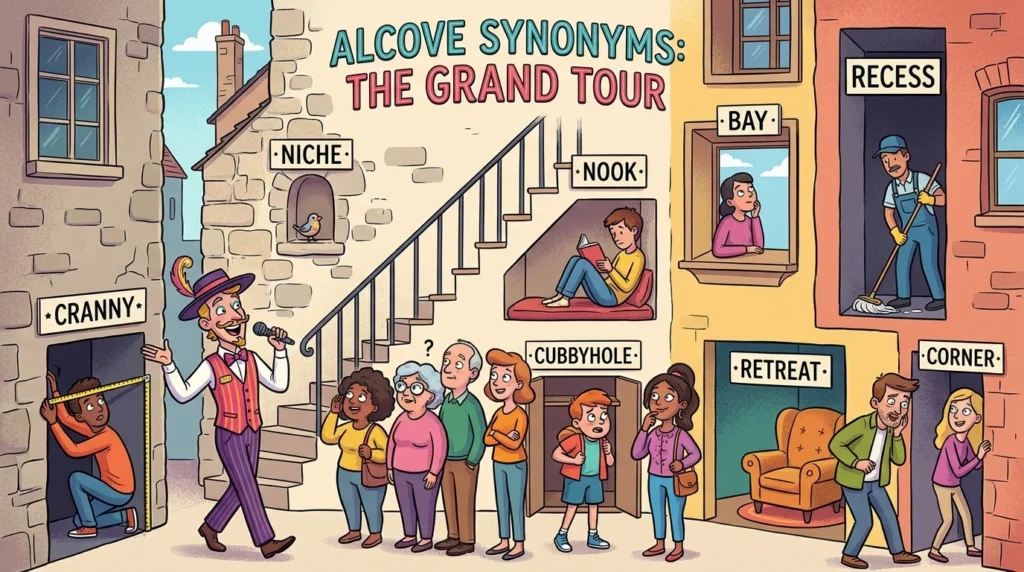
An alcove is a small, recessed, or partly enclosed space within a larger room, wall, or building. Depending on the context, useful synonyms include nook, recess, niche, corner, cubby, compartment, enclosure, retreat, hideaway, and cove. The best choice depends on the size, shape, purpose, and level of privacy the space provides.
Quick Synonym List
Here are some of the closest and most useful synonyms for alcove:
- Nook
- Recess
- Niche
- Corner
- Cubby
- Cove
- Compartment
- Enclosure
- Hideaway
- Retreat
- Cozy corner
- Small room
- Side space
- Secluded space
- Built-in space
- Wall recess
- Enclosed corner
- Sheltered space
- Private corner
- Reading nook
- Seating area
- Bay
- Inset
- Hollow
- Cranny
- Snug
- Den
- Cell
- Booth
- Recessed area
What Does Alcove Mean?
An alcove is a small space that is set back from the main area of a room, wall, or structure. It is usually partly enclosed and may be used for sitting, reading, sleeping, storage, displaying objects, or creating a private area.
For example:
She placed a comfortable chair in the alcove beside the window.
The word often suggests a space that feels separate, sheltered, or cozy without being a completely independent room.
The exact synonym you choose should match the physical structure and purpose of the space.
Nook
Nook is one of the closest everyday synonyms for alcove.
A nook is usually a small, comfortable, or somewhat secluded space. Unlike alcove, it does not always have to be physically recessed into a wall.
Best for: Homes, reading areas, cozy spaces, and informal writing.
Example:
He created a small reading nook near the fireplace.
How it differs:
Nook emphasizes comfort and coziness more than architectural structure.
Recess
Recess is one of the most precise alternatives when you mean a space that is set back into a wall or surface.
Best for: Architecture, interior design, construction, and formal descriptions.
Example:
The shelves were built into a recess in the wall.
How it differs:
Recess focuses on the physical indentation rather than how the space is used.
Niche
Niche can describe a small recessed area in a wall, especially one designed to hold an object.
Best for: Architecture, decoration, art, and interior design.
Example:
A small statue stood in a decorative niche.
How it differs:
A niche often has a specific display or decorative purpose, while an alcove may be large enough for a person or furniture.
Corner
Corner is a broad and simple alternative.
Best for: Everyday descriptions when the exact architectural shape is not important.
Example:
She put a desk in the quiet corner of the room.
How it differs:
A corner is not necessarily recessed or enclosed, so it is a broader term than alcove.
Cubby
A cubby is a small compartment or enclosed space, often used for storage.
Best for: Schools, offices, children’s rooms, lockers, and storage areas.
Example:
Each child had a cubby for their backpack.
How it differs:
Cubby usually refers to a much smaller space and often has a storage function.
Cove
Cove can refer to a small sheltered or partly enclosed space. In architectural contexts, it can also describe a curved recess.
Best for: Architecture, design, and descriptions of sheltered spaces.
Example:
The sofa was positioned inside a curved cove.
How it differs:
Cove can have meanings that are quite different from alcove, including a small sheltered coastal inlet.
Compartment
A compartment is a separate section within a larger structure.
Best for: Trains, furniture, storage, buildings, and organized spaces.
Example:
The cabinet contains a separate compartment for books.
How it differs:
A compartment is usually more enclosed and functional than an alcove.
Enclosure
Enclosure describes an area that is surrounded or partly surrounded.
Best for: Formal, architectural, and technical writing.
Example:
The plants were placed inside a small glass enclosure.
How it differs:
An enclosure emphasizes being surrounded rather than being recessed into another space.
Hideaway
Hideaway is an informal word for a private or secluded place.
Best for: Casual writing, fiction, bedrooms, secret spaces, and cozy areas.
Example:
The children discovered a quiet hideaway beneath the stairs.
How it differs:
Hideaway emphasizes privacy or secrecy rather than architectural design.
Retreat
A retreat is a place where someone can go for privacy, peace, or relaxation.
Best for: Bedrooms, reading areas, gardens, hotels, and lifestyle writing.
Example:
The window alcove became her favorite retreat.
How it differs:
Retreat describes the purpose or feeling of the space more than its physical structure.
Cozy Corner
Cozy corner is a natural phrase when an alcove is designed for comfort and relaxation.
Example:
The alcove provided a cozy corner for reading.
Best for: Home décor, lifestyle content, blogs, and informal descriptions.
It is less architectural than recess or niche.
Small Room
Sometimes an alcove is large enough to function almost like a small room.
Example:
The apartment included a small room beside the living area.
However, this is not a direct synonym because an alcove is generally not a fully separate room.
Secluded Space
Secluded space works when privacy is the main feature.
Example:
The restaurant offered a secluded space for private conversations.
This phrase describes the function and atmosphere rather than the architectural form.
Built-In Space
Built-in space can describe an area designed as part of a wall or larger structure.
Example:
The built-in space beside the staircase was used for storage.
It is useful in interior design writing but is broader than alcove.
Reading Nook
A reading nook is a small area designed specifically for reading.
Example:
The bedroom has a charming reading nook by the window.
It can be an alcove, but a reading nook does not have to be recessed into a wall.
Seating Area
Seating area is appropriate when an alcove is used for chairs, a bench, or a sofa.
Example:
The window alcove was converted into a comfortable seating area.
This phrase focuses on function rather than structure.
Hollow
Hollow can refer to a recessed or empty space, although it is not always interchangeable with alcove.
Example:
The old wall contained a shallow hollow.
It works better for descriptive or literary writing than for precise architectural descriptions.
Cranny
A cranny is a small, narrow, or hidden space.
Example:
Dust had collected in every cranny of the old house.
A cranny is usually much smaller and less usable than an alcove.
Snug
Snug can describe a small, comfortable room or space, particularly in British English.
Example:
They relaxed in the little snug beside the fireplace.
It emphasizes comfort and warmth rather than a recessed architectural form.
Den
A den is a private room or comfortable space used for relaxing.
Example:
He turned the alcove into a quiet den.
A den is generally larger and more functional than an alcove, so it is a contextual alternative rather than a direct synonym.
Bay
Bay can refer to a section of a building that projects outward or a defined section within a larger space.
Example:
The house has a beautiful window bay overlooking the garden.
A bay and an alcove have different architectural forms, so they should not be treated as exact synonyms.
Synonyms for Alcove by Context
Different situations call for different alternatives.
For Architecture
The most suitable choices include:
- Recess
- Niche
- Inset
- Cove
- Enclosure
- Built-in space
These words work well in architectural and interior-design descriptions.
For Home Décor
Consider:
- Nook
- Reading nook
- Cozy corner
- Seating area
- Retreat
- Hideaway
These alternatives create a warmer and more inviting tone.
For Storage
Use:
- Cubby
- Compartment
- Recess
- Built-in space
- Storage niche
These terms emphasize practical use.
For Privacy
Useful choices include:
- Hideaway
- Retreat
- Secluded space
- Private corner
- Quiet space
These words focus on the feeling or purpose of the alcove.
For Formal Writing
Consider:
- Recess
- Niche
- Enclosure
- Compartment
- Recessed area
These terms are more precise than casual words such as nook or hideaway.
True Synonyms vs. Related Alternatives
| Alternative | Relationship | Can Replace “Alcove”? | Tone | Best Context |
|---|---|---|---|---|
| Nook | Close synonym | Often | Friendly | Homes, reading |
| Recess | Close architectural equivalent | Yes | Formal | Architecture |
| Niche | Close contextual synonym | Sometimes | Formal | Design, display |
| Corner | Broader alternative | Sometimes | Neutral | Everyday speech |
| Cubby | Related small space | Sometimes | Informal | Storage |
| Hideaway | Functional alternative | Sometimes | Casual | Private spaces |
| Retreat | Purpose-based alternative | Sometimes | Neutral | Relaxation |
| Cove | Related architectural term | Sometimes | Formal | Design |
| Compartment | Functional alternative | Rarely | Neutral | Storage |
| Cranny | Smaller related space | Rarely | Literary | Descriptive writing |
Comparison of Common Alcove Synonyms
| Word/Phrase | Meaning | Tone | Strength | Best Use | Interchangeable? |
|---|---|---|---|---|---|
| Alcove | Small recessed or partly enclosed area | Neutral | Precise | General use | — |
| Nook | Small cozy area | Warm | Moderate | Homes | Often |
| Recess | Area set back into a surface | Formal | Precise | Architecture | Often |
| Niche | Small recessed space | Formal | Precise | Display/design | Sometimes |
| Corner | Meeting point of walls | Neutral | Broad | Everyday use | Sometimes |
| Cubby | Small compartment | Informal | Specific | Storage | Rarely |
| Hideaway | Private or secluded place | Casual | Suggestive | Informal writing | Sometimes |
| Retreat | Place for privacy or relaxation | Neutral | Functional | Lifestyle writing | Sometimes |
| Cove | Sheltered or curved space | Formal | Contextual | Architecture | Sometimes |
How to Choose the Right Synonym
Use nook when you want the space to sound cozy.
Use recess when describing the physical structure of a wall.
Use niche when the space is intended for decoration or display.
Use corner when the exact architectural structure does not matter.
Use cubby when the space is small and mainly used for storage.
Use hideaway when privacy or secrecy matters.
Use retreat when the space is intended for rest or relaxation.
Use cove when describing a sheltered or curved architectural area.
Sentence Transformations
1. Original
She placed a chair in the alcove.
Better alternative:
She placed a chair in the cozy nook.
Why: Nook gives the sentence a warmer, more inviting feeling.
2. Original
The painting was displayed in an alcove.
Better alternative:
The painting was displayed in a recessed niche.
Why: Niche is more specific when the space is designed for displaying artwork.
3. Original
The shelves were installed in an alcove.
Better alternative:
The shelves were installed in a wall recess.
Why: Recess clearly describes the architectural feature.
4. Original
We found an alcove where we could sit quietly.
Better alternative:
We found a secluded corner where we could sit quietly.
Why: Secluded corner emphasizes privacy.
5. Original
The children made an alcove their secret place.
Better alternative:
The children turned the space into a little hideaway.
Why: Hideaway fits the idea of a private or secret place.
6. Original
The apartment has an alcove beside the bedroom.
Better alternative:
The apartment has a small nook beside the bedroom.
Why: Nook sounds natural in residential descriptions.
7. Original
The statue stood inside the alcove.
Better alternative:
The statue stood inside the wall niche.
Why: Niche is more precise for a decorative architectural opening.
8. Original
They created an alcove for reading.
Better alternative:
They created a comfortable reading nook.
Why: Reading nook immediately communicates the space’s purpose.
Common Mistakes With Alcove Synonyms
Mistake 1: Treating “corner” as an exact synonym
Not every corner is an alcove. An alcove is generally recessed or partly enclosed, while a corner can simply be where two walls meet.
Mistake 2: Using “niche” for every alcove
A niche often serves as a place for displaying or holding something. If people can comfortably sit inside the space, nook or alcove may be more appropriate.
Mistake 3: Calling a large room a cubby
A cubby usually refers to a small compartment. It does not normally describe a comfortable room-sized space.
Mistake 4: Using “recess” for atmosphere
Recess describes physical structure. If you want to emphasize comfort, nook is usually more natural.
Mistake 5: Assuming “hideaway” is architectural
A hideaway describes a place that offers privacy. It does not necessarily describe a recessed section of a wall.
Mistake 6: Using “cove” without checking context
Cove has several meanings. In architecture, it may describe a curved or sheltered space, but it is not always interchangeable with alcove.
Mistake 7: Choosing a synonym only because it sounds sophisticated
A simple word such as nook may communicate the idea more naturally than a technical term such as recess.
When “Alcove” Is Better Than a Synonym
Sometimes the original word is the clearest choice.
Use alcove when you specifically mean a small recessed area that forms part of a larger room or building.
For example:
The hotel room had a charming alcove beside the window.
Replacing alcove with corner would lose the idea that the space is structurally set apart.
Likewise, nook may suggest coziness but does not necessarily communicate that the area is physically recessed.
If architectural accuracy matters, alcove or recess is usually preferable.
Writing Tips for Using Alcove Naturally
Avoid replacing alcove with a synonym simply to prevent repetition. Repetition is sometimes better than using an inaccurate word.
For example:
The alcove contained a small bench. The alcove also had a window.
This can be improved without forcing a synonym:
The alcove contained a small bench and a narrow window.
You can also use descriptive phrases such as:
- Small wall alcove
- Window alcove
- Reading alcove
- Quiet alcove
- Recessed alcove
- Cozy alcove
- Hidden alcove
- Decorative alcove
These phrases preserve the original meaning while adding useful detail.
Editor’s Choice: Strong Alternatives for “Alcove”
For general writing, these five alternatives are especially useful because they cover different meanings:
- Nook — best for a cozy, informal space.
- Recess — best for precise architectural writing.
- Niche — best for decorative or display spaces.
- Hideaway — best for private or secret spaces.
- Reading nook — best when the space is designed for reading.
These are not a universal ranking. Each works best in a different context.
Related Questions About Alcove Synonyms
What is the closest synonym for alcove?
Nook is one of the closest everyday synonyms. Recess is often the closest architectural alternative.
What is another word for a small room?
Depending on the context, alternatives include nook, den, snug, cubicle, chamber, compartment, and retreat.
Is “nook” the same as “alcove”?
Not exactly. A nook is a small, often cozy space, while an alcove is typically recessed or partly enclosed within a larger room or structure.
What is an alcove in interior design?
An alcove is a recessed section of a room that can be used for seating, storage, decoration, sleeping, or other purposes.
What is another word for a recessed area?
Useful alternatives include recess, niche, inset, hollow, and recessed space.
What is a cozy alcove called?
A cozy alcove can be called a nook, reading nook, cozy corner, retreat, or hideaway, depending on how it is used.
What is the difference between a niche and an alcove?
A niche is usually a smaller recessed space designed to hold or display something. An alcove is often larger and may be large enough for people or furniture.
FAQs
What is a simple word for alcove?
A simple word for alcove is nook. It works especially well when describing a small, comfortable space in a home.
What is the formal synonym for alcove?
Recess is a strong formal synonym, particularly in architectural or interior-design writing.
What is a synonym for alcove in a house?
Depending on the purpose, you can use nook, reading nook, recessed area, seating area, niche, or quiet corner.
What is another word for a recessed room?
Possible terms include alcove, nook, recess, niche, and small enclosed space. The correct choice depends on the size and structure.
Can “niche” replace “alcove”?
Sometimes. Niche is appropriate when the recessed area is small and designed for displaying or holding an object. It is not always suitable for an alcove intended for seating or living.
Can “corner” replace “alcove”?
Sometimes, but corner is broader. A corner does not need to be recessed or partly enclosed.
What is the opposite of an alcove?
There is no single exact opposite. Depending on the context, you might contrast an alcove with an open area, open space, exposed area, or main room.
Key Takeaways
- Alcove means a small recessed or partly enclosed space within a larger area.
- Nook is the best everyday alternative when the space feels cozy.
- Recess is useful for architectural and technical descriptions.
- Niche works especially well for decorative or display spaces.
- Choose words such as hideaway, retreat, or reading nook when you want to emphasize the purpose or atmosphere of the space.