
Quick Answer: What Are the Best Synonyms for Condition?
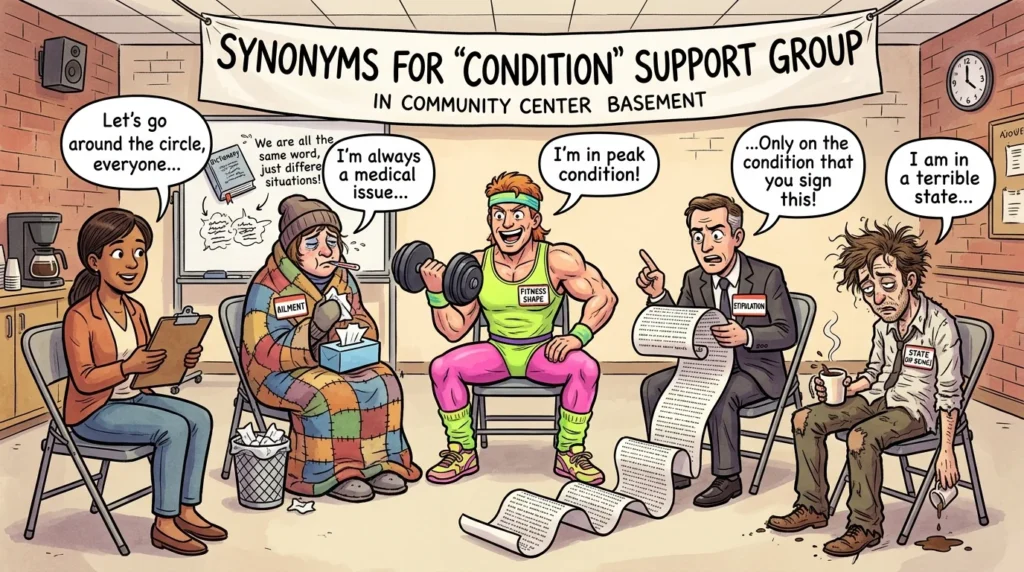
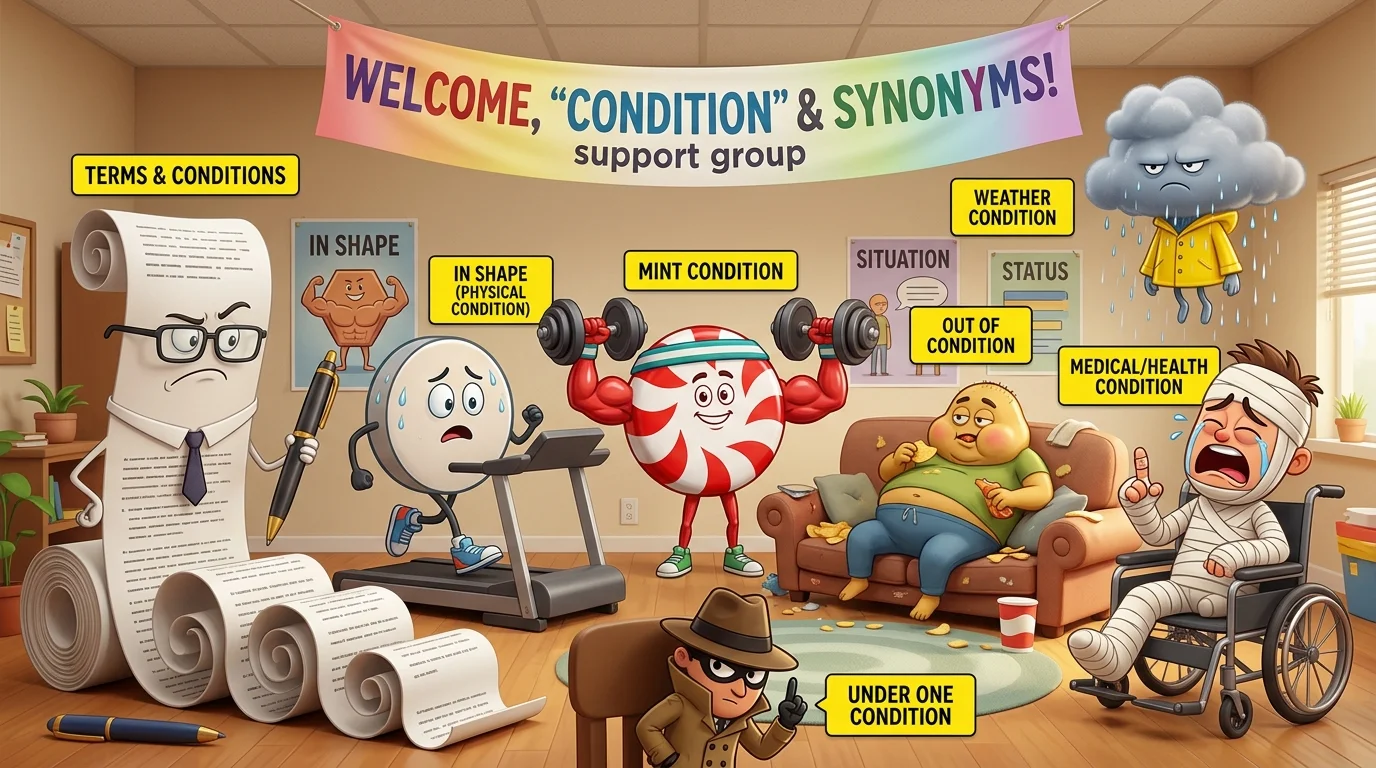
The best synonyms for condition include state, situation, status, circumstance, requirement, term, quality, and state of affairs. Use state to describe how something is, situation for a set of circumstances, requirement for something that must be fulfilled, and term for a rule in an agreement. The right choice depends on the intended meaning.
Quick List of Synonyms for Condition
Here are 35 useful alternatives to consider.
State
Situation
Status
Circumstance
State of affairs
Position
Shape
Quality
Shape and state
Standard
Situation or state
Requirement
Prerequisite
Term
Stipulation
Provision
Qualification
Restriction
Limitation
Rule
Criterion
Factor
Situation
Environment
Setting
Context
Health
Disorder
Illness
Ailment
Malady
Fitness
Well-being
Standing
Condition of use
Note: These words are related to different meanings of condition. For example, requirement refers to something that must be satisfied, while illness is relevant only when condition refers to a health problem.
What Does Condition Mean?
The word condition is a noun with several common meanings. Understanding these meanings helps you select an appropriate alternative.
1. The State of Something
This meaning describes the quality, appearance, or working order of a person or object.
Example: The house is in excellent condition.
Possible synonyms include state, shape, quality, and state of repair.
2. A Situation or Set of Circumstances
This meaning refers to the circumstances in which someone lives, works, or operates.
Example: The workers faced difficult conditions.
Possible synonyms include situation, circumstances, environment, and state of affairs.
3. A Requirement or Rule
A condition can be something that must happen or be satisfied before an agreement, action, or outcome is possible.
Example: Payment is a condition of receiving the service.
Possible synonyms include requirement, prerequisite, term, and stipulation.
4. A Medical Problem
In healthcare, a condition can refer to a disease, disorder, or other health issue.
Example: The doctor explained how to manage the condition.
Depending on the medical context, related words include disorder, illness, and ailment. These terms are not always interchangeable, because condition can also refer to a health state that is not necessarily a disease.
20 Detailed Synonyms for Condition
1. State
Meaning: The way something or someone is at a particular time.
How it differs: State is one of the closest general alternatives to condition, especially when describing quality, appearance, or circumstances.
Tone: Neutral and versatile.
Best for: Objects, emotions, systems, and general descriptions.
Example: The building is in a poor state of repair.
Watch out: State does not usually mean a contractual requirement.
2. Situation
Meaning: A set of circumstances affecting a person, place, or event.
How it differs: Situation emphasizes what is happening rather than the physical state or quality of something.
Tone: Neutral and conversational.
Best for: Problems, relationships, work, and everyday events.
Example: The company is trying to improve its financial situation.
Watch out: Use state when describing the actual quality or physical condition of an object.
3. Status
Meaning: The current position, standing, or recognized state of a person or thing.
How it differs: Status often concerns classification, progress, or standing rather than physical quality.
Tone: Professional and formal.
Best for: Applications, projects, employment, and official records.
Example: Please check the status of your application.
Watch out: Status is not usually suitable for describing how well a piece of furniture has been maintained.
4. Circumstance
Meaning: A fact or situation that affects an event, decision, or outcome.
How it differs: Circumstance focuses on surrounding factors rather than the intrinsic state of something.
Tone: Neutral to formal.
Best for: Explanations, decisions, legal writing, and personal situations.
Example: Under these circumstances, postponing the meeting makes sense.
Watch out: The plural circumstances is often more natural when describing several contributing factors.
5. State of Affairs
Meaning: The overall situation at a particular time.
How it differs: This phrase usually describes a broader situation involving several factors rather than one object’s condition.
Tone: Formal and analytical.
Best for: Reports, discussions, and social or political analysis.
Example: The report describes the current state of affairs in the industry.
Watch out: It can sound unnecessarily formal in casual conversation.
6. Position
Meaning: A person’s or organization’s situation, standing, or place in relation to something.
How it differs: Position often emphasizes someone’s circumstances, status, or relationship to an issue.
Tone: Neutral and professional.
Best for: Business, negotiations, finances, and personal circumstances.
Example: The company’s financial position improved during the year.
Watch out: Position can also mean a physical location or an opinion, so context matters.
7. Shape
Meaning: The physical state or quality of something, especially how well it has been maintained.
How it differs: Shape is more informal and often refers to an object’s overall quality or a person’s fitness.
Tone: Conversational.
Best for: Cars, buildings, clothing, equipment, and physical fitness.
Example: The used bicycle is in excellent shape.
Watch out: Use state or condition in formal reports where greater precision is needed.
8. Quality
Meaning: The degree of excellence or standard of something.
How it differs: Quality focuses on how good something is, while condition may describe wear, damage, or current state.
Tone: Neutral and professional.
Best for: Products, services, materials, and performance.
Example: The furniture is in good condition and is of excellent quality.
Watch out: A product can be in good condition but have poor quality, or vice versa.
9. Standard
Meaning: A level of quality, performance, or acceptability.
How it differs: Standard usually refers to an expected or required level rather than the current state of something.
Tone: Professional and formal.
Best for: Education, manufacturing, performance, and regulations.
Example: The equipment must meet strict safety standards.
Watch out: Standard is not a direct replacement for condition in every sentence.
10. Requirement
Meaning: Something that must be fulfilled, provided, or completed.
How it differs: Requirement is appropriate when condition means something necessary for an action or agreement.
Tone: Clear and professional.
Best for: Applications, contracts, eligibility, and instructions.
Example: A valid identification document is a requirement for registration.
Watch out: Use state or situation when you are describing how things currently are.
11. Prerequisite
Meaning: Something that must happen or be completed before something else is possible.
How it differs: A prerequisite specifically comes before another action or stage.
Tone: Formal and precise.
Best for: Education, employment, applications, and project planning.
Example: Completing the introductory course is a prerequisite for advanced training.
Watch out: Not every condition must be fulfilled first; some apply throughout an agreement or process.
12. Term
Meaning: A rule, provision, or requirement included in an agreement.
How it differs: Term is especially suitable when a condition forms part of a contract or arrangement.
Tone: Professional and legal.
Best for: Contracts, employment agreements, services, and negotiations.
Example: One term of the agreement requires payment within 30 days.
Watch out: A term can be a general contractual rule, not just a condition that must be met before something happens.
13. Stipulation
Meaning: A specific requirement or provision agreed upon by the parties involved.
How it differs: Stipulation emphasizes an explicitly stated requirement, often in a formal agreement.
Tone: Formal and legal.
Best for: Contracts, negotiations, and official arrangements.
Example: The agreement includes a stipulation that the work must be completed by June.
Watch out: This word may sound overly technical in everyday conversation.
14. Provision
Meaning: A specific clause, rule, or arrangement in a document or agreement.
How it differs: Provision refers to the wording or content of an agreement, while condition may describe the requirement itself.
Tone: Formal and professional.
Best for: Contracts, policies, legislation, and regulations.
Example: The contract contains a provision allowing either party to cancel with notice.
Watch out: A provision can address many subjects, not just requirements.
15. Qualification
Meaning: A requirement, limitation, or detail that affects how a statement or offer should be understood.
How it differs: Qualification can narrow the meaning of a statement or establish eligibility, while condition is broader.
Tone: Formal and analytical.
Best for: Eligibility rules, professional qualifications, and precise explanations.
Example: The offer comes with one important qualification.
Watch out: The word also means a credential or skill needed for a job.
16. Restriction
Meaning: A rule or limitation that controls what is permitted.
How it differs: A restriction limits behavior or options, while a condition can be any requirement or circumstance.
Tone: Neutral to formal.
Best for: Policies, access rules, legal documents, and safety.
Example: The property has restrictions on commercial use.
Watch out: A condition does not necessarily limit freedom or prohibit an action.
17. Limitation
Meaning: A factor that restricts ability, scope, or choice.
How it differs: Limitation emphasizes what cannot be done or what is restricted.
Tone: Neutral and professional.
Best for: Research, planning, technology, and agreements.
Example: The study has several limitations that affect its conclusions.
Watch out: Use requirement when something must be done rather than when something is restricted.
18. Criterion
Meaning: A standard used to judge, evaluate, or decide something.
How it differs: A criterion is a specific measure for assessment, while a condition may be a requirement or circumstance.
Tone: Formal and analytical.
Best for: Selection, evaluation, hiring, and research.
Example: Experience is an important criterion for selecting the candidate.
Watch out: The plural is criteria, not criterions in standard usage.
19. Factor
Meaning: Something that influences a result or situation.
How it differs: A factor contributes to an outcome but is not necessarily a requirement or the overall state of something.
Tone: Neutral and professional.
Best for: Research, planning, analysis, and decision-making.
Example: Weather is an important factor in determining road conditions.
Watch out: Use circumstance when referring to the broader surrounding situation.
20. Disorder
Meaning: A disruption of normal functioning, especially in health or medicine.
How it differs: Disorder can be a synonym for condition when the word refers to a health problem, but it is much narrower.
Tone: Medical and clinical.
Best for: Healthcare discussions and medical descriptions.
Example: The specialist explained how the disorder may affect sleep.
Watch out: Not every medical condition is a disorder, and the terms should not be substituted without considering the medical context.
Synonyms for Condition by Context
The right alternative depends on what condition means in your sentence.
Physical Condition and Quality
When describing the state or quality of an object, useful alternatives include:
State: The general way something is.
Shape: Its overall physical state, often informally.
Quality: How good or well-made something is.
State of repair: How well something has been maintained.
Working order: Whether a device or machine functions properly.
Standard: The level of quality it meets.
Example: Instead of saying, “The car is in excellent condition,” you could write, “The car is in excellent shape.”
For a more precise description, you might say, “The car is in excellent working order” if you mean that its mechanical systems function properly.
Social and Economic Conditions
When discussing the circumstances in which people live or work, consider:
Circumstances: Factors surrounding a person or event.
Situation: The overall circumstances at a particular time.
Environment: The surroundings or setting that influence people.
State of affairs: The broader situation.
Living standards: The level of comfort and material well-being.
Working environment: The setting and circumstances of employment.
Example: “The workers faced difficult conditions” could become “The workers faced difficult circumstances.”
If you mean the physical workplace, however, working environment may be more precise.
Contractual and Legal Conditions
When referring to requirements in an agreement, useful alternatives include:
Terms: Rules forming part of an agreement.
Requirements: Things that must be fulfilled.
Stipulations: Explicitly stated requirements.
Provisions: Clauses in a legal or formal document.
Prerequisites: Requirements that must be met beforehand.
Restrictions: Rules limiting certain actions.
Example: “The condition of the contract requires written approval” could be rewritten as “The contract includes a requirement for written approval.”
The exact replacement depends on whether you mean a specific clause, a prerequisite, or a general contractual obligation.
Medical Conditions
When condition refers to health, the following words may be appropriate:
Disorder: A disruption of normal functioning.
Illness: A state of being unwell.
Ailment: A health problem, often a relatively minor one.
Disease: A recognized pathological process or illness.
Health issue: A broad, accessible expression.
Medical problem: A general term for a health concern.
Example: “The patient has a medical condition” could become “The patient has a health issue.”
Important: These terms have different medical meanings. Use the terminology that accurately describes the particular diagnosis or health concern.
Condition vs. Similar Words: What’s the Difference?
These words may appear interchangeable, but their meanings differ in important ways.
| Word | Meaning | Best Use | Interchangeable with Condition? |
|---|---|---|---|
| State | How something is at a particular time | Physical quality or general status | Often |
| Situation | A set of surrounding circumstances | Problems and events | Sometimes |
| Status | Current position or standing | Applications and progress | Sometimes |
| Circumstance | A factor or surrounding situation | Personal or external factors | Sometimes |
| Requirement | Something that must be fulfilled | Rules and agreements | When condition means a requirement |
| Prerequisite | Something needed beforehand | Courses and eligibility | In specific contexts |
| Term | A rule in an agreement | Contracts | In contractual contexts |
| Stipulation | An explicitly stated requirement | Legal agreements | In formal contexts |
| Quality | The degree of excellence | Products and services | Only when referring to quality |
| Disorder | A disruption of normal functioning | Medical contexts | Only for certain health conditions |
Condition vs. State
Condition and state are often close in meaning when describing the current quality of something.
Condition: The house is in good condition.
State: The house is in good repair.
Both convey a positive assessment, although good repair specifically emphasizes maintenance.
Condition vs. Situation
Condition can refer to the state of something, while situation usually describes the circumstances surrounding an event or person.
Condition: The machine is in poor condition.
Situation: The company is in a difficult situation.
A machine’s physical quality is not the same as a company’s circumstances.
Condition vs. Requirement
When condition means something that must be satisfied, requirement can be a strong alternative.
Condition: Approval is a condition of the agreement.
Requirement: Approval is a requirement of the agreement.
The sentences are similar, but requirement can sound more direct and accessible.
10 Sentence Transformations Using Synonyms for Condition
These examples show how to replace condition with a more specific word or phrase.
1. Original
The house is in excellent condition.
Alternative: The house is in excellent shape.
Why it works: Shape is a natural, conversational alternative when describing the physical state of a property.
2. Original
The company is operating under difficult conditions.
Alternative: The company is operating under difficult circumstances.
Why it works: Circumstances emphasizes the external factors affecting the company.
3. Original
Payment is a condition of receiving the service.
Alternative: Payment is a requirement for receiving the service.
Why it works: Requirement makes it clear that payment must be completed.
4. Original
The contract includes several conditions.
Alternative: The contract includes several terms.
Why it works: Terms is appropriate when referring to the rules and obligations in an agreement.
5. Original
The patient’s condition improved after treatment.
Alternative: The patient’s health improved after treatment.
Why it works: Health makes the sentence more accessible, although it may be less specific than condition in a medical report.
6. Original
The school provides students with good learning conditions.
Alternative: The school provides students with a supportive learning environment.
Why it works: Learning environment emphasizes the surroundings and support available to students.
7. Original
The equipment must be kept in good condition.
Alternative: The equipment must be kept in good working order.
Why it works: Working order specifically emphasizes proper functioning.
8. Original
The application was approved on one condition.
Alternative: The application was approved subject to one requirement.
Why it works: Requirement makes the obligation explicit, although the sentence structure changes slightly.
9. Original
Weather conditions affected the journey.
Alternative: Weather circumstances affected the journey.
Why it works: The sentence is understandable, but a more natural alternative is “The weather affected the journey.” Sometimes removing condition is better than replacing it.
10. Original
The study examined the condition of the local economy.
Alternative: The study examined the state of the local economy.
Why it works: State naturally describes the economy’s overall situation or performance.
Common Mistakes When Using Synonyms for Condition
1. Treating State and Situation as Identical
State often describes how something is, while situation refers to the surrounding circumstances. A building has a physical state, while a family may face a difficult situation.
2. Using Requirement for Physical Quality
A requirement is something that must be fulfilled. It cannot replace condition when you are describing a damaged car or a well-maintained building.
3. Confusing Condition with Status
Status often refers to progress, standing, or classification. It is appropriate for an application or project but may not describe physical quality accurately.
4. Using Disorder for Every Medical Condition
A medical condition does not always constitute a disorder. Choose medical terminology based on the actual health issue and the context in which it is being discussed.
5. Treating Terms and Stipulations as Perfect Synonyms
A term can be a general rule in an agreement. A stipulation usually emphasizes a specific requirement that has been explicitly stated or agreed upon.
6. Confusing Quality with Condition
A product can be well-made but damaged, or poorly made but still in new condition. Quality and condition describe different characteristics.
7. Using Circumstances for Every Meaning
Circumstances works well for external factors but is usually unsuitable for describing the physical condition of an object or the precise wording of a contract clause.
8. Replacing a Word Without Improving Clarity
Sometimes, the best edit is to remove condition altogether. For example, “The weather conditions were cold” is more naturally written as “The weather was cold.”
When Should You Keep the Word Condition?
Sometimes, condition is the clearest and most accurate word. Keep it when you need to describe a general state, a contractual requirement, or a medical issue without narrowing the meaning unnecessarily.
For example:
“The vehicle is in good condition.”
“The patient has a chronic medical condition.”
“The offer is subject to certain conditions.”
“Working conditions have improved.”
“The experiment was conducted under controlled conditions.”
In these sentences, replacing condition with a narrower term could change the meaning.
Keep the word when it is the established term in your field or when the surrounding sentence already makes its meaning clear. In technical, legal, and medical writing, precision is more important than avoiding repetition.
Tips for Choosing the Right Synonym for Condition
Use these practical guidelines to select the most accurate alternative.
For the physical state of an object: Use state, shape, or state of repair.
For a general set of circumstances: Use situation or circumstances.
For a person’s or project’s current standing: Use status.
For something that must be fulfilled: Use requirement.
For something that must happen first: Use prerequisite.
For rules in an agreement: Use terms, provisions, or stipulations.
For the quality of a product: Use quality or standard.
For the surroundings that affect people: Use environment or setting.
For a medical issue: Choose the specific and accurate health-related term.
For a broad description that could have several meanings: Keep condition if it remains the clearest choice.
Always consider the sentence as a whole. The right synonym should preserve the intended meaning and make the sentence easier to understand.
Editor’s Choice: The Best Alternatives to Condition
These five alternatives are particularly useful in common writing situations.
1. State
Best for describing the current state or quality of a person, object, or system. It is one of the most versatile alternatives.
2. Situation
Best for describing circumstances surrounding a person, organization, or event.
3. Requirement
Best when condition means something that must be fulfilled before an action or outcome is possible.
4. Circumstance
Best for describing external factors that influence a decision, event, or outcome.
5. Status
Best for describing current standing, progress, or classification, especially in professional communication.
Editor’s tip: Start by identifying what condition means in your sentence. If it describes quality, choose state. If it describes circumstances, choose situation. If it describes an obligation, choose requirement. This simple distinction will help you avoid awkward substitutions.
Frequently Asked Questions
1. What is the closest synonym for condition?
State is one of the closest general synonyms for condition, particularly when describing how something is at a particular time. However, requirement, situation, or circumstance may be more accurate in other contexts.
2. What is another word for condition in a sentence?
Common alternatives include state, situation, status, circumstance, and requirement. The correct word depends on whether you mean physical quality, surrounding circumstances, current standing, or something that must be fulfilled.
3. What is a formal synonym for condition?
Formal alternatives include circumstance, stipulation, provision, prerequisite, and state of affairs. Use stipulation or provision in suitable legal contexts, and state of affairs when discussing a broader situation.
4. What is another word for good condition?
Depending on the context, alternatives include excellent shape, good repair, well-maintained, sound, and in good working order. For example, well-maintained emphasizes proper care, while in good working order emphasizes functionality.
5. What is another word for working conditions?
Depending on the meaning, alternatives include work environment, workplace circumstances, and employment conditions. Work environment emphasizes the workplace setting, while employment conditions may include hours, pay, and other terms of employment.
6. What is another word for a medical condition?
Depending on the specific health issue, alternatives may include illness, disease, disorder, ailment, or health problem. These terms have different medical meanings, so they should not be used interchangeably without considering the context.
7. What is the difference between a condition and a requirement?
A condition can refer to a state, circumstance, or requirement. A requirement specifically means something that must be fulfilled. For example, a contract may include a requirement that payment be made before a service begins.
Key Takeaways
State, situation, status, circumstance, and requirement are among the most useful synonyms for condition.
Use state for how something is, situation for surrounding circumstances, and requirement for something that must be fulfilled.
In contracts, terms, provisions, and stipulations may be more precise.
In medical contexts, choose health-related terminology carefully because condition, illness, and disorder do not always mean the same thing.
The best synonym depends on the context and should preserve the original meaning.
Suggested Internal Links
Consider linking this article to related vocabulary guides on your website:
Synonyms for Situation
Synonyms for Circumstances
Synonyms for Status
Synonyms for Requirement
Synonyms for State
Synonyms for Quality
Synonyms for Environment
Synonyms for Standard