
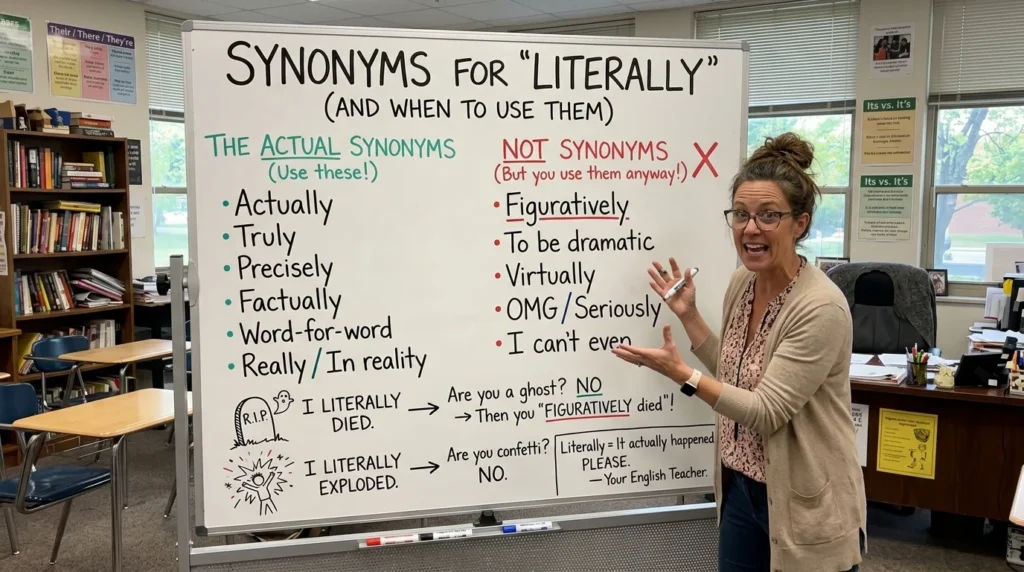

Quick Answer: What Are the Best Synonyms for Literally?
The best synonyms for literally include exactly, actually, truly, precisely, word for word, and in the true sense. Use exactly when emphasizing accuracy, actually when correcting or clarifying information, and word for word when referring to an exact quotation or reproduction. In informal speech, literally can also serve as an intensifier, but alternatives such as really or seriously may sound more natural.
Quick List of Synonyms for Literally
Here are 35 alternatives to consider, depending on your sentence and intended meaning.
Exactly
Actually
Truly
Precisely
Really
In fact
Genuinely
Strictly speaking
In the true sense
In the exact sense
Word for word
Verbatim
To the letter
Without exaggeration
In reality
For real
Indeed
Explicitly
Directly
Accurately
Faithfully
To be exact
To be precise
In actual fact
Without figurative meaning
In plain terms
In a strict sense
In the most basic sense
As stated
As written
As described
Exactly as stated
Without embellishment
No exaggeration
Seriously
Note: These expressions are related to different meanings of literally. They are not interchangeable in every sentence. For example, verbatim refers to exact wording, while actually often introduces a correction or clarification.
What Does Literally Mean?
Literally is an adverb that commonly means something is true in its exact or ordinary sense, without metaphor, exaggeration, or figurative interpretation.
It can also be used informally to add emphasis, even when the statement is figurative. This second use is common in conversation, although it can create confusion in formal writing.
Consider these examples:
Exact meaning: “The glass literally broke into three pieces.” The glass really broke into three pieces.
Clarification: “I literally have no money left.” The speaker means they have no money, assuming the statement is accurate.
Informal emphasis: “I literally waited forever.” The speaker is exaggerating how long the wait felt.
Exact wording: “She repeated the sentence word for word.” She used the same words as the original.
Understanding which meaning you intend is the first step toward choosing an effective synonym.
20 Detailed Synonyms for Literally
1. Exactly
Meaning: In a completely accurate or precise way.
How it differs: Exactly emphasizes accuracy or a perfect match. It does not always carry the distinction between literal and figurative meaning.
Tone: Neutral and widely appropriate.
Best for: Instructions, measurements, facts, and precise descriptions.
Example: The report contains exactly 20 pages.
Watch out: Use exactly when precision is the point, not simply to add emotional emphasis.
2. Actually
Meaning: In reality or in fact; used to clarify what is true.
How it differs: Actually often corrects a misunderstanding or contrasts reality with an assumption. Literally more often emphasizes exact meaning or truth.
Tone: Conversational to formal.
Best for: Clarifications and corrections.
Example: I actually finished the assignment yesterday.
Watch out: “I actually waited forever” does not necessarily mean the wait lasted forever.
3. Truly
Meaning: Genuinely, sincerely, or in a way that is genuinely true.
How it differs: Truly can express sincerity or authenticity, while literally emphasizes an exact or nonfigurative interpretation.
Tone: Warm, expressive, or formal.
Best for: Personal statements and descriptions of genuine feelings.
Example: She truly appreciated their support.
Watch out: Truly is not a good replacement when you need to emphasize exact wording.
4. Precisely
Meaning: In an exact, accurate, or carefully defined way.
How it differs: Precisely emphasizes technical or verbal accuracy, while literally can emphasize that something is not figurative.
Tone: Formal and analytical.
Best for: Academic writing, instructions, and detailed explanations.
Example: The technician followed the instructions precisely.
Watch out: Use precisely for accuracy rather than as a general emotional intensifier.
5. Really
Meaning: Actually, genuinely, or to a significant degree.
How it differs: Really is flexible and often informal. It can express truth or intensity, but it does not necessarily mean “in the exact, nonfigurative sense.”
Tone: Casual and conversational.
Best for: Everyday speech and informal writing.
Example: I really enjoyed the concert.
Watch out: In formal writing, choose a more specific word if accuracy matters.
6. In Fact
Meaning: Used to introduce information that confirms, clarifies, or corrects a statement.
How it differs: This phrase connects a statement to a fact; it does not necessarily indicate a literal interpretation.
Tone: Neutral to formal.
Best for: Explanations, essays, and corrections.
Example: In fact, the museum opened two hours earlier than expected.
Watch out: In fact generally works at the sentence or clause level, not as a direct replacement in every position.
7. Genuinely
Meaning: In a sincere, authentic, or real way.
How it differs: Genuinely emphasizes authenticity rather than exactness.
Tone: Natural and moderately formal.
Best for: Feelings, intentions, and authentic experiences.
Example: He was genuinely surprised by the announcement.
Watch out: It does not necessarily mean that an event occurred exactly as described.
8. Strictly Speaking
Meaning: When a statement is judged according to its precise definition or technical meaning.
How it differs: This phrase highlights a careful distinction rather than simply emphasizing that something is true.
Tone: Analytical and formal.
Best for: Academic explanations and technical discussions.
Example: Strictly speaking, the two terms do not mean the same thing.
Watch out: It can sound overly technical in casual conversation.
9. In the True Sense
Meaning: According to the genuine or proper meaning of a word or concept.
How it differs: This phrase emphasizes the intended definition, while literally often emphasizes a nonfigurative meaning.
Tone: Formal or reflective.
Best for: Definitions and conceptual discussions.
Example: She is a leader in the true sense of the word.
Watch out: This expression can sound subjective if the meaning of the term is not clearly explained.
10. In the Exact Sense
Meaning: According to a precise interpretation of a word, phrase, or statement.
How it differs: This expression draws attention to exact meaning and is especially useful when contrasting technical and casual uses.
Tone: Formal.
Best for: Language discussions, analysis, and definitions.
Example: In the exact sense of the word, the statement is accurate.
Watch out: It is a phrase rather than a single-word synonym.
11. Word for Word
Meaning: Using precisely the same words as the original.
How it differs: This expression specifically refers to wording, not to whether a general statement is true.
Tone: Neutral.
Best for: Quotations, transcripts, speeches, and reproducing text.
Example: She copied the instructions word for word.
Watch out: Do not use it when you mean that an event actually happened.
12. Verbatim
Meaning: Using exactly the same words as an original source.
How it differs: Verbatim is a concise, often formal term for exact reproduction of spoken or written words.
Tone: Formal and professional.
Best for: Legal documents, interviews, transcripts, and quotations.
Example: The journalist published the interview verbatim.
Watch out: It describes the accuracy of wording, not the literal truth of a claim.
13. To the Letter
Meaning: Following instructions, rules, or requirements exactly.
How it differs: This expression emphasizes strict compliance rather than nonfigurative meaning.
Tone: Neutral to formal.
Best for: Procedures, rules, and instructions.
Example: The team followed the safety guidelines to the letter.
Watch out: It does not mean that a statement should be understood literally.
14. Without Exaggeration
Meaning: Without making something seem greater, more serious, or more extreme than it really is.
How it differs: This phrase explicitly rejects exaggeration, making it useful when a statement might otherwise sound unbelievable.
Tone: Conversational or formal.
Best for: Emphasizing the truth of a surprising claim.
Example: Without exaggeration, we waited for three hours.
Watch out: Use it only when the statement is genuinely not exaggerated.
15. In Reality
Meaning: In the actual situation, rather than in appearance, imagination, or expectation.
How it differs: In reality contrasts facts with perceptions or assumptions. It does not necessarily emphasize exact wording.
Tone: Neutral and explanatory.
Best for: Comparisons between appearances and facts.
Example: The task looked simple, but in reality, it required several days of work.
Watch out: It can sound unnatural when inserted into a sentence that only needs exactly.
16. For Real
Meaning: Genuinely or actually; also used informally to ask whether something is serious or true.
How it differs: For real is casual and conversational, while literally can be appropriate in both formal and informal contexts.
Tone: Informal.
Best for: Casual dialogue and social media.
Example: Are you for real, or are you joking?
Watch out: Avoid it in formal reports and academic writing.
17. Indeed
Meaning: Certainly; used to confirm, emphasize, or strengthen a statement.
How it differs: Indeed often reinforces a point, but it does not necessarily mean “in a literal sense.”
Tone: Formal or polished.
Best for: Essays, professional writing, and emphatic statements.
Example: The results were indeed impressive.
Watch out: It is usually not a direct substitute for literally in a sentence about physical or exact events.
18. Explicitly
Meaning: In a clear, direct, and unambiguous way.
How it differs: Explicitly concerns how clearly something is stated, not whether it is figurative.
Tone: Formal and precise.
Best for: Instructions, agreements, and written communication.
Example: The contract explicitly prohibits sharing confidential information.
Watch out: A statement can be explicit without being literally true.
19. Accurately
Meaning: Correctly and without errors.
How it differs: Accurately emphasizes correctness, while literally can emphasize a word’s exact meaning.
Tone: Neutral to formal.
Best for: Research, reporting, measurement, and description.
Example: The witness accurately described the vehicle.
Watch out: Accurate reporting and literal interpretation are related but different ideas.
20. To Be Precise
Meaning: Used to introduce a more exact or detailed description.
How it differs: This phrase signals clarification or refinement, while literally emphasizes truth or a nonfigurative interpretation.
Tone: Neutral to formal.
Best for: Explanations, presentations, and detailed writing.
Example: The journey took three hours and 20 minutes, to be precise.
Watch out: Use it when adding detail, not when simply emphasizing a feeling.
Synonyms for Literally by Context
The right alternative depends on where and how you are using the word.
In Everyday Conversation
For casual speech, these alternatives often sound natural:
Really: “I really need a break.”
Actually: “I actually met her last week.”
Seriously: “Are you seriously considering moving?”
For real: “Is that for real?”
Truly: “I’m truly happy for you.”
These words can communicate sincerity, surprise, or emphasis without making a sentence sound overly formal.
In Academic and Professional Writing
When accuracy and clarity matter, consider:
Precisely: Useful for exact details.
Exactly: Suitable for measurements and specific facts.
Strictly speaking: Useful when clarifying a definition.
Accurately: Appropriate for facts and descriptions.
Verbatim: Best for exact quotations.
In fact: Useful for confirming or correcting information.
Example: Instead of writing, “The report literally describes the results,” write, “The report accurately describes the results” if your intended meaning is that the description is correct.
In Creative Writing
Writers often need to distinguish a literal event from a figurative expression.
Useful alternatives include:
In the true sense
Without exaggeration
In reality
Exactly as described
Truly
Genuinely
Example: “The forest was literally silent” suggests that there were no sounds, or almost none, depending on context. “The forest was unusually quiet” may be more natural if you mean that the forest had fewer sounds than expected.
In Texting and Social Media
Informal alternatives can make a message sound more natural:
Really
Seriously
Actually
For real
Honestly
Truly
No exaggeration
Example: “I’m literally so excited!” could become “I’m seriously so excited!” if you want to preserve the emotional emphasis.
Remember that honestly emphasizes sincerity, while seriously often emphasizes intensity or disbelief. Neither is an exact synonym in every situation.
Literal Meaning vs. Figurative Meaning
One of the most important distinctions is between a literal statement and a figurative expression.
A literal statement describes something according to its direct meaning. A figurative statement uses language creatively, such as through metaphor, hyperbole, or idiom.
| Expression | Meaning | Better Alternative |
|---|---|---|
| “The bottle literally shattered.” | The bottle actually broke into pieces. | Exactly, actually |
| “I literally ran five miles.” | The speaker ran a real distance of five miles. | Actually, exactly |
| “I literally died laughing.” | An exaggerated way to say something was very funny. | Seriously, really |
| “My inbox is literally exploding.” | Usually a figurative way to describe an overwhelming number of messages. | My inbox is overflowing. |
| “She repeated it literally.” | Depending on context, she used the exact words or followed the direct meaning. | Word for word, verbatim |
| “He took the instruction literally.” | He interpreted the instruction according to its direct meaning. | In its exact sense |
The best replacement depends on the intended meaning. If a statement is figurative, replacing literally with exactly may make the sentence inaccurate rather than clearer.
True Synonyms vs. Related Alternatives
Some alternatives overlap with literally, while others perform a different function.
| Word or Phrase | Relationship to Literally | Can Replace It? | Best Context |
|---|---|---|---|
| Exactly | Emphasizes precision | Sometimes | Facts and measurements |
| Actually | Clarifies what is real | Sometimes | Corrections |
| Truly | Emphasizes genuineness | Sometimes | Feelings and sincerity |
| Precisely | Emphasizes exactness | Sometimes | Formal explanations |
| Really | Emphasizes truth or intensity | Sometimes | Everyday speech |
| In fact | Introduces confirmation or correction | Sometimes | Essays and explanations |
| Verbatim | Means using the same words | In specific contexts | Quotations |
| Accurately | Means correctly | In specific contexts | Reports and descriptions |
| Explicitly | Means clearly and directly | Rarely | Instructions and agreements |
| Seriously | Adds emphasis or conveys earnestness | In informal contexts | Conversation |
| Honestly | Emphasizes sincerity | Rarely | Personal statements |
| Genuinely | Emphasizes authenticity | Sometimes | Emotions and intentions |
A good synonym preserves both the meaning and the grammatical role of the original word.
10 Sentence Transformations Using Synonyms for Literally
Here are examples of how to replace literally with a more precise alternative.
1. Original
I literally forgot everything I studied.
Alternative: I completely forgot what I studied.
Why it works: Completely emphasizes the extent of forgetting without suggesting an impossible or exaggerated meaning.
2. Original
She literally copied the entire paragraph.
Alternative: She copied the entire paragraph exactly.
Why it works: Exactly emphasizes that the copy matches the original.
3. Original
He literally repeated every word.
Alternative: He repeated every word verbatim.
Why it works: Verbatim is concise and specifically means using the same words.
4. Original
I literally cannot believe the news.
Alternative: I genuinely cannot believe the news.
Why it works: Genuinely emphasizes the speaker’s sincere reaction.
5. Original
The temperature literally reached 40 degrees.
Alternative: The temperature actually reached 40 degrees.
Why it works: Actually emphasizes that the measurement is real, perhaps contrary to expectations.
6. Original
She literally followed every instruction.
Alternative: She followed every instruction to the letter.
Why it works: This expression emphasizes strict compliance.
7. Original
I literally waited for hours.
Alternative: I really did wait for hours.
Why it works: Really did emphasizes that the wait happened, provided the statement is accurate.
8. Original
The document literally states that payment is due Friday.
Alternative: The document explicitly states that payment is due Friday.
Why it works: Explicitly emphasizes that the document clearly states the deadline.
9. Original
He literally described the event as it happened.
Alternative: He accurately described the event as it happened.
Why it works: Accurately focuses on the correctness of the description.
10. Original
That was literally the best meal of my life.
Alternative: That was genuinely the best meal of my life.
Why it works: Genuinely preserves the sincere emphasis without implying a strict technical meaning.
Common Mistakes When Using Synonyms for Literally
1. Replacing Literally with Exactly in Every Sentence
Exactly emphasizes precision, while literally can indicate a nonfigurative meaning. The two words overlap but are not identical.
2. Using Actually When You Mean Word for Word
Actually means in reality or in fact. If someone repeats a sentence using the same wording, verbatim or word for word is more accurate.
3. Confusing Truly with Literally
Truly emphasizes sincerity or genuineness. It does not necessarily mean that something happened in its exact, nonfigurative sense.
4. Using Literally to Make Every Statement Sound Stronger
Overusing literally can weaken your writing. Words such as extremely, completely, seriously, or remarkably may communicate the intended emphasis more clearly.
5. Using Verbatim for Events Rather Than Words
Verbatim refers to the exact reproduction of spoken or written language. It is not a general replacement for actually or really.
6. Treating Figurative Language as a Factual Statement
Expressions such as “I literally exploded with excitement” are usually hyperbole. If you want a more accurate description, try “I was incredibly excited.”
7. Using In Fact as a Direct Substitute Everywhere
In fact usually introduces a supporting or correcting statement. Its sentence structure differs from the adverb literally.
8. Using Informal Alternatives in Formal Reports
Words such as for real and seriously can sound too casual in academic or professional writing. Choose actually, precisely, or accurately when those words match your meaning.
When Should You Keep the Word Literally?
Sometimes, literally is the clearest word available. Keep it when you specifically need to distinguish a direct meaning from a figurative one.
For example:
“The sign literally says, ‘Do not enter.’” This emphasizes the exact wording.
“The ice literally melted in the sun.” This describes a real physical event.
“The phrase should not be interpreted literally.” This directly contrasts literal and figurative meaning.
“He interpreted the directions literally.” This means he followed the direct meaning of the instructions rather than an implied or figurative meaning.
In formal writing, use literally carefully. If the sentence already makes the exact meaning clear, the word may be unnecessary.
For example, “The glass broke into three pieces” is often clearer than “The glass literally broke into three pieces.” The best editing choice is not always to find a synonym; sometimes, removing the word improves the sentence.
Tips for Choosing the Right Synonym for Literally
For exact measurements or details: Use exactly or precisely.
For correcting a misunderstanding: Use actually or in fact.
For exact quotations: Use verbatim or word for word.
For genuine feelings: Use truly or genuinely.
For informal emphasis: Use really or seriously.
For correct reporting: Use accurately.
For clear instructions or statements: Use explicitly.
For strict compliance: Use to the letter.
For a nonfigurative meaning: Keep literally when it expresses the distinction most clearly.
Always consider your audience. An alternative that works in a text message may not be suitable for a research paper, business report, or formal essay.
Editor’s Choice: The Best Alternatives to Literally
These five alternatives are especially useful in common writing situations.
1. Exactly
Best for precision, measurements, and details. Use it when something matches a specific fact or description.
2. Actually
Best for clarifying what is true or correcting an assumption. It is especially useful in everyday conversation.
3. Precisely
Best for formal or technical writing where accuracy matters.
4. Verbatim
Best for quotations, transcripts, and reproducing the exact words of a source.
5. Really
Best for casual conversation and informal emphasis. It sounds natural in many everyday sentences, although it is not always as precise as literally.
Editor’s tip: Before replacing literally, decide whether you mean exact wording, factual truth, precise measurement, or emotional emphasis. That distinction will help you choose the most natural alternative.
Frequently Asked Questions
1. What is the closest synonym for literally?
Exactly is one of the closest alternatives when literally means in a precise or nonfigurative sense. Actually may be better when you want to emphasize that something is real, while verbatim is best for exact wording.
2. What is another word for literally in informal writing?
Really, seriously, actually, and for real are common informal alternatives. Choose the word that matches your intention: really emphasizes degree, while actually often emphasizes truth or correction.
3. What is a formal synonym for literally?
Precisely, exactly, and verbatim can work in formal writing, depending on the sentence. Precisely emphasizes accuracy, while verbatim refers specifically to the exact words used.
4. Is literally the same as actually?
No. Literally commonly emphasizes a direct or nonfigurative meaning. Actually usually emphasizes what is true or real, often in contrast with an assumption or expectation.
5. Can truly replace literally?
Sometimes. Truly works when the intended meaning is genuinely or sincerely. However, it is not an exact substitute when literally means that something occurred in its direct, nonfigurative sense.
6. What is a synonym for literally meaning word for word?
Verbatim and word for word are the most accurate choices when you mean that something was repeated or copied using exactly the same words.
7. Should I use literally in formal writing?
Yes, when it communicates a precise distinction between literal and figurative meaning. However, avoid using it merely as an intensifier when a more specific word—or no additional word at all—would make the sentence clearer.
Key Takeaways
Exactly and precisely are useful when emphasizing accuracy.
Actually and in fact help clarify what is true.
Verbatim and word for word refer to exact wording.
Really, seriously, and genuinely can replace literally in some informal or expressive contexts.
The best synonym depends on whether you mean factual truth, exact wording, a nonfigurative meaning, or emotional emphasis.
Suggested Internal Links
Consider linking this article to related vocabulary guides on your website:
Synonyms for Actually
Synonyms for Exactly
Synonyms for Really
Synonyms for Truly
Synonyms for Seriously
Synonyms for Precisely
Synonyms for Genuinely
Synonyms for Obviously