
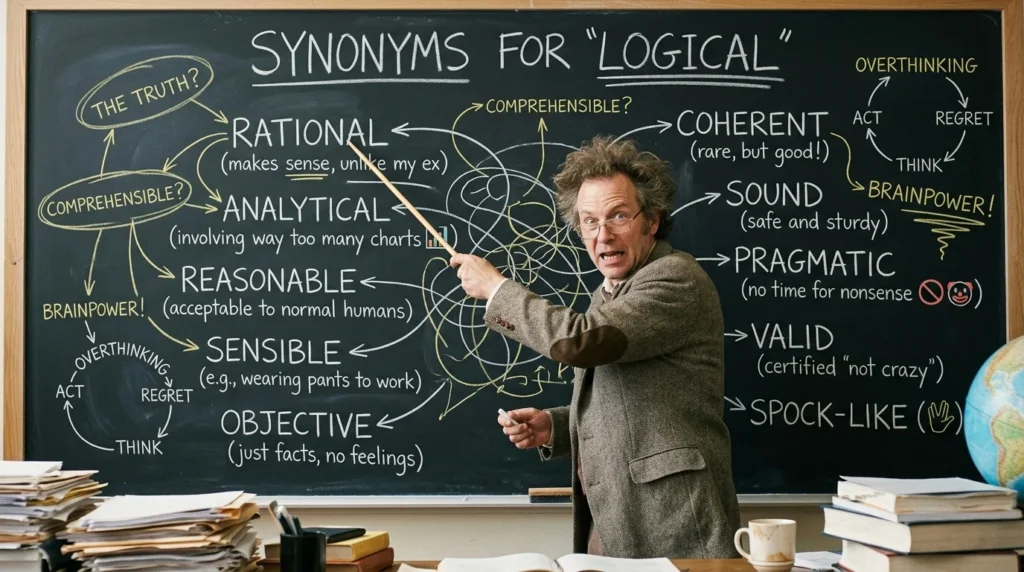

Quick Answer: What Is Another Word for Logical?
The best synonyms for logical include rational, reasonable, sensible, coherent, sound, consistent, analytical, systematic, clear, and well-reasoned. Use rational for decisions based on reason, sensible for practical choices, coherent for clearly connected ideas, and sound for conclusions supported by reliable reasoning.
Quick List of Synonyms for Logical
Here are 35 useful alternatives to logical:
Rational
Reasonable
Sensible
Coherent
Sound
Consistent
Analytical
Systematic
Clear
Well-reasoned
Thoughtful
Practical
Intelligent
Judicious
Wise
Objective
Evidence-based
Justifiable
Defensible
Valid
Plausible
Orderly
Methodical
Structured
Organized
Disciplined
Critical
Reasoned
Calculated
Deductive
Persuasive
Convincing
Principled
Appropriate
Level-headed
These alternatives are not all exact synonyms. Some describe sound reasoning, while others refer to clear communication, practical judgment, or conclusions supported by evidence.
What Does Logical Mean?
Logical means based on reason, sound thinking, or a clear connection between ideas. Something logical follows a recognizable pattern of reasoning instead of relying only on emotion, guesswork, or unsupported assumptions.
The word is often used in three main ways.
1. Based on reason
Example: It was logical to compare the prices before buying a laptop.
Here, “logical” means the decision followed a reasonable thought process.
2. Clear and consistent
Example: Her explanation followed a logical sequence.
In this context, the ideas were organized and connected in a way that made sense.
3. Following the rules of logic
Example: The researcher identified a logical error in the argument.
Here, “logical” refers to the structure and validity of reasoning.
Understanding which meaning you intend will help you select the most accurate replacement.
Best Synonyms for Logical With Meanings and Examples
1. Rational
Meaning: Based on reason, evidence, and careful thought rather than uncontrolled emotion.
How it differs: “Rational” emphasizes the reasoning process behind a belief, decision, or action.
Tone: Neutral to formal.
Best for: Decisions, arguments, evaluations, and academic writing.
Example: She made a rational decision after reviewing all the available options.
Watch out: A decision can be rational based on the information available without necessarily being the best decision.
2. Reasonable
Meaning: Fair, sensible, or supported by acceptable reasons.
How it differs: “Reasonable” often considers what is practical, fair, or acceptable in a particular situation.
Tone: Neutral.
Best for: Everyday communication, workplace discussions, and negotiations.
Example: Asking for an extra day to complete the project was reasonable.
Watch out: A reasonable suggestion is not necessarily the only logical solution.
3. Sensible
Meaning: Showing good judgment and practical thinking.
How it differs: “Sensible” emphasizes practicality and common sense more than formal reasoning.
Tone: Natural and conversational.
Best for: Everyday decisions, advice, and practical recommendations.
Example: Taking an umbrella was a sensible choice because rain was expected.
Watch out: Use “rational” when you want to emphasize reasoning and “sensible” when you want to emphasize practical judgment.
4. Coherent
Meaning: Clear, organized, and logically connected.
How it differs: “Coherent” usually describes explanations, arguments, ideas, or writing that fit together in an understandable way.
Tone: Neutral to formal.
Best for: Essays, speeches, reports, and explanations.
Example: The student presented a coherent argument supported by relevant examples.
Watch out: A coherent argument can still be incorrect if its evidence or reasoning is flawed.
5. Sound
Meaning: Reliable, well-founded, or supported by good reasoning.
How it differs: “Sound” emphasizes the strength or reliability of a judgment, argument, or decision.
Tone: Neutral to formal.
Best for: Business decisions, research, recommendations, and arguments.
Example: The committee reached a sound conclusion after reviewing the evidence.
Watch out: “Sound” often works best with nouns such as reasoning, judgment, argument, and decision.
6. Consistent
Meaning: In agreement with other ideas, facts, principles, or previous statements.
How it differs: “Consistent” emphasizes the absence of contradictions or unexpected changes.
Tone: Neutral.
Best for: Explanations, policies, theories, and arguments.
Example: Her explanation was consistent with the available evidence.
Watch out: Consistency alone does not prove that an idea is true or logical.
7. Analytical
Meaning: Involving careful examination of information, evidence, or problems.
How it differs: “Analytical” describes an approach that breaks a subject into parts to understand it more clearly.
Tone: Professional and academic.
Best for: Research, problem-solving, reports, and critical thinking.
Example: His analytical approach helped the team identify the cause of the problem.
Watch out: Being analytical means examining information carefully; it does not automatically mean that every conclusion is correct.
8. Systematic
Meaning: Following an organized method or planned sequence.
How it differs: “Systematic” emphasizes an orderly process rather than the correctness of a conclusion.
Tone: Neutral to formal.
Best for: Research, troubleshooting, planning, and professional work.
Example: The team used a systematic method to test the new software.
Watch out: A systematic process can still produce a poor result if the method itself is flawed.
9. Well-Reasoned
Meaning: Supported by clear thinking, relevant evidence, and strong explanations.
How it differs: This phrase directly describes reasoning that has been carefully developed and supported.
Tone: Neutral to formal.
Best for: Essays, reports, recommendations, and arguments.
Example: The report offered a well-reasoned explanation for the proposed changes.
Watch out: A well-reasoned claim still needs accurate evidence.
10. Objective
Meaning: Based on facts and evidence rather than personal preferences or bias.
How it differs: “Objective” emphasizes impartiality, while “logical” emphasizes reasoning.
Tone: Formal and professional.
Best for: Research, evaluations, workplace decisions, and reviews.
Example: The manager used objective criteria to compare the candidates.
Watch out: An objective approach can still contain errors if the facts or analysis are inaccurate.
11. Practical
Meaning: Suitable for real situations and likely to work effectively.
How it differs: “Practical” focuses on usefulness and real-world results rather than the reasoning structure alone.
Tone: Neutral.
Best for: Plans, solutions, advice, and everyday decisions.
Example: Choosing a smaller office was a practical solution for the growing expenses.
Watch out: A practical solution may involve compromises rather than being theoretically ideal.
12. Judicious
Meaning: Showing careful judgment when making decisions.
How it differs: “Judicious” emphasizes wisdom, balance, and thoughtful evaluation.
Tone: Formal.
Best for: Professional recommendations, leadership, and decision-making.
Example: The director took a judicious approach to allocating the budget.
Watch out: This word can sound formal in casual conversation. “Sensible” is often simpler.
13. Valid
Meaning: Well-founded or logically acceptable according to relevant rules or evidence.
How it differs: In formal logic, a valid argument is one in which the conclusion follows from the premises. In everyday language, “valid” can also mean legitimate or acceptable.
Tone: Neutral to formal.
Best for: Logic, mathematics, academic arguments, and evidence-based discussions.
Example: The conclusion follows from a valid argument.
Watch out: A logically valid argument does not guarantee a true conclusion if its premises are false.
14. Plausible
Meaning: Seeming reasonable or likely to be true.
How it differs: “Plausible” means an explanation appears believable, but it may not have been proven.
Tone: Neutral.
Best for: Hypotheses, explanations, theories, and possibilities.
Example: The researcher proposed a plausible explanation for the unexpected results.
Watch out: Something plausible is not necessarily correct.
15. Justifiable
Meaning: Able to be supported or defended with appropriate reasons.
How it differs: “Justifiable” emphasizes whether a decision or action can be defended.
Tone: Neutral to formal.
Best for: Decisions, policies, actions, and recommendations.
Example: The additional expense was justifiable because it improved safety.
Watch out: A justifiable decision may still have disadvantages.
16. Defensible
Meaning: Capable of being supported with reasons or evidence when challenged.
How it differs: “Defensible” emphasizes the ability to stand up to criticism or questioning.
Tone: Formal.
Best for: Arguments, conclusions, professional decisions, and academic writing.
Example: The lawyer presented a defensible interpretation of the contract.
Watch out: A defensible position is not necessarily the strongest possible position.
17. Methodical
Meaning: Done in a careful, organized, and step-by-step manner.
How it differs: “Methodical” describes how someone approaches a task, while “logical” can describe either a process or the reasoning behind an idea.
Tone: Neutral to formal.
Best for: Research, planning, investigations, and problem-solving.
Example: She took a methodical approach to checking the calculations.
Watch out: Methodical work is orderly, but its outcome still depends on the quality of the method.
18. Level-Headed
Meaning: Calm and sensible, especially under pressure.
How it differs: “Level-headed” emphasizes emotional control and sound judgment in difficult situations.
Tone: Conversational.
Best for: Personal decisions, leadership, and conflict resolution.
Example: He remained level-headed during the unexpected crisis.
Watch out: Use “rational” when you want to emphasize reasoning rather than calmness.
19. Deductive
Meaning: Involving reasoning from general principles to a specific conclusion.
How it differs: “Deductive” refers to a particular type of reasoning, not a general replacement for “logical.”
Tone: Academic and technical.
Best for: Philosophy, mathematics, science, and formal logic.
Example: The detective used deductive reasoning to narrow down the possibilities.
Watch out: Deduction is one form of reasoning. Not every logical process is deductive.
20. Persuasive
Meaning: Able to convince someone through reasons, evidence, or effective communication.
How it differs: “Persuasive” describes the ability to influence an audience, while “logical” describes the quality of reasoning.
Tone: Neutral.
Best for: Presentations, essays, proposals, and debates.
Example: She made a persuasive case for changing the policy.
Watch out: A persuasive argument is not necessarily logically sound; people can be convinced by weak reasoning.
Synonyms for Logical by Context
The best alternative depends on what you are describing.
For Logical Thinking
When describing a person’s thought process, consider:
Rational
Analytical
Reasoned
Critical
Systematic
Methodical
Objective
Deductive
Example: Her analytical thinking helped her identify the problem quickly.
Use rational when emphasizing reason, analytical when emphasizing careful examination, and systematic when emphasizing an organized method.
For a Logical Person
When describing someone who tends to think clearly and make sensible decisions, use:
Rational
Reasonable
Sensible
Level-headed
Analytical
Methodical
Clear-thinking
Practical
Example: He is a level-headed person who stays calm when making difficult decisions.
“Logical person” is a broad description. “Analytical person” suggests close examination, while “level-headed person” highlights calm judgment.
For a Logical Argument
When describing an argument that makes sense and follows a clear line of reasoning, consider:
Coherent
Sound
Well-reasoned
Valid
Consistent
Defensible
Persuasive
Reasoned
Example: The author presented a coherent argument supported by reliable evidence.
Use valid when the structure of the reasoning follows the relevant logical rules. Use sound when the argument is valid and its premises are true, in the technical sense of logic.
For a Logical Decision
When describing a decision that makes sense based on available information, use:
Rational
Reasonable
Sensible
Practical
Judicious
Justifiable
Well-considered
Informed
Example: Moving the meeting online was a practical decision that saved everyone time.
“Practical” highlights usefulness, “rational” highlights reason, and “judicious” highlights careful judgment.
For a Logical Explanation
When describing an explanation that is easy to follow, consider:
Clear
Coherent
Consistent
Well-reasoned
Structured
Understandable
Persuasive
Evidence-based
Example: The teacher gave a clear explanation of the mathematical problem.
Use “coherent” when the ideas connect logically and “clear” when the main concern is how easily the audience understands the explanation.
For Logical Writing
When describing writing that is organized and easy to follow, consider:
Coherent
Clear
Structured
Organized
Consistent
Well-reasoned
Systematic
Well-organized
Example: The essay followed a coherent structure, moving from the problem to possible solutions.
For writing, coherent and clear are often more precise than logical, depending on the sentence.
Synonyms for Logical in Academic and Professional Writing
Academic and professional writing benefits from precise vocabulary. Choose an alternative that explains exactly what makes the reasoning effective.
| Situation | Recommended Word | Example |
|---|---|---|
| A decision based on reason | Rational | The team made a rational choice. |
| An argument with clear connections | Coherent | The paper presents a coherent argument. |
| Reasoning supported by evidence | Well-reasoned | The report offers a well-reasoned recommendation. |
| A conclusion supported by reliable premises | Sound | The researchers reached a sound conclusion. |
| A process that follows clear steps | Systematic | The study used a systematic approach. |
| An impartial evaluation | Objective | The review used objective criteria. |
| A defensible action | Justifiable | The expense was justifiable under the circumstances. |
| Careful decision-making | Judicious | The board took a judicious approach. |
Avoid choosing formal words simply to make your writing sound sophisticated. Precision and clarity matter more than complexity.
True Synonyms vs. Related Alternatives
Some words overlap with “logical” without having the same meaning.
| Alternative | Relationship | Can Replace “Logical”? | Tone | Best Context |
|---|---|---|---|---|
| Rational | Based on reason | Often | Neutral/formal | Thinking and decisions |
| Reasonable | Fair or sensible | Often | Neutral | Everyday judgments |
| Sensible | Shows practical judgment | Often | Conversational | Advice and choices |
| Coherent | Ideas connect clearly | Sometimes | Neutral/formal | Writing and arguments |
| Sound | Well-founded | Often | Neutral/formal | Reasoning and conclusions |
| Consistent | Free from contradictions | Sometimes | Neutral | Explanations and theories |
| Analytical | Involves careful examination | Sometimes | Academic | Thinking and problem-solving |
| Systematic | Follows an organized method | Sometimes | Formal | Processes and research |
| Objective | Minimizes personal bias | Sometimes | Formal | Evaluation and analysis |
| Valid | Meets relevant logical requirements | In specific contexts | Technical | Formal logic |
| Plausible | Seems believable | Sometimes | Neutral | Explanations and hypotheses |
| Persuasive | Likely to convince | Rarely | Neutral | Arguments and presentations |
| Practical | Useful in real situations | Sometimes | Neutral | Solutions and decisions |
| Judicious | Shows careful judgment | Sometimes | Formal | Decisions and recommendations |
| Level-headed | Calm under pressure | In some contexts | Conversational | People and behavior |
A word can be related to logical thinking without being a direct substitute. For example, “persuasive” refers to convincing an audience, not necessarily to correct reasoning.
Logical vs. Rational vs. Reasonable vs. Sensible
These four words are common alternatives, but their meanings differ.
| Word | Main Meaning | Tone | Best Use | Interchangeable? |
|---|---|---|---|---|
| Logical | Follows clear reasoning | Neutral | Arguments and processes | Broad term |
| Rational | Based on reason | Neutral/formal | Decisions and beliefs | Often |
| Reasonable | Fair or supported by acceptable reasons | Neutral | Requests and judgments | Sometimes |
| Sensible | Practical and showing good judgment | Conversational | Choices and advice | Sometimes |
Logical: The conclusion follows from the evidence.
Rational: She considered the available facts before deciding.
Reasonable: The deadline extension was reasonable.
Sensible: Wearing comfortable shoes was a sensible choice.
These words overlap, but the best choice depends on the point you want to emphasize.
Sentence Transformations: Replace Logical Naturally
1. A Logical Decision
Original: It was a logical decision to reduce unnecessary expenses.
Better alternative: It was a rational decision to reduce unnecessary expenses.
Why: “Rational” emphasizes the use of reason when making the decision.
2. A Logical Argument
Original: The student presented a logical argument.
Better alternative: The student presented a coherent argument.
Why: “Coherent” highlights the clear connection between the argument’s ideas.
3. A Logical Explanation
Original: The manager gave a logical explanation for the delay.
Better alternative: The manager gave a reasonable explanation for the delay.
Why: “Reasonable” emphasizes that the explanation makes sense under the circumstances.
4. A Logical Solution
Original: We need a logical solution to this problem.
Better alternative: We need a practical solution to this problem.
Why: “Practical” emphasizes whether the solution will work in real life.
5. Logical Thinking
Original: Logical thinking helps students solve difficult problems.
Better alternative: Analytical thinking helps students solve difficult problems.
Why: “Analytical” emphasizes examining information carefully to understand a problem.
6. A Logical Conclusion
Original: The researchers reached a logical conclusion.
Better alternative: The researchers reached a well-supported conclusion.
Why: “Well-supported” makes the role of evidence explicit.
7. A Logical Process
Original: The team followed a logical process to investigate the issue.
Better alternative: The team followed a systematic process to investigate the issue.
Why: “Systematic” emphasizes an organized, step-by-step method.
8. A Logical Person
Original: She is a logical person who considers the facts.
Better alternative: She is a rational person who considers the facts.
Why: “Rational” focuses on reason-based thinking.
9. A Logical Recommendation
Original: The consultant made a logical recommendation.
Better alternative: The consultant made a well-reasoned recommendation.
Why: The revised version emphasizes the quality of the reasoning behind the advice.
10. A Logical Choice
Original: Taking the earlier train was a logical choice.
Better alternative: Taking the earlier train was a sensible choice.
Why: “Sensible” sounds natural when describing a practical everyday decision.
Common Mistakes When Using Synonyms for Logical
1. Assuming Rational and Logical Mean Exactly the Same Thing
“Logical” focuses on the structure of reasoning, while “rational” often emphasizes reason-based thinking and decision-making.
Better: Use the word that reflects whether you mean a sound argument or a reason-based decision.
2. Using Coherent to Mean Correct
A coherent explanation is understandable and well-connected, but it may still be factually wrong.
Better: Use “accurate” for factual correctness and “sound” when evaluating reasoning and supporting premises.
3. Confusing Plausible With Proven
A plausible explanation seems believable, but it has not necessarily been confirmed.
Better: Use “well-supported” or “verified” when evidence provides stronger confirmation.
4. Treating Objective as a Synonym for Logical
An objective approach attempts to reduce bias. A logical approach emphasizes reasoning. They are related, but not identical.
Better: Use “objective” when discussing impartial evaluation and “logical” when discussing reasoning.
5. Using Persuasive to Mean Logically Correct
A persuasive statement may convince people without being logically sound.
Better: Use “well-reasoned” or “valid” when evaluating reasoning rather than its ability to influence an audience.
6. Using Systematic to Describe a Correct Conclusion
A systematic method is organized, but the method can still contain errors.
Better: Use “sound” or “well-supported” when you mean that a conclusion is reliable.
7. Choosing Complicated Words Unnecessarily
Words such as “deductive” and “judicious” are useful in specific situations but may sound unnatural in simple sentences.
Better: Use “rational,” “sensible,” or “reasonable” when those words express the intended meaning clearly.
8. Repeating Logical Too Often
Repeated use of “logical” can make writing sound limited.
Better: Vary your wording naturally with alternatives such as “rational,” “coherent,” “sound,” and “well-reasoned,” but only when their meanings fit.
When You Should Not Replace Logical
Sometimes “logical” is the most accurate word available. Keep it when:
You are describing a conclusion that follows from earlier statements.
You are discussing formal logic or logical fallacies.
You mean a clear sequence of reasoning rather than practical usefulness.
The word is already clear and does not appear too often.
Other alternatives would change the meaning.
For example:
“The conclusion follows logically from the premises.”
Replacing “logically” with “sensibly” would change the meaning. The original sentence describes a relationship between premises and a conclusion, not simply a practical or sensible choice.
Likewise, “logical fallacy” is an established term. Replacing it with “rational mistake” would not convey the same precise meaning.
Tips for Improving Your Word Choice
Identify the exact meaning: Decide whether you mean reason, practicality, clarity, consistency, or evidence.
Match the noun: A “coherent argument,” “rational decision,” and “systematic process” are natural combinations.
Consider your audience: Use everyday words such as “sensible” for general readers and technical terms when appropriate.
Check the evidence: Do not call a conclusion sound merely because it seems convincing.
Avoid forced synonyms: Repeating “logical” is better than choosing an inaccurate replacement.
Prefer precision over complexity: A simple, accurate word is usually stronger than an unnecessarily formal one.
Read the sentence aloud: Choose the alternative that communicates your intended meaning naturally.
Editor’s Choice: The Best Alternatives to Logical
These five alternatives are useful starting points for common writing situations:
Rational — Best for decisions and thinking based on reason.
Reasonable — Best for judgments, requests, and explanations that make sense.
Coherent — Best for arguments, essays, and explanations with connected ideas.
Sound — Best for reasoning, conclusions, and judgments supported by strong foundations.
Sensible — Best for practical choices and everyday advice.
These are editorial recommendations based on common usage, not an objective ranking. The best choice depends on your sentence and intended meaning.
Frequently Asked Questions
What is the best synonym for logical?
“Rational” is one of the best general alternatives for logical, especially when describing decisions or thinking. “Coherent” works well for arguments and explanations, while “sensible” is useful for practical choices.
What is a formal word for logical?
“Rational,” “coherent,” “systematic,” “well-reasoned,” and “analytical” are useful formal alternatives. Choose “coherent” for connected ideas and “systematic” for an organized process.
What is another word for a logical person?
You can describe a logical person as rational, reasonable, analytical, clear-thinking, sensible, or level-headed. Use “analytical” when the person examines details carefully and “level-headed” when emphasizing calm judgment.
What is a synonym for logical thinking?
Useful alternatives include rational thinking, analytical thinking, critical thinking, systematic reasoning, and clear reasoning. Each phrase emphasizes a different aspect of the thinking process.
What is the opposite of logical?
Depending on the context, antonyms include illogical, irrational, unreasonable, inconsistent, incoherent, and nonsensical. “Illogical” is the most direct opposite when an idea does not follow sound reasoning.
Can reasonable and logical be used interchangeably?
Sometimes. Both can describe something that makes sense, but “reasonable” often emphasizes fairness or acceptability, while “logical” focuses on the connection between ideas and the quality of reasoning.
What is another word for a logical argument?
“Coherent argument,” “sound argument,” and “well-reasoned argument” are useful alternatives. “Valid argument” has a more specific meaning in formal logic, where the conclusion follows from the premises.
Key Takeaways
“Rational” is a strong general alternative when describing reason-based thinking and decisions.
“Coherent” is especially useful for arguments, explanations, and writing.
“Sensible” emphasizes practical judgment, while “reasonable” often emphasizes fairness or acceptability.
“Sound” and “well-reasoned” are useful when evaluating arguments and conclusions.
Choose synonyms according to meaning and context instead of changing words merely for variety.
Suggested Internal Links
| Anchor Text | Suggested Topic | Why It Fits |
|---|---|---|
| Synonyms for Rational | Alternatives to rational | Explores reason-based vocabulary |
| Synonyms for Reasonable | Words for reasonable decisions | Covers everyday judgments and explanations |
| Synonyms for Sensible | Alternatives to sensible | Supports practical decision-making vocabulary |
| Synonyms for Coherent | Words for clear and connected ideas | Connects to writing and argument structure |
| Synonyms for Analytical | Alternatives for analytical thinking | Expands critical-thinking vocabulary |
| Synonyms for Explain | Better words for explaining ideas | Helps readers improve clarity |
| Synonyms for Understand | Alternatives to understand | Supports communication and comprehension |
| Synonyms for Important | Better words for important | Broadens general writing vocabulary |