

Quick Answer: What Are the Best Synonyms for Mundane?
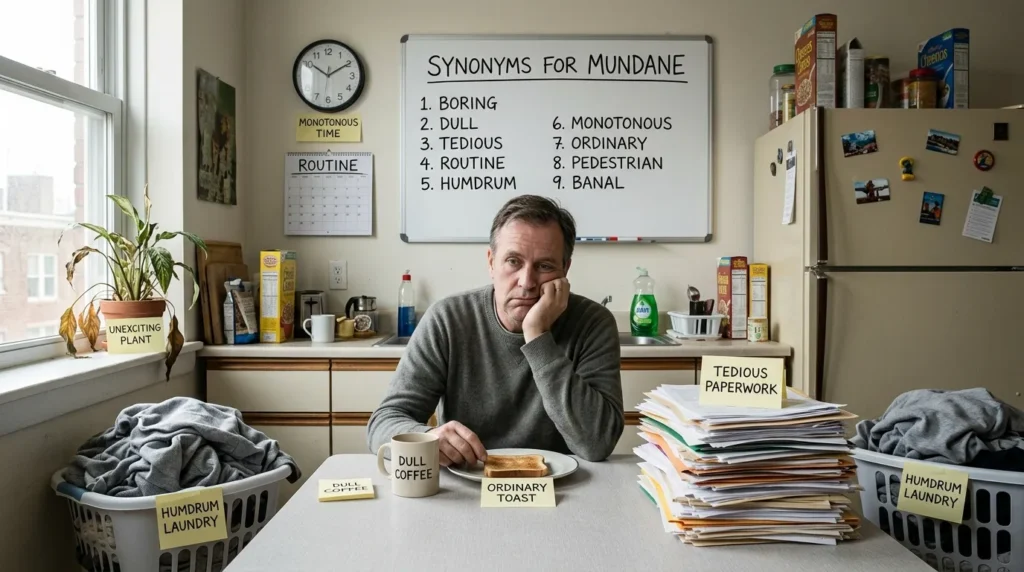
The best synonyms for “mundane” include ordinary, everyday, commonplace, routine, regular, conventional, monotonous, tedious, humdrum, and unremarkable. Use ordinary for something typical, routine for a regularly performed activity, monotonous for repetitive experiences, and humdrum for something dull or lacking excitement.
Quick Synonym List for Mundane
Here are useful alternatives for different contexts:
Ordinary
Everyday
Commonplace
Routine
Regular
Conventional
Typical
Normal
Familiar
Unremarkable
Average
Standard
Usual
Common
Prosaic
Humdrum
Monotonous
Tedious
Dull
Boring
Unexciting
Repetitive
Predictable
Recurrent
Habitual
Day-to-day
Workaday
Run-of-the-mill
Unexceptional
Unspectacular
Plain
Basic
Unadorned
Matter-of-fact
Practical
Down-to-earth
Earthly
Worldly
Trivial
Insignificant
Inconsequential
Routine-based
Repetitious
Lackluster
Uneventful
Drab
Colorless
Uninspiring
Prosaically ordinary
Everyday and familiar
Important: These words are not all interchangeable. “Mundane” can mean ordinary or related to everyday life, while “tedious” and “monotonous” specifically suggest boredom. “Trivial” refers to a lack of importance, and “worldly” can mean practical or concerned with ordinary material life.
What Does Mundane Mean?
“Mundane” is an adjective that describes something ordinary, familiar, or related to everyday life rather than something unusual, exciting, or extraordinary.
It commonly appears in three contexts:
1. Ordinary daily activities: Tasks that are part of everyday life.
Example: She finished her mundane household chores before going out.
2. Boring or repetitive experiences: Activities that lack variety or excitement.
Example: He wanted to escape the mundane routine of his office job.
3. Ordinary or non-spiritual matters: In some contexts, “mundane” contrasts with spiritual, extraordinary, or supernatural experiences.
Example: The story moves from a mundane world into a realm of magic.
The intended meaning matters because a mundane task is not necessarily unimportant or unpleasant. It may simply be ordinary. If you want to emphasize boredom, words such as “tedious,” “monotonous,” or “humdrum” may be more accurate.
20 Detailed Synonyms for Mundane
1. Ordinary
Meaning: Normal, familiar, or not unusual.
How it differs: “Ordinary” is one of the closest general alternatives to “mundane.” It does not necessarily suggest boredom.
Tone: Neutral and versatile.
Best for: Daily experiences, common objects, and typical situations.
Example: It was an ordinary Tuesday with no unexpected events.
Watch out: Something ordinary can still be enjoyable, meaningful, or important.
2. Everyday
Meaning: Connected with normal daily life or commonly used experiences.
How it differs: “Everyday” emphasizes regular life and familiar activities rather than a lack of excitement.
Tone: Neutral and accessible.
Best for: Habits, objects, problems, responsibilities, and experiences.
Example: Good communication helps solve many everyday problems.
Watch out: “Everyday” is an adjective, as in “everyday tasks.” “Every day” is a phrase meaning each day.
3. Commonplace
Meaning: Ordinary, familiar, or frequently encountered.
How it differs: “Commonplace” emphasizes that something is common or not unusual.
Tone: Neutral to formal.
Best for: Ideas, experiences, events, and observations.
Example: Smartphones have become commonplace in modern life.
Watch out: It does not necessarily mean boring; it may simply mean widely familiar.
4. Routine
Meaning: Part of a regular, established pattern of activity.
How it differs: “Routine” focuses on repeated habits or procedures rather than general ordinariness.
Tone: Neutral and practical.
Best for: Work, chores, schedules, and daily responsibilities.
Example: She completed her routine administrative tasks before lunch.
Watch out: A routine can be comforting and efficient, not necessarily dull.
5. Monotonous
Meaning: Repetitive and lacking variety.
How it differs: “Monotonous” strongly emphasizes repetition that makes an experience boring or tiring.
Tone: Negative and descriptive.
Best for: Work, sounds, activities, and long processes.
Example: The monotonous task made it difficult to stay focused.
Watch out: Use this word when repetition is a central part of the problem.
6. Tedious
Meaning: Long, repetitive, or tiring in a way that causes boredom.
How it differs: “Tedious” emphasizes how tiresome an activity feels, often because it requires too much time or attention.
Tone: Negative and direct.
Best for: Paperwork, lengthy tasks, procedures, and explanations.
Example: Entering hundreds of records manually was tedious.
Watch out: A task can be tedious because it is lengthy even if it is not repeated in exactly the same way.
7. Humdrum
Meaning: Lacking excitement, variety, or interest.
How it differs: “Humdrum” describes a dull, uneventful quality and often suggests dissatisfaction with an ordinary routine.
Tone: Informal to literary.
Best for: Daily life, jobs, schedules, and familiar routines.
Example: He dreamed of escaping his humdrum existence and traveling abroad.
Watch out: It has a stronger sense of dullness than “ordinary.”
8. Conventional
Meaning: Following accepted customs, standards, or traditional practices.
How it differs: “Conventional” emphasizes conformity to established expectations rather than repetition or boredom.
Tone: Neutral to formal.
Best for: Ideas, behavior, designs, lifestyles, and methods.
Example: She chose a conventional approach to solving the problem.
Watch out: Conventional can describe something respectable or traditional, not necessarily mundane.
9. Typical
Meaning: Showing the usual features of a person, thing, or situation.
How it differs: “Typical” emphasizes what is expected or representative of a particular group or situation.
Tone: Neutral.
Best for: Behavior, examples, experiences, and patterns.
Example: It was a typical morning filled with emails and meetings.
Watch out: Something typical may be interesting; the word does not automatically imply dullness.
10. Unremarkable
Meaning: Not unusual, impressive, or worthy of special attention.
How it differs: “Unremarkable” emphasizes the absence of distinctive or notable qualities.
Tone: Neutral to mildly negative.
Best for: Events, performances, experiences, and results.
Example: The trip was pleasant but otherwise unremarkable.
Watch out: It can sound dismissive when describing a person’s achievements or efforts.
11. Prosaic
Meaning: Ordinary, unimaginative, or lacking a poetic or exciting quality.
How it differs: “Prosaic” often suggests that something lacks creativity, romance, or inspiration.
Tone: Formal and literary.
Best for: Writing, descriptions, lifestyles, and experiences.
Example: The film transformed a prosaic setting into something beautiful.
Watch out: In literary contexts, “prosaic” can specifically mean resembling ordinary prose rather than poetry.
12. Workaday
Meaning: Ordinary and associated with regular work or daily life.
How it differs: “Workaday” specifically evokes the practical, routine side of everyday existence.
Tone: Literary and descriptive.
Best for: Jobs, responsibilities, routines, and ordinary settings.
Example: The artist found beauty in the workaday details of city life.
Watch out: It is less common in casual conversation than “everyday.”
13. Run-of-the-Mill
Meaning: Average, ordinary, or not particularly special.
How it differs: This informal expression often suggests that something is merely average or unexceptional.
Tone: Conversational.
Best for: Products, performances, events, and experiences.
Example: The restaurant served a run-of-the-mill meal.
Watch out: It often carries a mildly negative judgment that something is not impressive.
14. Unexciting
Meaning: Not creating much interest, enthusiasm, or anticipation.
How it differs: “Unexciting” directly describes the lack of excitement rather than ordinary status alone.
Tone: Neutral to negative.
Best for: Activities, events, stories, and experiences.
Example: The first part of the presentation was informative but unexciting.
Watch out: Something can be unexciting but still useful, valuable, or necessary.
15. Dull
Meaning: Lacking interest, energy, brightness, or liveliness.
How it differs: “Dull” can describe boredom, low energy, muted colors, or a lack of sharpness.
Tone: Direct and often negative.
Best for: Conversations, events, weather, colors, and activities.
Example: The meeting became dull after the same points were repeated.
Watch out: Because it has several meanings, make sure the sentence makes the intended sense clear.
16. Boring
Meaning: Not interesting or enjoyable.
How it differs: “Boring” directly describes the experience of causing boredom.
Tone: Informal and clear.
Best for: Movies, classes, tasks, conversations, and events.
Example: The lecture felt boring because it lacked examples.
Watch out: “Boring” is more openly negative than “mundane,” which can simply mean ordinary.
17. Repetitive
Meaning: Involving the same actions, details, or ideas repeatedly.
How it differs: “Repetitive” focuses on repetition rather than ordinary life in general.
Tone: Neutral to negative.
Best for: Work, instructions, writing, exercises, and procedures.
Example: The repetitive nature of the task made automation useful.
Watch out: Repetition can be helpful in learning or practice, so it is not always negative.
18. Predictable
Meaning: Easy to anticipate because something follows a familiar pattern.
How it differs: “Predictable” emphasizes the lack of surprise rather than the lack of importance or excitement.
Tone: Neutral to negative.
Best for: Stories, behavior, outcomes, and routines.
Example: The plot was predictable, with few unexpected developments.
Watch out: Predictability can be positive when consistency and reliability are desirable.
19. Uneventful
Meaning: Happening without significant or unusual events.
How it differs: “Uneventful” focuses on the absence of notable developments during a period.
Tone: Neutral.
Best for: Days, journeys, meetings, and experiences.
Example: The flight was long but uneventful.
Watch out: An uneventful experience is not necessarily boring; it may be peaceful or safe.
20. Lackluster
Meaning: Lacking energy, enthusiasm, brilliance, or impressive qualities.
How it differs: “Lackluster” often describes disappointing performance or weak results rather than simple everyday routine.
Tone: Negative and evaluative.
Best for: Performances, presentations, sales, and efforts.
Example: The team delivered a lackluster performance in the final match.
Watch out: Use it when something falls short of expectations, not merely because it is ordinary.
Synonyms for Mundane by Context
The best alternative depends on whether you mean ordinary, repetitive, boring, or connected with everyday life.
Synonyms for Mundane Daily Tasks
When describing ordinary activities or responsibilities, choose words that emphasize routine and familiarity.
Useful alternatives:
Everyday
Routine
Ordinary
Day-to-day
Workaday
Usual
Regular
Habitual
Commonplace
Examples:
She organized her everyday responsibilities before starting a new project.
He wanted to make his routine tasks more enjoyable.
The writer found inspiration in workaday experiences.
“Routine” is best for repeated activities, while “everyday” is useful for things associated with normal daily life.
Synonyms for Mundane and Boring
If you want to emphasize a lack of excitement, these words may be more precise.
Useful alternatives:
Tedious
Monotonous
Humdrum
Dull
Boring
Unexciting
Tiresome
Repetitive
Drab
Uninspiring
Examples:
The repetitive work became monotonous.
The lengthy instructions were tedious.
He wanted a break from his humdrum routine.
Use “tedious” when something feels tiring, “monotonous” when repetition is the main problem, and “uninspiring” when something fails to create interest or motivation.
Synonyms for Mundane in Formal Writing
Formal and academic writing often benefits from neutral, precise vocabulary.
Useful alternatives:
Ordinary
Commonplace
Conventional
Unremarkable
Routine
Typical
Prosaic
Standard
Conventional
Day-to-day
Examples:
The research examined commonplace social behaviors.
The study focused on ordinary experiences.
The report documented routine administrative procedures.
Avoid replacing every instance of “mundane” with a more elaborate word. The best choice is the one that accurately reflects your meaning.
Synonyms for Mundane in Creative Writing
Creative writing may require more vivid language to portray dullness, routine, or ordinary life.
Useful alternatives:
Humdrum
Prosaic
Drab
Colorless
Uneventful
Uninspiring
Run-of-the-mill
Workaday
Monotonous
Predictable
Examples:
She longed to escape her colorless routine.
The character felt trapped in a humdrum existence.
Beneath the town’s prosaic appearance, a mystery was unfolding.
“Colorless” is figurative in this context, while “prosaic” can suggest a lack of imagination or romance.
Synonyms for Mundane in Professional Settings
At work, “mundane” often describes regular tasks that are necessary but not especially challenging or exciting.
Useful alternatives:
Routine
Repetitive
Standard
Day-to-day
Administrative
Ordinary
Procedural
Time-consuming
Tedious
Examples:
Automation can reduce repetitive administrative work.
The team completed its routine procedures.
The new software simplified several time-consuming tasks.
“Administrative” describes the type of work, while “tedious” describes how the work feels. They are not direct synonyms in every sentence.
Synonyms for Mundane in Philosophical or Spiritual Contexts
In philosophical or spiritual writing, “mundane” can refer to ordinary material existence, especially when contrasted with the sacred, spiritual, or extraordinary.
Related alternatives include:
Earthly
Worldly
Temporal
Material
Ordinary
Everyday
Secular (in certain contexts)
Examples:
The character struggled to balance worldly concerns with spiritual aspirations.
The story contrasts ordinary life with extraordinary experiences.
The philosopher questioned whether material success could provide lasting fulfillment.
These terms have distinct meanings. “Secular” generally refers to what is not religious or governed by religious institutions, while “temporal” can refer to time or worldly affairs. Neither is a universal substitute for “mundane.”
True Synonyms vs. Related Alternatives
Some words can replace “mundane” directly, while others express a more specific quality.
| Alternative | Main meaning | Best use | Interchangeable? |
|---|---|---|---|
| Ordinary | Not unusual | Everyday situations | Often |
| Everyday | Connected with daily life | Activities and objects | Often |
| Commonplace | Common or familiar | Ideas and experiences | Often |
| Routine | Regularly repeated | Tasks and schedules | Sometimes |
| Monotonous | Repetitive and boring | Work and activities | When repetition matters |
| Tedious | Tiresome or boring | Long tasks and procedures | When boredom matters |
| Prosaic | Ordinary or unimaginative | Creative and formal writing | Sometimes |
| Humdrum | Dull and uneventful | Lifestyle and routine | When dullness matters |
| Trivial | Of little importance | Issues and details | Not always |
| Unremarkable | Not noteworthy | Events and results | Often |
| Predictable | Easy to anticipate | Stories and outcomes | Sometimes |
| Conventional | Following established norms | Ideas and methods | Context-dependent |
| Earthly | Related to the physical world | Spiritual or philosophical contexts | Context-dependent |
| Uneventful | Without notable developments | Days and journeys | Sometimes |
| Lackluster | Lacking energy or impact | Performance and results | When disappointment matters |
Mundane vs. Ordinary vs. Monotonous vs. Tedious
These four words are related, but each emphasizes something different.
| Word | Meaning | Best use | Example |
|---|---|---|---|
| Mundane | Ordinary or connected with daily life | Everyday tasks and familiar experiences | He handled mundane paperwork. |
| Ordinary | Not unusual or special | Typical situations | It was an ordinary afternoon. |
| Monotonous | Repetitive and lacking variety | Repeated activities | The monotonous routine exhausted her. |
| Tedious | Tiresome or boring | Long or demanding tasks | Completing the forms was tedious. |
Use “mundane” for ordinary daily matters, “ordinary” for things that are not unusual, “monotonous” for repetition, and “tedious” when a task feels tiresome.
10 Sentence Transformations Using Synonyms for Mundane
These examples show how to replace “mundane” with a more precise alternative.
1. Daily Responsibilities
Original: She spent the morning completing mundane tasks.
Alternative: She spent the morning completing routine tasks.
Why it works: “Routine” emphasizes that the tasks are part of a regular pattern.
2. Ordinary Experiences
Original: The book finds beauty in mundane moments.
Alternative: The book finds beauty in everyday moments.
Why it works: “Everyday” emphasizes familiar experiences without suggesting they are boring.
3. Repetitive Work
Original: The job involved many mundane activities.
Alternative: The job involved many repetitive activities.
Why it works: “Repetitive” is more precise if the activities repeatedly involve the same actions.
4. Boring Instructions
Original: The mundane instructions made the training session less engaging.
Alternative: The tedious instructions made the training session less engaging.
Why it works: “Tedious” highlights the tiring or boring nature of the instructions.
5. An Ordinary Day
Original: It was a mundane day at the office.
Alternative: It was an uneventful day at the office.
Why it works: “Uneventful” emphasizes that nothing notable happened.
6. A Dull Lifestyle
Original: He wanted to escape his mundane lifestyle.
Alternative: He wanted to escape his humdrum lifestyle.
Why it works: “Humdrum” adds a stronger sense of dullness and dissatisfaction.
7. Common Experiences
Original: The film transforms mundane experiences into meaningful stories.
Alternative: The film transforms commonplace experiences into meaningful stories.
Why it works: “Commonplace” emphasizes how familiar or ordinary the experiences are.
8. Uninspiring Work
Original: She was tired of the mundane nature of the project.
Alternative: She was tired of the uninspiring nature of the project.
Why it works: “Uninspiring” suggests that the project failed to motivate or interest her.
9. A Conventional Approach
Original: The designer rejected the mundane approach.
Alternative: The designer rejected the conventional approach.
Why it works: This works if the intended meaning is that the approach followed familiar standards rather than offering something new.
10. Everyday Concerns
Original: The character struggled with mundane concerns.
Alternative: The character struggled with everyday concerns.
Why it works: “Everyday” communicates ordinary life issues without implying that they are unimportant.
Common Mistakes When Using Synonyms for Mundane
Choosing an alternative requires attention to meaning and tone. Avoid these common mistakes.
1. Treating Ordinary and Boring as Identical
Something ordinary is not necessarily boring. A normal family dinner may be meaningful and enjoyable even though it is not unusual.
Use “boring” when you specifically mean that something lacks interest.
2. Using Monotonous Without Repetition
“Monotonous” usually describes something that lacks variety or repeatedly follows the same pattern.
If a single event is simply uninteresting, “dull” or “unexciting” may be more appropriate.
3. Confusing Tedious With Trivial
“Tedious” means tiring or boring. “Trivial” means unimportant or insignificant.
A task can be tedious but important, such as carefully reviewing a long legal document.
4. Using Conventional to Mean Boring
“Conventional” means following accepted customs or established methods. It does not automatically mean dull.
Use “unexciting” or “uninspiring” when lack of interest is the intended meaning.
5. Using Prosaic in Casual Writing Without Considering Tone
“Prosaic” can sound literary or formal. It may be suitable for a critical essay but feel unnatural in an informal message.
For everyday conversations, “ordinary” or “boring” is usually clearer.
6. Confusing Mundane With Insignificant
“Mundane” often describes ordinary life or routine tasks. “Insignificant” means something has little importance or influence.
A mundane task may still be essential.
7. Replacing Mundane With Earthly in Every Context
“Earthly” is appropriate when discussing the physical world or contrasting worldly concerns with spiritual matters.
It is not a natural replacement for “mundane” in every sentence about chores, office work, or everyday routines.
8. Overusing Negative Words
Words such as “drab,” “humdrum,” and “lackluster” express a negative judgment. They may make a sentence sound more critical than intended.
Use “everyday,” “ordinary,” or “commonplace” when you want a neutral tone.
When Should You Keep the Original Word Mundane?
You do not need to replace “mundane” every time you use it. It is a useful word when you want to describe familiar daily activities, ordinary experiences, or the practical side of life.
Keep it when:
You want to describe everyday life without necessarily calling it boring.
The contrast between ordinary and extraordinary experiences is important.
You need a concise word that can cover routine tasks and familiar situations.
A more specific alternative would change the intended meaning.
You are writing about the difference between ordinary material concerns and spiritual or extraordinary experiences.
For example, “The novel finds meaning in mundane moments” works well because the word captures the ordinary nature of the moments without necessarily calling them unpleasant.
Likewise, “She handled the mundane details of organizing the event” clearly refers to practical, everyday responsibilities.
The goal is not to eliminate “mundane” from your vocabulary. It is to choose an alternative when it makes your meaning more specific, vivid, or natural.
Tips for Choosing the Right Synonym for Mundane
Identify the main idea. Decide whether you mean ordinary, repetitive, boring, or unimportant.
Consider your tone. Use “everyday” for a neutral tone and “humdrum” for a stronger sense of dullness.
Choose precise language. Use “monotonous” when repetition is the issue and “tedious” when an activity feels tiresome.
Match the audience. “Run-of-the-mill” works in casual writing, while “commonplace” may fit a more formal discussion.
Avoid unnecessary negativity. Do not use “trivial” if you simply mean that something is ordinary.
Think about context. “Earthly” may fit spiritual writing, while “routine” may fit professional tasks.
Read the sentence aloud. Make sure the replacement sounds natural and preserves your intended meaning.
Editor’s Choice: The Best Alternatives to Mundane
If you need a quick recommendation, start with these five choices:
Ordinary: Best for something normal or not unusual. Example: It was an ordinary afternoon.
Everyday: Best for familiar experiences and daily life. Example: She enjoys finding beauty in everyday moments.
Routine: Best for regularly repeated activities. Example: He completed his routine responsibilities.
Monotonous: Best for repetitive activities that become boring. Example: The monotonous work drained her energy.
Commonplace: Best for something familiar or frequently encountered. Example: Online shopping has become commonplace.
For general writing, “ordinary” and “everyday” are usually the safest choices. If you want to express boredom, choose “monotonous,” “tedious,” or “humdrum.” If you want to describe something conventional or lacking imagination, “prosaic” may fit better.
Frequently Asked Questions
1. What is the best synonym for mundane?
The best synonym depends on the sentence. “Ordinary” and “everyday” work for familiar experiences, “routine” describes regularly repeated tasks, and “monotonous” or “tedious” emphasizes boredom. “Commonplace” is useful when describing something that is common or frequently encountered.
2. What is a formal word for mundane?
“Commonplace,” “prosaic,” “unremarkable,” and “conventional” are useful alternatives in formal writing. “Prosaic” can suggest a lack of imagination, while “commonplace” emphasizes familiarity. Choose the word that matches your intended meaning rather than using a formal term simply to sound sophisticated.
3. What is another word for mundane and boring?
Useful alternatives include “humdrum,” “monotonous,” “tedious,” “dull,” and “unexciting.” “Monotonous” emphasizes repetition, “tedious” suggests something tiring, and “humdrum” describes an unexciting or uneventful lifestyle or routine.
4. Is mundane the same as ordinary?
The words overlap, but they are not always identical. “Ordinary” means normal or not unusual. “Mundane” often refers to ordinary daily life and can sometimes suggest that something lacks excitement. However, neither word necessarily means boring in every context.
5. What is the opposite of mundane?
Common antonyms include “extraordinary,” “remarkable,” “exceptional,” “exciting,” “unusual,” and “spectacular.” The best opposite depends on the meaning. “Extraordinary” contrasts with ordinary, while “exciting” contrasts with boring or uneventful.
6. Can mundane have a positive meaning?
Yes. Although “mundane” sometimes suggests dullness, it can also describe ordinary moments and everyday responsibilities without judging them negatively. For example, someone might find comfort or beauty in mundane routines. The surrounding sentence determines the tone.
7. What is the difference between mundane and monotonous?
“Mundane” often means ordinary or connected with everyday life. “Monotonous” specifically describes something repetitive and lacking variety. A mundane task can be interesting, but a monotonous task tends to become boring because it repeatedly follows the same pattern.
Key Takeaways
“Mundane” usually describes ordinary experiences, everyday activities, or familiar routines.
“Ordinary,” “everyday,” and “commonplace” are useful neutral alternatives.
“Monotonous,” “tedious,” and “humdrum” emphasize boredom or repetition.
“Trivial” means unimportant, while “conventional” means following established standards.
Choose a synonym according to the intended meaning, tone, and context rather than replacing “mundane” automatically.
Suggested Internal Links
Consider linking this article to related vocabulary guides on your website:
Synonyms for Ordinary
Synonyms for Boring
Synonyms for Monotonous
Synonyms for Tedious
Synonyms for Routine
Synonyms for Commonplace
Synonyms for Interesting
Synonyms for Extraordinary