

Quick Answer
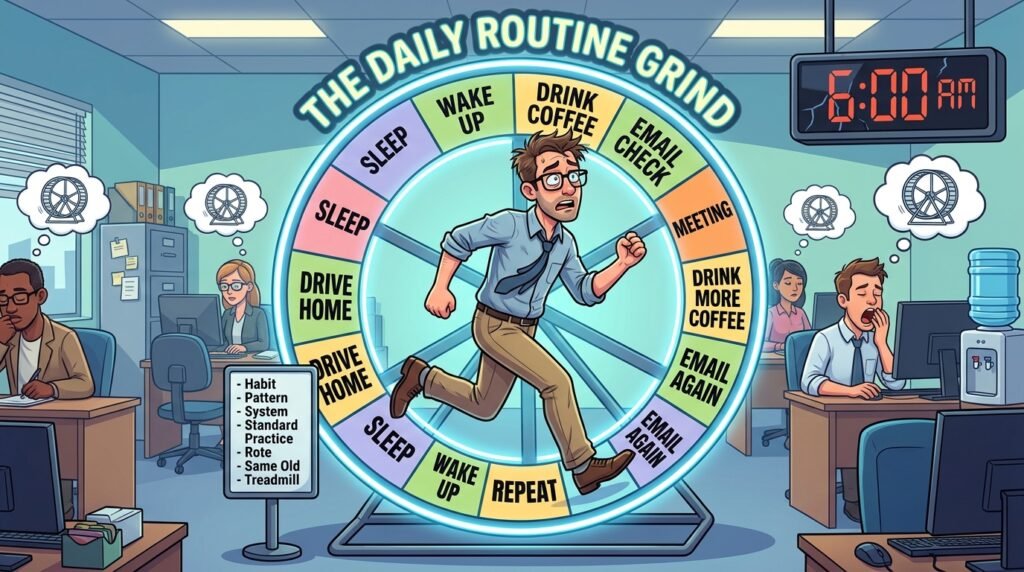
Useful synonyms for routine include habit, practice, pattern, procedure, process, regimen, schedule, system, method, custom, tradition, ritual, regularity, repetition, standard practice, daily practice, protocol, and commonplace. The right choice depends on context: habit suits personal behavior, procedure suits formal processes, and regimen often describes a structured plan.
Quick Synonym List
Here are more than 33 useful alternatives and related expressions for routine:
Closest synonyms
- Habit
- Practice
- Pattern
- Regular practice
- Repetition
- Regularity
- Custom
- Regimen
Formal and professional alternatives
- Procedure
- Process
- Protocol
- Standard procedure
- Standard practice
- Operating procedure
- System
- Method
- Established practice
- Protocol
Everyday alternatives
- Schedule
- Daily practice
- Usual practice
- Way of doing things
- Regular activity
- Daily pattern
- Normal practice
- Usual routine
Contextual alternatives
- Ritual
- Tradition
- Cycle
- Sequence
- Program
- Regimen
- Order
- Framework
- Convention
- Ceremony
Alternatives describing something boring or predictable
- Mundane
- Ordinary
- Repetitive
- Predictable
- Unremarkable
- Mechanical
- Monotonous
- Formulaic
Important: These words are not all interchangeable. Some describe a repeated behavior, some describe an organized process, and others describe the quality of being ordinary or repetitive.
Closest Synonyms for Routine
1. Habit
Meaning: A behavior that a person regularly repeats, often without thinking much about it.
How it differs: Habit usually describes something a person does repeatedly, while routine can describe a broader set of activities.
Tone: Neutral and everyday.
Best for: Personal behavior and daily life.
Example:
“Reading for 20 minutes before bed has become a habit.”
Watch out: A routine can contain several habits. The words are related but are not always exact substitutes.
2. Practice
Meaning: A repeated way of doing something.
How it differs: Practice often refers to an established or accepted way of working, especially in professional or social settings.
Best for: Work, education, professional settings, and general behavior.
Example:
“Checking the equipment before each shift is standard practice.”
Watch out: Practice can also mean training or deliberate exercise, so context matters.
3. Pattern
Meaning: A repeated or recognizable way in which something happens.
How it differs: Pattern focuses on repetition or regular behavior rather than a planned set of activities.
Example:
“There is a clear pattern in how she organizes her mornings.”
Watch out: A pattern does not necessarily involve a deliberate routine.
4. Regimen
Meaning: A structured plan of activities or behaviors followed regularly.
Tone: More formal than routine.
Best for: Exercise, health-related plans, training, and structured programs.
Example:
“He follows a strict exercise regimen during the season.”
Watch out: Regimen suggests a more organized or disciplined plan. It is not a natural replacement for every use of routine.
5. Custom
Meaning: A usual or traditional way of behaving or doing something.
How it differs: Custom often develops within a group or culture rather than being an individual’s personal schedule.
Example:
“It is a local custom to greet guests before dinner.”
Watch out: Use custom when tradition or social practice matters.
6. Ritual
Meaning: A repeated action or series of actions performed regularly, often with personal or symbolic importance.
Example:
“Making coffee has become part of my morning ritual.”
Watch out: Ritual can imply emotional, symbolic, or ceremonial importance that routine does not.
7. Regularity
Meaning: The quality of happening repeatedly or at consistent intervals.
Example:
“The plants need watering with some regularity.”
Watch out: Regularity is a noun describing consistent occurrence, not usually the activity itself.
8. Repetition
Meaning: The act of doing or saying something again.
Example:
“Repetition helped the students remember the new vocabulary.”
Watch out: Repetition emphasizes doing something again. It does not necessarily imply an organized routine.
Formal and Professional Alternatives
In workplace writing, simply replacing routine with a more complicated word can make a sentence less natural. The best alternative depends on what the routine actually represents.
Procedure
A procedure is an established way of completing a particular task.
Example:
“Employees must follow the safety procedure before operating the equipment.”
Use procedure when the routine involves specific steps that should be followed.
Process
A process is a series of actions used to achieve a result.
Example:
“The hiring process includes three interviews.”
Process is broader than procedure. A process may describe how something happens, while a procedure often tells people how to perform it.
Protocol
A protocol is a formal set of rules or procedures, especially in professional, technical, medical, scientific, or official contexts.
Example:
“The laboratory follows a strict testing protocol.”
Do not use protocol merely to make ordinary writing sound formal.
Standard practice
Standard practice means a commonly accepted or established way of doing something.
Example:
“Backing up important files is standard practice in the company.”
This is particularly natural in professional writing.
Method
A method is a particular way of doing something.
Example:
“This method makes the process easier to manage.”
Method emphasizes how something is done rather than how often it is done.
System
A system is an organized set of methods, rules, or procedures.
Example:
“She developed a simple system for organizing customer requests.”
A system is usually broader than a routine.
Neutral and Everyday Alternatives
Schedule
Use schedule when routine refers mainly to planned times and activities.
Example:
“My morning schedule starts at 6:30.”
A schedule tells you when things happen. A routine tells you what you regularly do.
Daily practice
Daily practice emphasizes an activity that happens every day.
Example:
“Daily practice is essential for improving your pronunciation.”
Usual practice
Use usual practice when describing what normally happens.
Example:
“It is our usual practice to confirm appointments by email.”
Regular activity
This phrase works when you want to emphasize that something happens frequently.
Example:
“Walking after dinner is a regular activity for many families.”
Way of doing things
This conversational phrase works when describing a person’s or group’s normal approach.
Example:
“That is simply their usual way of doing things.”
Casual Alternatives
There are fewer true casual synonyms for routine than dictionary lists often suggest. In everyday speech, people commonly use simple phrases instead.
Daily habits
Use this for repeated personal behaviors.
Example:
“My daily habits have changed since I started working from home.”
Usual thing
This informal expression can refer to something someone normally does.
Example:
“I’ll do my usual thing and grab coffee before work.”
Normal pattern
This works when describing something that repeatedly happens.
Example:
“That seems to be his normal pattern on busy days.”
These are conversational alternatives rather than exact one-word synonyms.
Synonyms for Routine When You Mean “Boring”
The word routine is not automatically negative. However, context can make it mean predictable, repetitive, or boring.
If that is the intended meaning, different words become more accurate.
Mundane
Means ordinary and lacking excitement.
Example:
“Even mundane tasks can become satisfying when you finish them efficiently.”
Repetitive
Means involving the same action or pattern again and again.
Example:
“The data-entry work became repetitive after several hours.”
Monotonous
Means lacking variety and becoming boring because nothing changes.
Example:
“The long, monotonous task made it difficult to stay focused.”
Predictable
Means easy to anticipate.
Example:
“Her response was completely predictable.”
Mechanical
Can describe an action performed automatically, with little thought or feeling.
Example:
“After months of practice, the steps became almost mechanical.”
Formulaic
Means following the same fixed pattern, often in a way that feels unimaginative.
Example:
“The presentation felt formulaic because every section followed the same structure.”
Key distinction: If you simply mean “done regularly,” use routine, regular, habitual, or custom. If you mean “boring because it never changes,” monotonous or repetitive may be more precise.
Synonyms vs. Near Synonyms
| Alternative | Relationship | Can Replace “Routine”? | Tone | Best Context |
|---|---|---|---|---|
| Habit | Close synonym | Sometimes | Neutral | Personal behavior |
| Practice | Close/near synonym | Often | Neutral | Work and general behavior |
| Pattern | Near synonym | Sometimes | Neutral | Repeated behavior |
| Procedure | Contextual alternative | Sometimes | Formal | Specific steps |
| Process | Related alternative | Sometimes | Neutral/professional | Workflows |
| Regimen | Contextual alternative | Sometimes | Formal | Structured plans |
| Schedule | Related alternative | Sometimes | Neutral | Timing and planning |
| Custom | Contextual synonym | Sometimes | Neutral/formal | Social behavior |
| Ritual | Contextual alternative | Sometimes | Neutral | Personal or symbolic repetition |
| Protocol | Contextual alternative | Rarely | Formal | Rules and procedures |
| Method | Related alternative | Sometimes | Neutral | Way of doing something |
| System | Related alternative | Rarely | Neutral/professional | Organized approaches |
| Repetition | Related alternative | Rarely | Neutral | Repeated actions |
| Mundane | Descriptive alternative | No | Neutral/negative | Ordinary or boring things |
| Monotonous | Descriptive alternative | No | Negative | Boring repetition |
| Predictable | Descriptive alternative | No | Neutral/negative | Expected outcomes |
Comparison Table
| Word/Phrase | Meaning | Tone | Strength | Best Use | Interchangeable? |
|---|---|---|---|---|---|
| Routine | Regular way of doing things | Neutral | Neutral | General use | Yes, depending on context |
| Habit | Repeated personal behavior | Neutral | Neutral | Personal life | Sometimes |
| Practice | Established way of doing something | Neutral | Neutral | Work/general use | Often |
| Procedure | Set steps for completing a task | Formal | Specific | Workplace | Context-dependent |
| Process | Series of actions leading to a result | Neutral | Broad | Work/projects | Context-dependent |
| Regimen | Structured repeated plan | Formal | Stronger structure | Training/exercise | Context-dependent |
| Custom | Traditional or usual behavior | Neutral/formal | Social | Culture/groups | Context-dependent |
| Ritual | Repeated action with symbolic/personal meaning | Neutral | Stronger emotional meaning | Personal life | Sometimes |
| Schedule | Planned timing of activities | Neutral | Structured | Time management | No |
| Protocol | Formal rules or procedures | Formal | Strong | Official/technical settings | No |
| Pattern | Repeated arrangement or behavior | Neutral | Observational | Behavior/events | Sometimes |
| Mundane | Ordinary and unexciting | Neutral/negative | Negative | Describing quality | No |
| Repetitive | Repeated too often or in the same way | Neutral/negative | Negative | Tasks/activities | No |
| Monotonous | Repetitive and boring | Negative | Strong | Boring activities | No |
| Formulaic | Following a predictable formula | Often negative | Moderate | Writing/work | No |
How to Choose the Right Alternative
Choosing a synonym for routine is easier if you first ask what you are actually trying to describe.
- A repeated personal behavior: choose habit.
- An established way of working: choose practice.
- A fixed series of steps: choose procedure.
- A broader sequence of work: choose process.
- A structured training or lifestyle plan: choose regimen.
- A planned timetable: choose schedule.
- A cultural or social practice: choose custom.
- A meaningful repeated personal action: choose ritual.
- A repeated trend or behavior: choose pattern.
- Formal rules for how something must be done: choose protocol.
- A boring repeated task: choose monotonous or repetitive.
- Something ordinary and unexciting: choose mundane.
- Something that follows the same predictable formula: choose formulaic.
Sentence Transformations
1. Personal life
Original:
“I have a morning routine.”
Better Alternative:
“I have a morning ritual.”
Why:
Ritual adds a sense of personal importance or familiarity. Keep routine if you simply mean a regular sequence of activities.
2. Personal behavior
Original:
“Exercise is part of my routine.”
Better Alternative:
“Exercise is part of my daily habit.”
Why:
Habit focuses more directly on repeated personal behavior.
3. Workplace
Original:
“This is our routine for handling complaints.”
Better Alternative:
“This is our standard procedure for handling complaints.”
Why:
Procedure is more precise when there are established steps for handling a task.
4. Business process
Original:
“The routine for approving invoices takes three days.”
Better Alternative:
“The invoice approval process takes three days.”
Why:
Process is more natural when describing a sequence of business actions.
5. Exercise
Original:
“She follows a strict routine at the gym.”
Better Alternative:
“She follows a strict training regimen at the gym.”
Why:
Regimen emphasizes a structured and disciplined plan.
6. Cultural behavior
Original:
“Eating together is part of their routine.”
Better Alternative:
“Eating together is a family custom.”
Why:
Custom is more precise if the behavior is shared and traditional within a family.
7. Boring work
Original:
“The routine work was tiring.”
Better Alternative:
“The repetitive work was tiring.”
Why:
Repetitive makes the source of the difficulty clearer: the same actions were performed again and again.
8. Professional communication
Original:
“We have a routine for checking the equipment.”
Better Alternative:
“We have a standard practice for checking the equipment.”
Why:
Standard practice sounds natural in professional writing and emphasizes that the approach is established.
9. Formal setting
Original:
“The hospital has a routine for emergency situations.”
Better Alternative:
“The hospital has an emergency protocol.”
Why:
Protocol is more precise when the routine consists of formal rules or procedures.
10. Predictable writing
Original:
“The article followed a routine structure.”
Better Alternative:
“The article followed a formulaic structure.”
Why:
Formulaic suggests that the structure was predictable or overly fixed, which adds a possible critical meaning.
Grammar and Usage
Routine can function as both a noun and an adjective.
Routine as a noun
When used as a noun, routine refers to a regular pattern or established sequence.
- “My morning routine takes about an hour.”
- “The team follows a daily routine.”
- “The routine became easier over time.”
Common patterns include:
- daily routine
- morning routine
- bedtime routine
- work routine
- exercise routine
- regular routine
- follow a routine
- establish a routine
- stick to a routine
- break a routine
- get into a routine
Routine as an adjective
As an adjective, routine can mean ordinary, regular, or standard.
- “The doctor performed a routine examination.”
- “It was a routine inspection.”
- “The company carried out routine maintenance.”
In these examples, procedure, regular, or standard may sometimes work, but they do not always have exactly the same meaning.
Routine vs. habitual
Habitual is an adjective meaning regularly done or repeatedly occurring.
- “He is a habitual early riser.”
- “She followed her habitual morning pattern.”
It is more formal than simply saying:
- “He has a morning routine.”
Common Mistakes
1. Treating every synonym as interchangeable
Incorrect approach: Replacing routine with protocol in every sentence.
Better: Use protocol only when formal rules or procedures are involved.
2. Using “habit” for a complete schedule
A routine can contain several habits.
Example:
“My morning routine includes showering, breakfast, and reading.”
Calling the entire sequence a habit changes the focus.
3. Assuming “routine” always means boring
A routine can be useful, comforting, efficient, or simply regular.
Example:
“My bedtime routine helps me relax.”
There is nothing negative about this use.
4. Using “monotonous” when you only mean regular
Monotonous means repetitive and boring.
Better:
“The employee has a regular schedule.”
Use monotonous only when the lack of variety is important.
5. Using “schedule” when you mean behavior
A schedule focuses on timing.
Schedule: “My appointments are on a tight schedule.”
Routine: “My morning routine includes breakfast and exercise.”
6. Confusing “procedure” with “process”
A procedure usually describes how a particular task should be performed.
A process can describe the broader sequence through which something happens.
7. Using overly formal words in simple conversation
You can say:
“What’s your morning routine?”
There is usually no advantage in saying:
“What is your morning regimen?”
The second sentence changes the tone and may sound unnatural unless you are specifically discussing a structured program.
8. Replacing a clear word just to avoid repetition
If routine is the most accurate word, keep it. Good writing is not a contest to use the largest possible number of synonyms.
When Not to Use an Alternative
Sometimes routine is actually the clearest choice.
Use routine when you mean a regular sequence of activities without adding another meaning.
For example:
“My morning routine includes coffee, exercise, and reading.”
Replacing routine with procedure would sound too formal and suggest official steps. Replacing it with habit would focus on individual behaviors rather than the entire sequence.
Likewise, don’t replace routine with monotonous unless you want to communicate boredom.
Compare:
“She enjoys her daily routine.”
with:
“She finds her daily routine monotonous.”
The second sentence adds a negative judgment that was absent from the first.
The original word is often better when it is already precise, natural, and easy to understand.
Writing Tips: How to Avoid Repetition Without Thesaurus Abuse
Synonyms are useful, but changing every repeated word can make writing less clear.
Keep the original when it is precise
If you are explaining a morning routine, repeating routine a few times is perfectly natural.
Use a synonym when the meaning changes
For example:
“The routine includes several procedures.”
Here, routine describes the broader pattern, while procedures describes specific sets of steps.
Match the reader
For general readers, routine, habit, practice, and schedule are usually clearer than specialized terms such as protocol or regimen.
Match the context
Use:
- habit for personal behavior
- procedure for specific instructions
- process for workflows
- protocol for formal rules
- regimen for structured plans
- custom for established social behavior

Do not use a synonym only because it sounds sophisticated
A more advanced word is not automatically a better word.
“Follow your daily routine” is often clearer than “adhere to your daily regimen” when discussing ordinary daily activities.
Editor’s Choice
For general English, these five alternatives are especially useful because each solves a different word-choice problem:
- Habit — best for repeated personal behavior.
- Practice — useful for an established way of doing something.
- Procedure — precise for specific steps.
- Process — useful for a broader workflow.
- Regimen — appropriate for a structured, disciplined plan.
These are editorial recommendations for usefulness and clarity, not a ranking of dictionary synonyms.