

Quick Answer
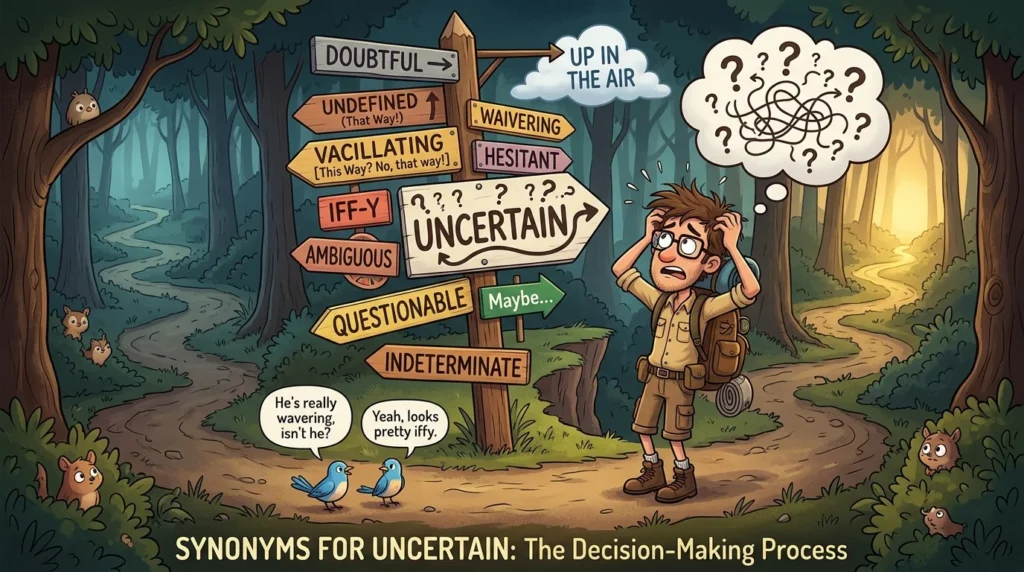
The best synonyms for uncertain depend on what you mean. Useful alternatives include unsure, doubtful, unclear, questionable, unpredictable, hesitant, tentative, ambiguous, undecided, insecure, and unknown. These words can describe a lack of confidence, unclear information, an unpredictable outcome, or hesitation about a decision.
Quick Synonym List
- Unsure
- Doubtful
- Unclear
- Uncertain
- Questionable
- Ambiguous
- Indefinite
- Undecided
- Hesitant
- Tentative
- Doubting
- Skeptical
- Suspicious
- Unpredictable
- Unreliable
- Unknown
- Undetermined
- Unresolved
- Inconclusive
- Vague
- Unsettled
- Unstable
- Insecure
- Wavering
- Hesitating
- Doubt-ridden
- Problematic
- Debatable
- Speculative
- Up in the air
What Does Uncertain Mean?
Uncertain describes something that is not known, decided, clear, reliable, or definite. It can refer to information, feelings, decisions, events, or future outcomes.
For example:
I am uncertain about which option to choose.
Here, uncertain means unsure or undecided.
But the same word can describe a future event:
The outcome remains uncertain.
In this sentence, it means the outcome is unknown or unpredictable.
Because uncertain has several related meanings, choosing the right synonym requires looking at the context.
Unsure
Unsure is one of the closest everyday synonyms for uncertain. It usually describes a person’s lack of confidence or knowledge.
Example:
She was unsure about the answer.
Best for: Everyday conversation, emails, and general writing.
Difference: Unsure usually focuses on a person’s feelings or thoughts, while uncertain can describe situations and facts too.
Doubtful
Doubtful suggests that someone does not believe something is likely to be true or happen.
Example:
It is doubtful that the package will arrive today.
Best for: Predictions, opinions, and situations involving doubt.
Tone: Neutral to moderately formal.
Watch out: Doubtful can sound stronger than uncertain because it may suggest that something is unlikely.
Unclear
Unclear means something is difficult to understand, determine, or interpret.
Example:
The instructions were unclear.
Best for: Information, explanations, instructions, plans, and communication.
Difference: Use unclear when the problem is a lack of clarity rather than a lack of confidence.
Questionable
Questionable means something is doubtful, unreliable, or open to criticism.
Example:
The accuracy of the report is questionable.
Best for: Claims, evidence, decisions, quality, and reliability.
Tone: Moderately formal and sometimes critical.
Watch out: This word can imply that something may be wrong, not simply unknown.
Ambiguous
Ambiguous describes something that has more than one possible meaning or interpretation.
Example:
The wording of the contract is ambiguous.
Best for: Language, instructions, statements, laws, and written communication.
Difference: Ambiguous means unclear because there are multiple possible interpretations. Uncertain is broader.
Indefinite
Indefinite means not fixed, clearly defined, or known.
Example:
The meeting has been postponed for an indefinite period.
Best for: Dates, periods, quantities, arrangements, and formal writing.
Tone: Formal.
Undecided
Undecided describes someone who has not made a choice or a decision.
Example:
I am still undecided about which course to take.
Best for: Decisions, choices, opinions, and plans.
Difference: Undecided specifically relates to a decision, while uncertain has a much wider meaning.
Hesitant
Hesitant describes someone who is unsure and therefore slow or reluctant to act.
Example:
He was hesitant to accept the offer.
Best for: Decisions, actions, conversations, and personal behavior.
Difference: Hesitant emphasizes reluctance or delay, not simply uncertainty.
Tentative
Tentative means uncertain, provisional, or not yet final.
Example:
We have made a tentative plan for Friday.
Best for: Plans, agreements, dates, proposals, and decisions.
Tone: Neutral and professional.
Unpredictable
Unpredictable describes something whose future behavior or outcome cannot be reliably known.
Example:
The weather has been unpredictable this week.
Best for: Weather, people, events, markets, results, and situations.
Difference: Unpredictable focuses on the inability to forecast what will happen.
Unknown
Unknown means something is not known or has not been discovered.
Example:
The cause of the problem remains unknown.
Best for: Facts, causes, information, identities, and outcomes.
Difference: Unknown emphasizes a lack of knowledge, while uncertain can also express doubt or hesitation.
Undetermined
Undetermined means something has not yet been decided, established, or calculated.
Example:
The final cost is still undetermined.
Best for: Results, decisions, quantities, causes, and formal writing.
Tone: Formal.
Unresolved
Unresolved describes an issue, question, or problem that has not been settled.
Example:
Several questions remain unresolved.
Best for: Problems, disputes, questions, investigations, and decisions.
Difference: Unresolved suggests that something needs to be settled, whereas uncertain can simply mean that the answer is not known.
Inconclusive
Inconclusive means evidence or results do not provide a definite answer.
Example:
The test results were inconclusive.
Best for: Research, investigations, medical tests, experiments, and evidence.
Tone: Formal and precise.
Vague
Vague means lacking clear details, limits, or specific information.
Example:
His explanation was too vague.
Best for: Statements, descriptions, instructions, plans, and explanations.
Difference: Vague usually means insufficiently specific rather than simply uncertain.
Unsettled
Unsettled can describe something that has not been decided or resolved.
Example:
The future of the project remains unsettled.
Best for: Plans, disputes, situations, and uncertain conditions.
It can also describe a person’s emotional state, depending on context.
Insecure
Insecure can mean lacking confidence, certainty, or stability.
Example:
She felt insecure about her decision.
Best for: Personal confidence, relationships, decisions, and stability.
Watch out: Insecure has a strong connection with self-confidence and emotional uncertainty, so it should not replace uncertain in every sentence.
Wavering
Wavering describes someone who repeatedly changes between choices, opinions, or actions.
Example:
He remained wavering about whether to accept the position.
Best for: Opinions, decisions, commitment, and behavior.
Difference: Wavering suggests changing one’s mind rather than simply lacking information.
Skeptical
Skeptical means not easily convinced that something is true or reliable.
Example:
She was skeptical about the company’s promises.
Best for: Claims, promises, explanations, evidence, and opinions.
Difference: Someone who is uncertain may simply lack information. A skeptical person actively questions the information.
Speculative
Speculative describes something based on guesses or incomplete information rather than established facts.
Example:
The article included several speculative explanations.
Best for: Predictions, theories, financial discussions, and analysis.
Tone: Formal.
Debatable
Debatable means open to disagreement or discussion.
Example:
Whether this was the best solution is debatable.
Best for: Opinions, arguments, interpretations, and controversial questions.
Up in the Air
Up in the air is an informal idiom meaning that something has not been decided or settled.
Example:
Our vacation plans are still up in the air.
Best for: Casual conversation, messages, and informal writing.
Tone: Informal.
Synonyms for Uncertain by Context
Uncertain About a Decision
Use:
- Unsure
- Undecided
- Hesitant
- Wavering
- Tentative
- Insecure
Example:
I am unsure about accepting the job.
Uncertain Information
Use:
- Unclear
- Ambiguous
- Vague
- Questionable
- Unknown
- Inconclusive
Example:
The available evidence is inconclusive.
Uncertain Future
Use:
- Unpredictable
- Unknown
- Undetermined
- Unsettled
- Doubtful
- Speculative
Example:
The future of the project remains uncertain.
Uncertain Outcome
Use:
- Unpredictable
- Undetermined
- Unknown
- Doubtful
- Inconclusive
Example:
The final outcome is still undetermined.
Uncertain Person
Use:
- Unsure
- Hesitant
- Wavering
- Doubting
- Skeptical
- Insecure
Example:
He seemed hesitant about making a commitment.
Formal Synonyms for Uncertain
In professional, academic, or formal writing, consider:
- Indeterminate
- Undetermined
- Inconclusive
- Tentative
- Ambiguous
- Indefinite
- Questionable
- Unresolved
- Speculative
For example:
The findings remain inconclusive.
This is more precise than:
The findings are uncertain.
Casual Synonyms for Uncertain
In everyday speech, these options sound natural:
- Unsure
- Not sure
- Doubting
- Hesitant
- Up in the air
- On the fence
- Unclear
For example:
I’m not sure what to do.
This sounds more conversational than:
I am uncertain about what to do.
True Synonyms vs. Related Alternatives
| Alternative | Relationship | Can Replace “Uncertain”? | Tone | Best Context |
|---|---|---|---|---|
| Unsure | Very close synonym | Often | Neutral | Everyday speech |
| Doubtful | Close synonym | Often | Neutral | Predictions |
| Unclear | Contextual synonym | Sometimes | Neutral | Information |
| Ambiguous | Related synonym | Sometimes | Formal | Language |
| Undecided | Contextual synonym | Sometimes | Neutral | Choices |
| Hesitant | Related synonym | Sometimes | Neutral | Actions |
| Tentative | Close contextual alternative | Often | Professional | Plans |
| Unknown | Related alternative | Sometimes | Neutral | Facts |
| Unpredictable | Related alternative | Sometimes | Neutral | Future events |
| Questionable | Stronger contextual alternative | Sometimes | Formal | Claims |
| Inconclusive | Contextual alternative | Sometimes | Formal | Evidence |
| Vague | Related alternative | Sometimes | Neutral | Descriptions |
Comparison Table
| Word/Phrase | Meaning | Tone | Strength | Best Use | Interchangeable? |
|---|---|---|---|---|---|
| Uncertain | Not definite or sure | Neutral | Broad | General use | — |
| Unsure | Not confident or certain | Neutral | Moderate | People and decisions | Often |
| Doubtful | Believed unlikely or questionable | Neutral | Stronger | Predictions | Sometimes |
| Unclear | Not easy to understand | Neutral | Moderate | Information | Sometimes |
| Ambiguous | Open to multiple interpretations | Formal | Specific | Language | Rarely |
| Hesitant | Reluctant because of uncertainty | Neutral | Moderate | Actions | Rarely |
| Tentative | Not final or definite | Professional | Moderate | Plans | Often |
| Unknown | Not known | Neutral | Direct | Facts | Sometimes |
| Unpredictable | Cannot be reliably forecast | Neutral | Strong | Future events | Sometimes |
| Inconclusive | Does not establish a result | Formal | Specific | Evidence | Rarely |
Practical Word-Choice Guide
Ask yourself what kind of uncertainty you mean:
Do you personally lack confidence?
Use unsure.
Has someone not made a decision?
Use undecided.
Is someone reluctant to act?
Use hesitant.
Is information difficult to understand?
Use unclear.
Can a statement have multiple meanings?
Use ambiguous.
Has something not been settled?
Use unresolved or undetermined.
Can you not predict what will happen?
Use unpredictable.
Is the answer not known?
Use unknown.
Does evidence fail to provide a definite conclusion?
Use inconclusive.
Is something only a temporary plan?
Use tentative.
Sentence Transformations
1. Original
I am uncertain about the answer.
Alternative:
I am unsure about the answer.
Why: Unsure sounds more natural in everyday conversation.
2. Original
The date is uncertain.
Alternative:
The date is still undetermined.
Why: Undetermined works well when a date has not yet been finalized.
3. Original
The instructions are uncertain.
Alternative:
The instructions are unclear.
Why: Unclear directly addresses a lack of understandable information.
4. Original
The result is uncertain.
Alternative:
The result is unpredictable.
Why: This works when the outcome cannot be reliably forecast.
5. Original
She was uncertain about accepting the offer.
Alternative:
She was hesitant to accept the offer.
Why: Hesitant adds the idea of reluctance.
6. Original
The evidence is uncertain.
Alternative:
The evidence is inconclusive.
Why: Inconclusive is more precise when evidence fails to establish an answer.
7. Original
His explanation was uncertain.
Alternative:
His explanation was vague.
Why: Vague works when the explanation lacks specific details.
8. Original
Our plans are uncertain.
Alternative:
Our plans are still up in the air.
Why: This informal idiom sounds natural in casual conversation.
Common Mistakes
Using “unsure” for objects
Unsure normally describes a person or sometimes an animate subject.
Incorrect or unnatural:
The schedule is unsure.
Better:
The schedule is uncertain.
Using “ambiguous” when something is simply unknown
If there is no information available, unknown may be better. Ambiguous means that available information can support more than one interpretation.
Using “hesitant” for facts
A person can be hesitant, but a fact is not usually hesitant.
Better:
She was hesitant about the decision.
Not:
The decision was hesitant.
Using “unpredictable” for a lack of information
Unpredictable means the outcome cannot be reliably predicted. If you simply do not know the answer, unknown may be more accurate.
Treating “doubtful” and “uncertain” as identical
Uncertain is neutral about what will happen. Doubtful often suggests that something is unlikely.
Overusing formal words
Words such as indeterminate and inconclusive can be useful, but simple alternatives such as unsure and unclear are often better for general readers.
When Not to Use a Synonym
Sometimes uncertain is the strongest choice because it is broad and neutral.
For example:
The future remains uncertain.
This sentence does not tell us whether the future is unknown, unpredictable, doubtful, or undecided. The broad meaning of uncertain is useful.
Similarly:
Scientists remain uncertain about the cause.
Changing this to doubtful could imply that scientists believe the proposed cause is unlikely, which may not be intended.
Choose a more specific synonym only when the context supports that additional meaning.
How to Improve Your Writing
Instead of repeatedly using uncertain, identify the exact kind of uncertainty.
Weak:
The situation is uncertain.
More specific:
The situation remains unresolved.
Or:
The outcome is unpredictable.
Or:
The available evidence is inconclusive.
Or:
The final decision is still undetermined.
Specific word choice gives readers more information without adding extra sentences.
FAQs
What is the best synonym for uncertain?
Unsure is one of the closest everyday synonyms. However, unclear, doubtful, tentative, unpredictable, and undetermined may be better depending on the context.
What is a formal word for uncertain?
Formal alternatives include indeterminate, undetermined, inconclusive, tentative, ambiguous, indefinite, and unresolved.
What is the opposite of uncertain?
Common opposites include certain, definite, sure, clear, known, settled, decided, and predictable.
What is a synonym for uncertain in a sentence?
Depending on the sentence, you can use unsure, doubtful, unclear, tentative, hesitant, unknown, undetermined, or unpredictable.
What is another word for feeling uncertain?
Useful choices include unsure, doubtful, hesitant, insecure, wavering, and undecided.
What is another word for an uncertain future?
You can describe an uncertain future as unpredictable, unknown, undetermined, unsettled, or uncertain.
What is the difference between uncertain and unsure?
Uncertain is broader and can describe people, information, events, decisions, and outcomes. Unsure most commonly describes a person’s lack of confidence or knowledge.
Key Takeaways
- Uncertain is a broad word meaning not definite, known, settled, or sure.
- Unsure is a natural everyday alternative for personal doubt.
- Unclear works best when information or instructions lack clarity.
- Tentative and undetermined are useful for plans and decisions that are not final.
- Unpredictable, unknown, and inconclusive describe different types of uncertainty and should be chosen according to context.